
• 158. Caroline to Luise Gotter in Gotha: Braunschweig, 13 October 1795
[Braunschweig,] 13 October [17]95
|375| . . . I had planned to give you a lengthy account of how we are doing — and then yet another hindrance gets in the way. Because I know not how long I will be able to sit here undisturbed, let me first mention a request my mother would like to make of Gotter. [1] . . .
|376| I am really just so sorry your husband was not in Weimar before the arrival of the Meyers [2] — when will he be going there now? Particularly since, as has long been the custom, it is already starting to get cold again.
In the event he might nonetheless make it, let me strongly recommend he make the acquaintance of the painter Tischbein and his wife, with the latter of whom I am assuming he did not become acquainted in Gotha, where Tischbein spent some time and where she passed through. He is an excellent portraitist [3] — I have seen paintings by him and was enraptured by the softness of his brush. She sings excellently and is allegedly otherwise quite charming as well, assuming I can trust what a common friend has told me. Schlegel knew these people quite well in Amsterdam. [4] —
You are a child with regard to Schlegel and my name change. Can one not simply have a friend without it involving a life-or-death alliance? [5]
[End of sheet]
Notes
[1] Erich Schmidt (1913), 1:710, who apparently still had access to the manuscript of this letter, remarks that the request was for an urn-shaped cup, two of which of the same sort Caroline herself resourcefully orders in undated notes, one for her sister Luise’s wedding (28 March 1796) and one for Luise’s father-in-law (Christian Rudolf Wilhelm Wiedemann’s father) with an inscription from the conclusion of Wilhelm Schlegel’s poem allegedly to Georg Ludwig Böhmer.
Although Schmidt refers the reader here to the notes to Caroline’s letter to Luise Gotter on 8 March 1789 (letter 91), where that poem is included in full, Wilhelm composed the poem on Auguste and Therese Böhmer’s behalf to give to their grandfather Johann David Michaelis for his birthday on 27 February 1789, not Georg Ludwig Böhmer, who was born on 18 February 1717 (or 1715); see letter 91, note 8 (text of poem in note 9 there). In any event, the poem’s concluding lines are:
That a flourishing family,
Whose pride he is, long adore him!
The other inscription — that for Luise — reads:
Drink to your happiness each morn anew,
always freshly crowned with love and faithfulness.
Caroline: “I composed these verses myself, but I cannot rhyme [Germ. reimen] — everything I rhyme becomes muddled [Germ. ungereimt, inconsistent, illogical, muddled].” Wilhelm Schlegel also later composed the “Glückwunsch eines jungen Mädchens am Hochzeittage ihrer Tante” (Auguste’s poem for Luise on the latter’s wedding day, 28 March 1796; originally published in Wilhelm Gottlieb Becker’s Almanach und Taschenbuch zum geselligen Vergnügen [1799], 300; reprinted in Sämmtliche Werke 2:359–60; here a prose approximation; illustration: Daniel Nikolaus Chodowiecki, Es lebe unser Graff und unsre Gräfinn [1786], Herzog Anton Ulrich-Museum; Museums./Signatur DChodowiecki AB 3.710):
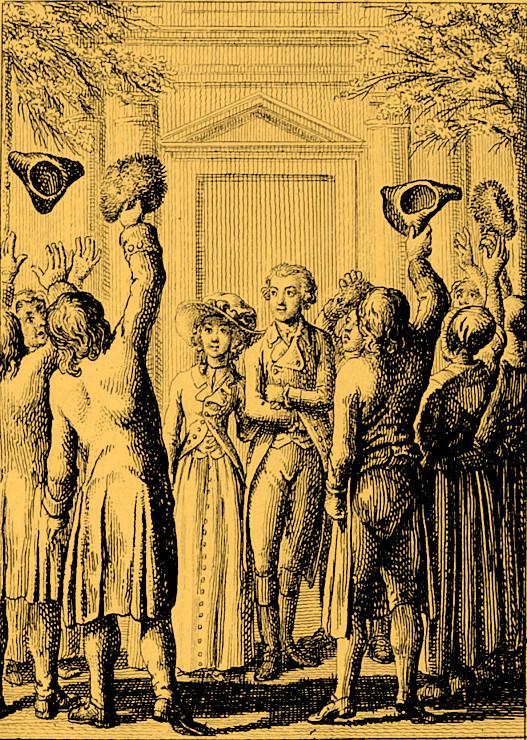
A Young Girl's Congratulations on her Aunt's Wedding Day
With cheeks aglow
and beating breast
Does Gustel come apace
and jumping sheer for joy.
Ah, my dearest, most dear aunt!
Since friends and acquaintances,
siblings and kin,
beloved each and all,
do now appear with wishes fond,
so also now, I ask, hear mine!
May the ties
that you today did bind
forever bloom, forever shine,
like flowers in the spring,
for you now wound in garlands fine.
Your cheerful ways
have been your boon:
and so be granted to you soon
a cheerful life, with days
that float and days that flow
easily, softly, as you go.
That for you my wish would be,
And now do hear my wish for me:
A dainty blossom to be mine,
a little cousin, cute and fine.
Her to love and cherish ever,
with her to play and jest wherever,
How quite delighted will I be,
Her sister ever and ever to be. Back.
[2] Post Karte Durch ganz Deutschland, ed. J. Walch (Augsburg 1795):
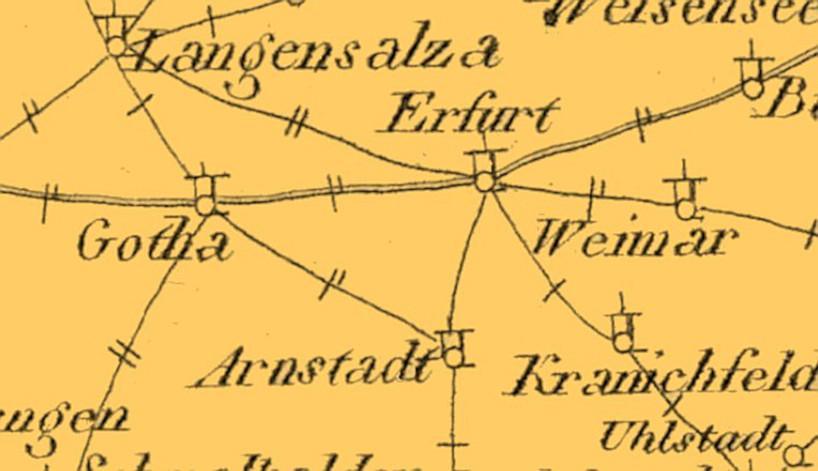
Caroline’s statement is somewhat puzzling, since she is presumably referring to Heinrich Meyer. On 2 October 1795, Meyer, a professor at the Weimar art institute, left Weimar to spend two years (1795 till 1797) pursuing art studies in Florence and Rome. Perhaps she instead means (the German allows this reading assuming she meant Abfahrt [departure] rather than Ankunft [arrival]) “before the departure of the Meyers.” Or perhaps the Meyers were elsewhere and arrived in Weimar (or Gotha) before departing for Italy.
In any event, Friedrich Wilhelm Gotter may have been interested in this acquaintance (thus also prompting Caroline’s ensuing mention of Johann Friedrich August Tischbein) because one of his daughters, Cäcilie, was interested in becoming a painter (Caroline tries to help her secure training later as well). Back.
[3] Johann Friedrich August Tischbein and his (according to Erich Schmidt [1913], 1:710–11: beautiful and musical) wife, Sophie, née Müller, from Bad Arolsen (a small town in northern Hesse), spent a lengthy period in Amsterdam, where he painted a portrait of Wilhelm Schlegel that (according to Schmidt) had unfortunately been lost.
Wilhelm wrote to Georg Joachim Göschen on 13 February 1794 (Oskar F. Walzel, “Wilhelm Schlegel und Georg Joachim Göschen,” in Untersuchungen und Quellen zur Germanischen und Romanischen Philologie. Johann von Kelle dargebracht von seinen Kollegen und Schülern, 2 vols., Prager Deutsche Studien 8 and 9 [Prague 1908], 2:125–47, here 143 [not 19 as in Schmidt (1913), 1:711]), praising especially Tischbein’s talent in portraiture (Wilhelm’s initial reference is to Christoph Martin Wieland’s Geschichte des Agathon, 4 vols. [Leipzig 1773]; here the frontispieces vol.s 1–4, albeit not by Tischbein):
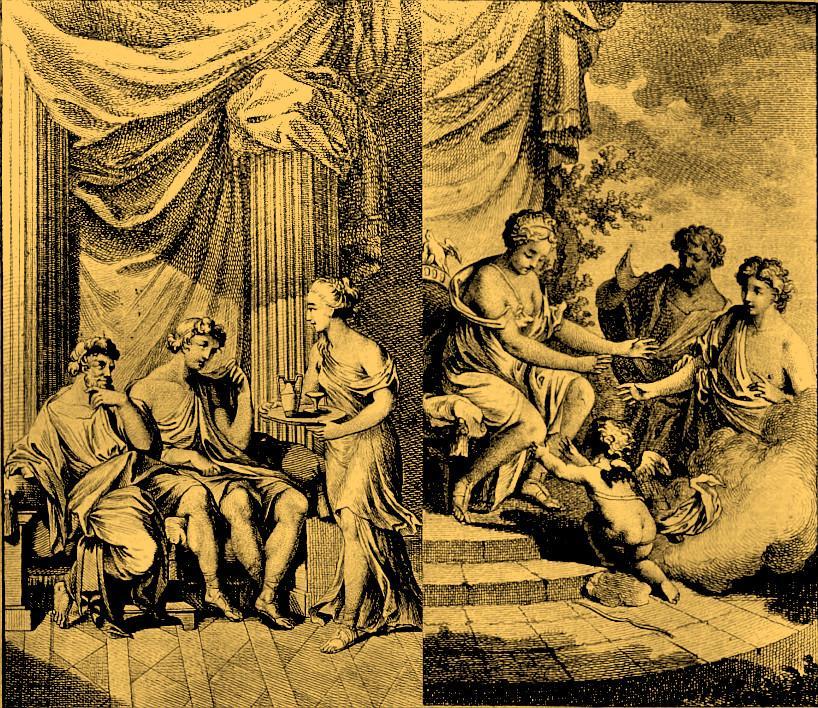
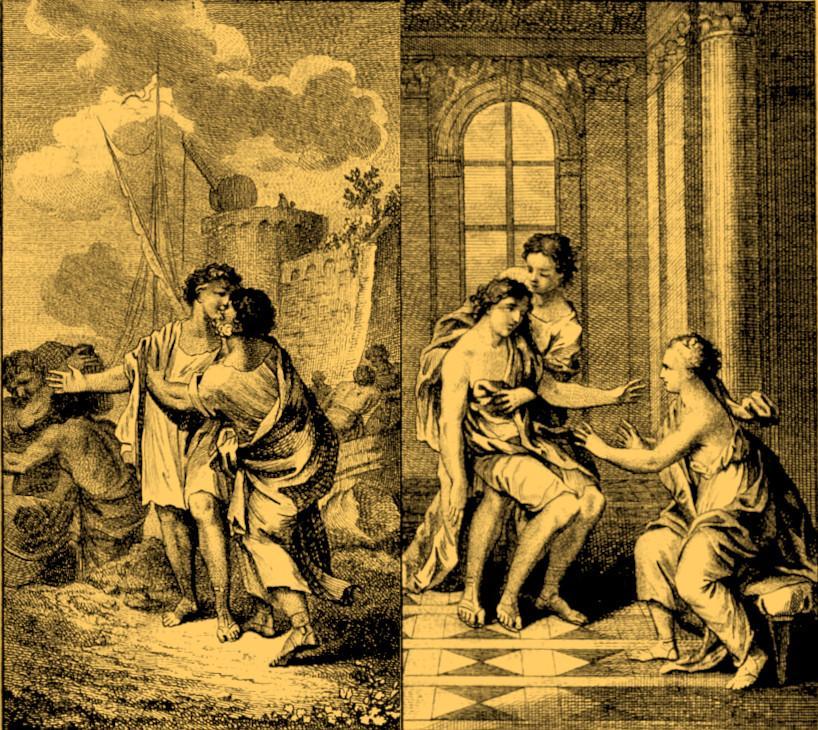
In Pyrmont there is a painting of a scene from Agathon, and that is allegedly quite well done. [Tischbein mentions this painting in a letter to Karl August Böttiger on 14 December 1795 (Adolf Stoll, Der Maler Joh. Friedrich August Tischbein und seine Familie: ein Lebensbild nach den Aufzeichnungen seiner Tochter Caroline (Stuttgart 1923), 181).] It is by Tischbein, who used to work in the service of the Prince of Waldeck and is just now living here [in Amsterdam]; an excellent artist, especially in portraiture. — When Madam Böhmer comes to Leipzig, she will show you the one he did of me [Caroline and Auguste, having come from Lucka, had already left Leipzig on 4 February 1794 or shortly thereafter for Gotha]. . . . It is the scene where Danaë awakens, while Agathon kneels at her bed.
On 28 August 1793 Friedrich requested that Wilhelm send the portrait to Caroline in Lucka (letter 134); after it arrived on 1 November 1793, Friedrich declared that it was not a good likeness at all (letter 135g).
Tischbein would eventually (1798) do the familiar portraits of Caroline and Auguste. Back.
[4] It is difficult to assess from this remark the extent to which Caroline was aware of Wilhelm’s otherwise unspecified but apparently serious romantic relationship with Sophie Tischbein in Amsterdam (apparently the “Sophie” Friedrich mentions in his letters to Wilhelm during the period) (Taschenbuch für Damen auf das Jahr 1801; Inhaltsverzeichnis deutscher Almanache, Theodor Springmann Stiftung):

See the supplementary appendix on Sophie Tischbein as the Amsterdam Sophie. Back.
[5] An indication that Wilhelm and Caroline had not yet definitively decided or at least were not speaking publicly about marriage. See similarly Caroline’s remarks in her letter to Georg Joachim Göschen back on 9 August 1795 (letter 152d), with note 2 there. Back.
Translation © 2011 Doug Stott