
136.2. Friedrich Schlegel to Wilhelm Schlegel in Amsterdam: Leipzig, 10 November 1793 [*]
[Leipzig, Sunday] 10 November [1793]
The best proof of how well things are going for C[aroline] is the enclosed letter. [1] —
After finishing my last letter to you, I went out to see her [2] and found things much as expected given the circumstances; initially she suffered from nerves, but not severely, and her spirits remained serene; then the milk fever started, [3] from which she also suffered some severe pain but which, like the nervous disquietude, did not last long.
She slept so well that night that on Thursday we could not stop joking about how quickly it passed. [4] She herself has probably related the rest to you in a letter.
As far as the scurvy is concerned, I know not where you came on that idea; [5] I can assure you there is absolutely nothing wrong with her teeth. I have, however, now been charged with asking you whether perhaps every person who does not have beautiful teeth has scurvy? —
Perhaps she herself asked you to write to Göschen and Tatter. Tatter asked Philipp for clarification and received it. [6] You, however, need to write a gentle, humane letter. She was quite glad to hear that Göschen has now been freed from his error, [7] but I wrote you about that in my last letter. You have to consider that although I did not betray anything to him he did not already know, I did speak quite openly, which is precisely why he does not understand me. —
Gusteline is doing quite well, better in fact than I have yet seen her; she just got back her pink cheeks. —
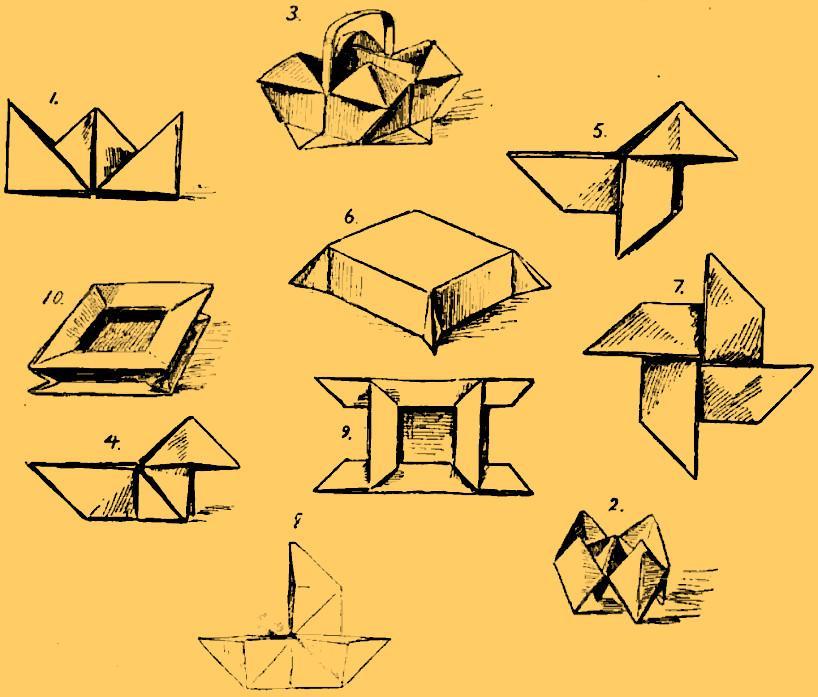
I am including here a paper-model cutout for you from C. She has this perpetual, crazy urge in her fingers to play, about which I could not help but laugh. She sent me this as a “finger project,” saying that it took her a great deal of time to get parts of it this long and asking whether it might perhaps have some metaphysical significance. [8]
Notes
[*] Sources: Walzel, 138; KFSA 23:154–55. Back.
[1] Regrettably not extant. Back.
[2] Friedrich’s last letter to Wilhelm was on 4–5 November 1793 (letter 136.1). The visit in Lucka to which he here refers commenced on Wednesday, 6 November 1793. Back.
[3] “Milk fever,” Febris lactea, at the time understood as a fever suffered by nursing mothers caused by spoiled or excessive milk (Adelung 3:207). See John Clarke, “On the Milk Fever, and on the Inflammation and Suppuration of the Breasts,” Practical Essays on the Management of Pregnancy and Labour; and on the Inflammatory and Febrile Diseases of Lying-in Women (London 1793), 37–39 (illustration: (Taschenkalender auf das Jahr 1798 für Damen; Inhaltsverzeichnis deutscher Almanache, Theodor Springmann Stiftung):
Nothing can be more self-evident than that nature intended that every woman should suckle her own child.

With a view to this, a great determination of blood is made to the breasts during pregnancy, which thence become considerably enlarged, especially near the time of delivery. This increased circulation sometimes will occasion a secretion of milk before labour in such quantity, that it will run out of the nipples in great abundance; more commonly, however, the secretion begins after delivery, and goes on most rapidly, about the third or fourth day, whence the breasts become enormously distended and very painful.
The irritation of this sometimes produces a great degree of fever in the system, which begins often with a violent rigor, and is followed by a severe hot fit, and a profuse degree of sweating. In some rare instances delirium has taken place during the continuance of the milk fever. When it is not combined with any other disease, it scarcely ever continues more than twenty-four hours.
It may be conceived then, that very little is necessary to be done to prevent or cure a disease so short in its duration, and in itself of so small importance. But notwithstanding that, simply considered, a fever of this kind would require little medical assistance, yet, as when once excited, it may be kept up by other causes, it is right to prevent it from arising, and to suppress it directly upon its attack.
Evacuation by purging seems to produce more effect than any other means which have been employed in the way of prevention or cure.
It has been customary for some years to give a purgative on the third day after delivery, so as to procure three or four evacuations, and this especially in robust patients.
The blood is by this means derived to the intestines from the breasts, whence the secretion becomes less, and the constitution is less apt to be stimulated. Nothing is more certain, than that patients treated in this way are less liable to any severe attack of milk fever than those in whom such evacuations have been omitted. Even after the fever has begun, the same treatment will succeed in diminishing it.
After evacuation by purging, saline draughts should be given, with a small quantity of vinum antimonii tartarisati [potassio-tartrate of antimony dissolved into a pint of sherry wine], and repeated every four hours, till the frequency of the pulse, heat, and thirst, have subsided. Back.
[4] 7 November 1793 (Schauplatz der Natur und der Künste, vol. 10 [Vienna 1783], plate 18):
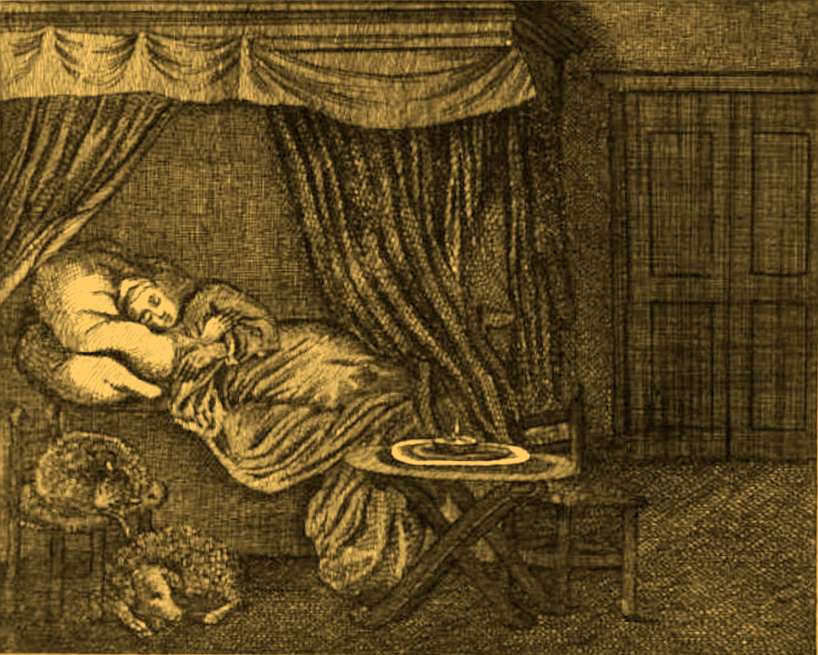
[5] Wilhelm seems to have picked up on Caroline’s own remarks as cited by Friedrich in the latter’s letter to Wilhelm on 16 October 1793 (letter 135cd). Back.
[6] Philipp Michaelis had engineered Caroline release back in July. Back.
[7] Namely, that Wilhelm himself was the father of Caroline’s newborn child. Back.
[8] Germ. Papierschnitzel; perhaps some version of a paper-folding sequence (Kate Hawley Hennessey, “Kindergarten Occupations: Paper Folding III,” 277–82, here 278):
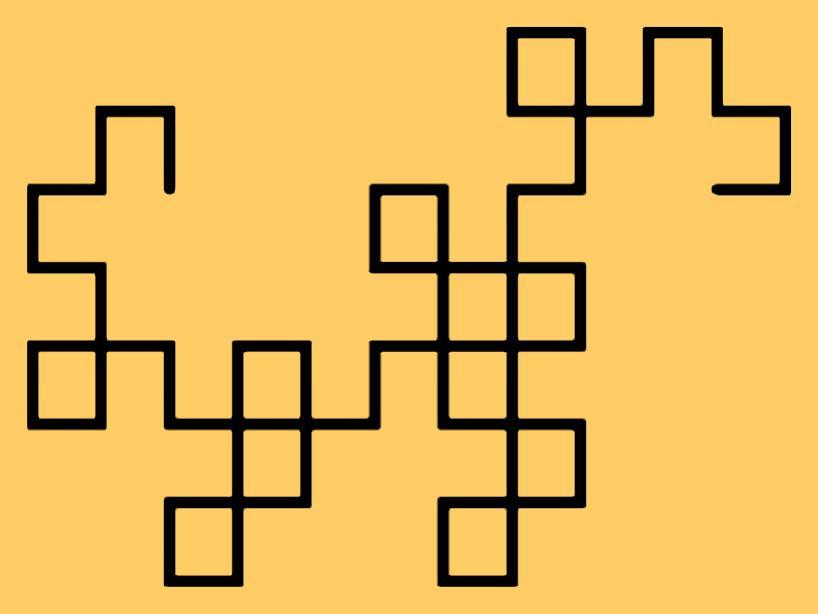
In the present context, viz., with reference specifically to length: perhaps some simple, distantly similar iteration of what today is known as a “dragon curve” as similarly based on repeated paper folds:
Concerning the metaphysical (and mathematical) intimations, see, a century later, A. W. Baldwin, “Kindergarten Method of Instruction,” The Metaphysical Magazine 5 (January 1897–May 1897), no. 5 (May 1897), 363–67, here 366–67:
Successive events or stages in growth in animal and plant life are brought out in the games. A sequence of movement in the construction of forms of life and beauty, with cubes, tablets, sticks, rings, etc., is followed in an unvarying order. The gifts illustrate, in symbols of geometric form, the movement of evolution. Beginning with the sphere, which is the symbol of Unity, and dividing it to show likenesses and differences, progressing through the plane to the line, to the embodied point, we reach here the finale of analysis in material symbols. The occupations now take up the movement, proceeding a step farther into the abstract — to the invisible point, the absent sphere, in pricking and then embodying the synthetic movement — that of integration; expressing the formation of the individual; progressing to the line on sewing and drawing; to the interlacing slats and paper-weaving; to the plane in paper folding and cutting; to the weaving mats; and finally reaching clay, the formless substance that contains all form and out of which all shapes can be evolved.
This is the orderly movement of the kindergarten method; yet at each step the fundamental principle — unity — is ever sought to be developed. Through the gifts, by which mathematics is specially taught in forms of life and beauty, the child’s physical and spiritual natures are appealed to. Through the occupations, which correspond to the physical nature, and which specially develop physical dexterity, lessons in progressive geometric form are given; and in the construction of forms of life the child is put in touch with Nature, and through forms of beauty his own spiritual perfection is suggested. The games correspond to spirituality, as through them the child expresses his joy, and is shown his relation to animal and plant life, as well as to other individuals — his dependence on them and his responsibilities to them; also the harmonious adjustment of the Whole of life. Back.
Translation © 2011 Doug Stott