
• 3. Caroline to Julie von Studnitz in Gotha: Göttingen, 7 October 1778 (Fr.)
Göttingen, 7 October 1778
|5| I had not had a single tranquil moment, my dear Julie, until I received your letter, but if it be possible for the |6| tender friendship I have for you to increase, it has now attained the highest degree. Yes, my worthy Julie, words cannot really express what I feel. My heart is full of admiration and affection. I am not being overly enthusiastic, I never exaggerate, I tell you quite simply what is going on in my heart.
Why are you so perfect, my friend? You make me despair at ever being like you; I will keep your letter like a masterpiece. Your excellent character, the precision of your mind, and the tenderness of your heart are all expressed there, and how dare I boast of having such a friend? Ah, even should heaven make me unhappy, it would not be absolute unhappiness, for your heart is too constant ever to deprive me of the sweet consolation that Julie de Studnitz is my friend. You will share my sorrows, and I will be the confidante of yours. What a marvelous prospect! dear Julie! . . .
Madam Mara was here. [1] Since you have doubtless already heard her divine voice, I need not tell you how much she delighted me; you probably also know her husband, with his haughty and brusque temperament and excellent talent on the cello. But I find him insufferable.
She gave two concerts here, singing divinely at the first. [2] Someone who had heard the famous Gabrieli told me that Madame Mara sang better. [3] But at the second concert she did not do so well because her husband made her utterly lose her composure with his constant rudeness. Hence he possesses my complete hatred. [4] . . .
Caroline Michaelis
Notes
[1] Elisabeth Mara, née Schmehling, gave an extremely successful concert in Göttingen in September 1778 along with her unpleasant husband, a cellist ([1] portrait by by Elisabeth Vigée-Lebrun; [2] Taschenbuch für das Jahr 1812: Der Liebe und Freundschaft gewidmet [Frankfurt]; Inhaltsverzeichnis deutscher Almanache, Theodor Springmann Stiftung):


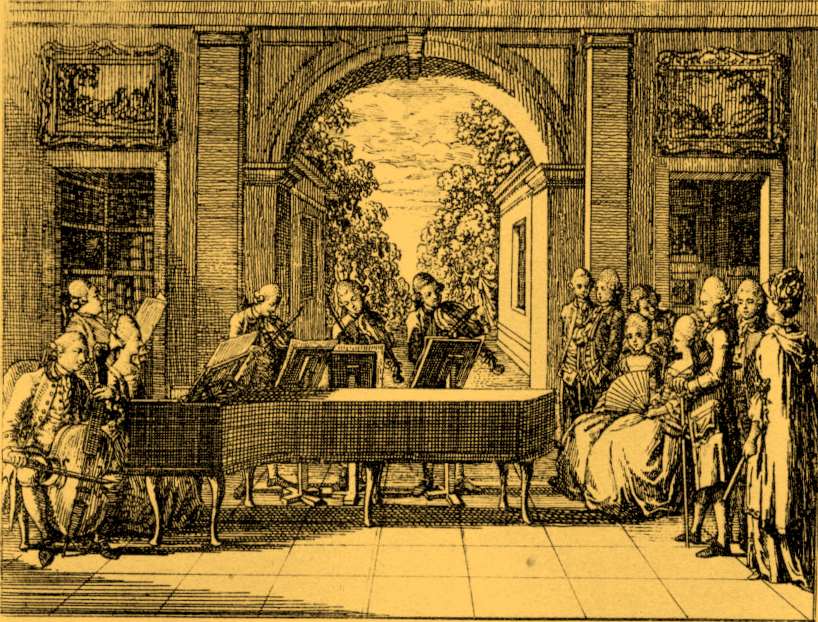
[2] Caroline mentions numerous concerts and musical performances in these letters, some public, some private, some by professionals, some by amateurs and aficionados.
Here three eighteenth-century musical performances reasonably representative of the sort Caroline experienced throughout her life. The first, by Daniel Nikolaus Chodowiecki (Kupfersammlung zu J[ohann] B[ernhard] Basedows Elementarwerke für die Jugend und ihre Freunde: Erste Lieferung in 53 Tafeln. Zweyte Lieferung in 47 Tafeln von L bis XCVI [Leipzig, Dessau, Berlin 1774], plate 18); the second: excerpt from an engraving after a painting by Augustin Saint-Aubin, “Un Concert au dix-huitième siècle,” Le magasin pittoresque 12 [1844] no. 1, 48); the third: Johann Rudolf Holzhalb, Concerto a Cembalo obligato con stromenti (Zürich 1777):


[3] The “someone who had heard the famous Gabrieli” was likely Georg Christoph Lichtenberg, who mentions Elisabeth Mara’s same two concerts in a letter on 28 September 1778 (Lichtenberg, Briefe, 1:314):
On Saturday [26 September] I heard the famous Madam Mara, née Schmehling, sing (who is receiving a 4000 Thaler stipend from the king of Prussia), and her husband play the violoncello. I do think the latter is, in his own way, a greater proficient. Although Göttingen is quite empty just now, the attendance was remarkable; indeed, they took in 346 Thaler. Today [28 September] they are giving another concert, this time — something unprecedented here — in the auditorium of the law school, and even more people are expected to attend.
Lichtenberg had indeed heard Caterina Gabrielli in London on 11 November 1775 in the role of Dido and was not particularly impressed; see his amusing account in “Briefe aus England,” Vermischte Schriften. Neue vermehrte von dessen Söhnen veranstaltete Original-Ausgabe (Göttingen 1844), 3:260–64 (supplementary appendix 3.1). Back.
[4] Mozart provides a vivid description of the “insufferable” behavior of Mara’s husband, Johann, in a letter to his father from Munich on 24 November 1780 (supplementary appendix 3.2).
Karl Friedrich Zelter confirms this generally held view in a letter to Goethe in February 1831 (Der Briefwechsel zwischen Goethe und Zelter in vier Bänden, ed. Max Hecker, vol. 3 [Leipzig 1918], 390–93, cited in Vera Viehöver, “‘It Wasn’t Enough for Me Just to Be a Singer’: (Self-)Representations of the ‘German Prima Donna’ Gertrud Elisabeth Mara,” in Portraits and Poses: Female Intellectual Authority, Agency and Authorship in Early Modern Europe, ed. Beatrijs Vanacker and Lieke van Deinsen [Leuven 2022], 323–45, here 331:
Also in the correspondence between Goethe and Zelter, there are traces of the narrative of the homme fatal and his female victim: “Nobly, she [Mara] never spoke of the source of her many sufferings, and that was her husband, the most depraved of all Greeks.” The victim narrative long dominated her story: Mara’s claim to authorship of her life, both professionally and privately, was completely ignored, and her consciously made decisions were transformed into an “unhappy fate.” Back.
Translation © 2011 Doug Stott