
• 45. Caroline to Lotte Michaelis in Göttingen: Clausthal 1784
[Clausthal 1784]
|97| A very interesting letter indeed! That much I must own. Quite apart from the fact that it introduces me to the gallant world of the head, it also shows me the path to the heart, to all those hiding places, by classifying for me all those who — each in his own fashion — think they sense a certain weakness there, and then tend to it with such loving care in the form of said tutors and sundry youths. [1] And all of it portrayed according to real life, just like the crayon sketch with the shorn hair. [2] . . .
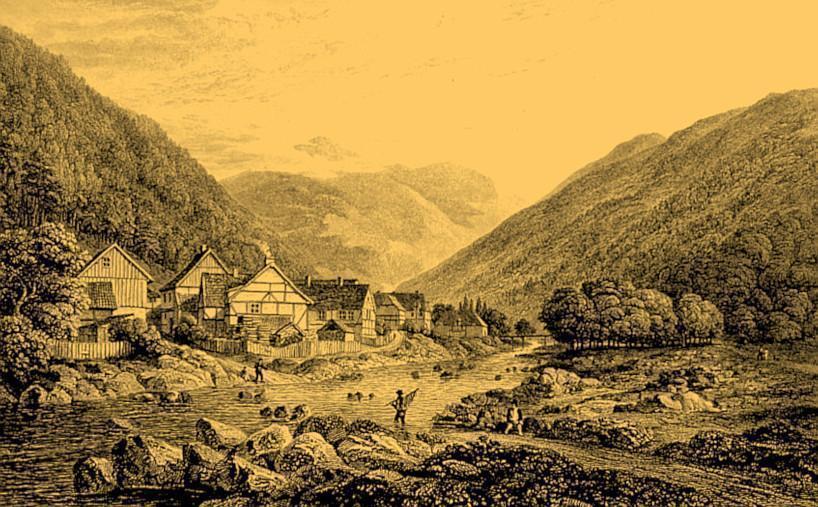
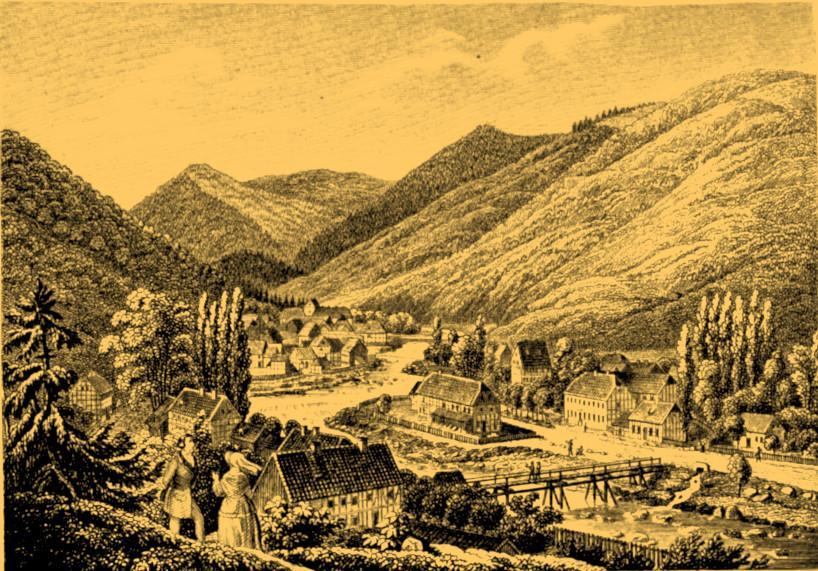
But now take an excursion with me into the domain of love. 14 days ago we traveled through Goslar to Oker, a locale with a hundred houses situated at the foot of a steep, forested mountain and bordered quite closely on the other side by the Oker River. [3] We were visiting an acquaintance and spent one night with him. The route to Goslar itself is beautiful and, at the midpoint, quite charming when, emerging from the dense forest, one has a view of the whole countryside extending even past Halberstadt. [4]
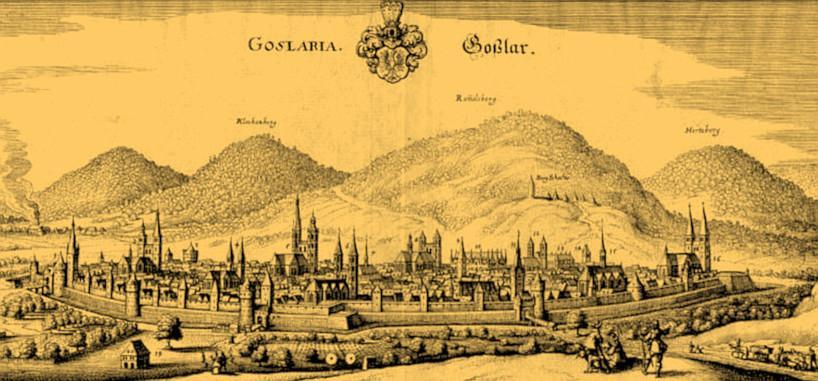
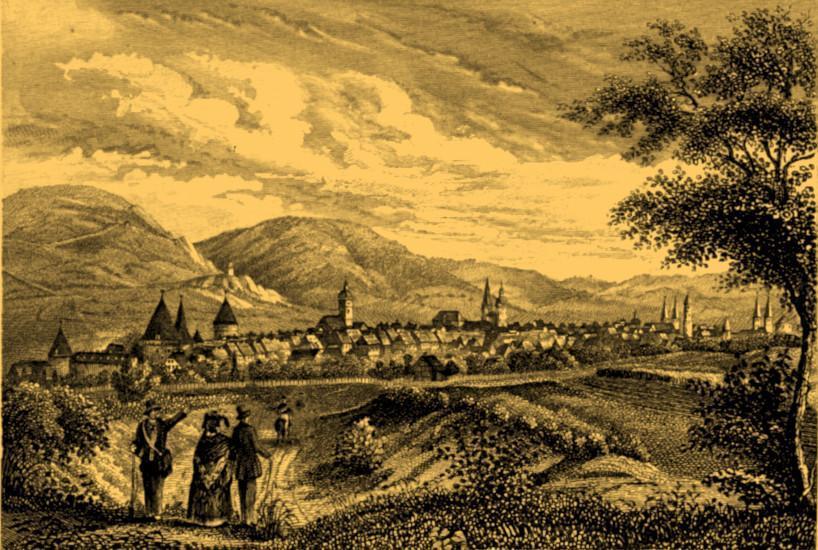
But in Goslar itself — as soon as from a far distance you glimpse the needlepoint shapes of the octagonal towers — nature itself dies away, the grass withers, and everything languishes and droops toward the ground. [5] You travel between bare mountains and then through a gate — where from sheer fright love itself would have to breathe out its last sigh, |98| else fall into fearsome despair. [6] I know not how the knight Sir Lauer made it through this adventure unless during his fair childhood his mother dipped him in brine instead of in the river Styx, thus rendering him utterly incapable of feeling. [7]
Inaccessibly high walls surround the city, which one never sees in its entirety but only piece by piece. Monasteries without windows and churches without number, and everywhere 16-cornered watchtowers that look like chained guard dogs. In the center, where the fire raged, [8] the new houses are quite nice, three stories, usually still with straw windows. As is well known, they occupy the same locations as before, so you find one here and then one there in a crooked labyrinthine arrangement.
On both sides: high, coarsely hewn stepping stones that would surely cost the Bürgermeister and Rath their crooked legs were everything here not organized just like a residence. No pavers in the middle of the street, just deeply rutted earth full of wet mud.
And thus does one continue on for at least a half hour before making it through, accompanied by a feeling of the most excruciating boredom suffocating all sense of joy and making the grave itself distasteful, but lacking the kind of melancholy consolation one might otherwise draw from, let us say, a nest of owls, [9] and without even the consolation that the inhabitants might be good, or perhaps even interesting descendants of the knights of previous centuries; but no, it is an old-fashioned, small, toad-like imperial town full of pretensions to modernity. [10]
And Lauer’s beloved lives here! And so come, oh ye charming doves of Venus, help me escape this cesspool and return to purer air. And behold, already I breathe more easily and am again at my writing table, writing to you!
Although much involving the aforementioned empire might also be related right here and right now, it will be passed over in prudent silence. It is a bit coarser even than |99| with Mr. Geisler, who accompanies his wife’s drunken lovers out the door. [11] But for precisely that reason will my own tongue and even less my quill ever mention it. Amen.
Notes
[1] Caroline seems to be parodying what is for us an otherwise unfamiliar style of speaking prompted by the previously mentioned letter (whether from Lotte herself or merely mediated by her). Back.
[2] Unknown allusion. Back.
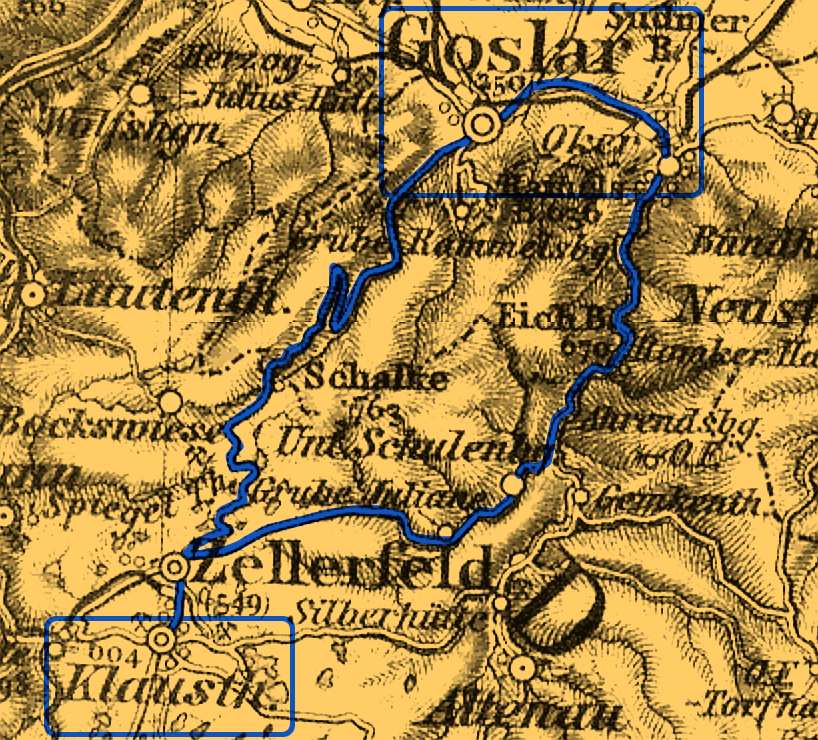
[3] Goslar is situated 13 km northeast of Clausthal, Oker — a quite small mining town — just southeast of Goslar; Caroline and Franz Wilhelm Böhmer likely returned to Klausthal directly from Oker rather than returning to Goslar first (Karte des deutschen Reichs, ed. C. Vogel [Gotha 1907], no. 13):
Here Oker, essentially as Caroline describes it, in an 1829 engraving by A. Schule and in 1855 from August Ey, Harzbuch: oder, Der geleitsmann durch den Harz, 2nd ed. (Goslar 1855), plate following p. 244:
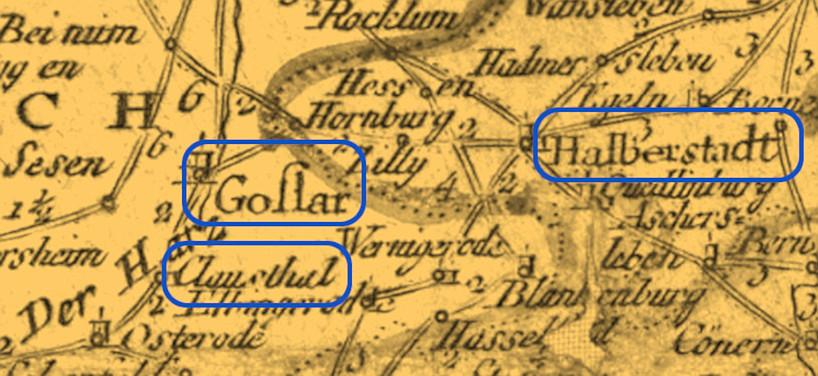
[4] A town ca. 40 km east of Goslar (Post Karte Durch ganz Deutschland, ed. J. Walch [Augsburg 1795]):
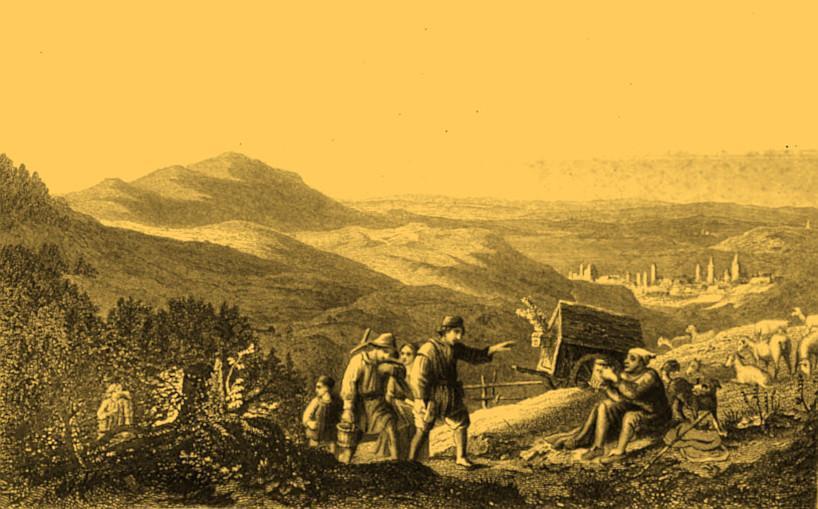
[5] Here the surrounding countryside and topography approaching Goslar in the distance, also much as Caroline describes it (Wilhelm Blumenhagen, Das malerische und romantische Deutschland, vol. 4: Der Harz, 2nd ed. [Leipzig 1847], plate following p. 12):
Here Goslar ca. 1653 and 1855 with its “needlepoint” towers (Matthäus Merian, Goslaria. Goßlar, from Topographia Saxoniae Inferioris [Frankfurt 1653]; August Ey, Harzbuch: oder, Der geleitsmann durch den Harz, 2nd ed. (Goslar 1855), plate following p. 136):
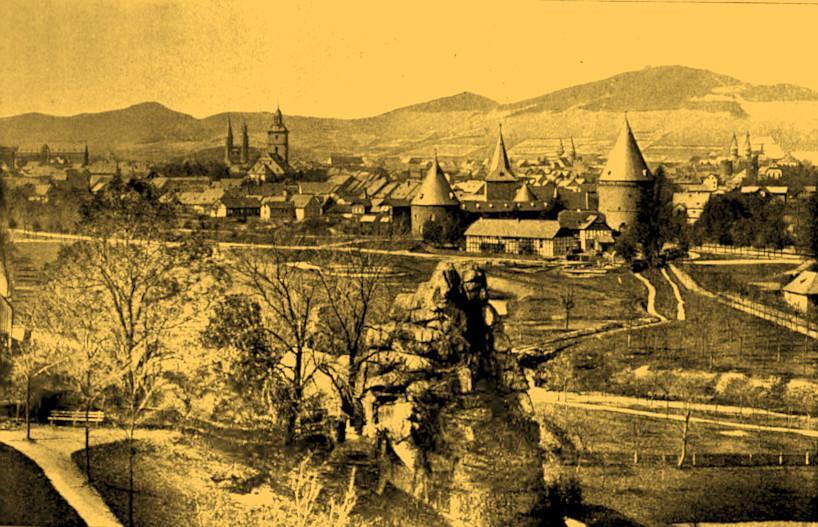
Here Goslar at the end of the nineteenth century, similarly displaying its unmistakable signature towers and spires (Hans Hoffmann, Der Harz [Leipzig 1899], plate following p. 152):
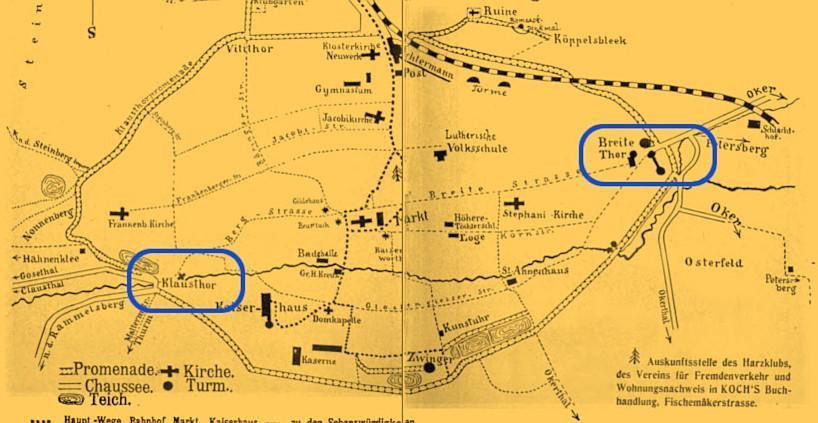
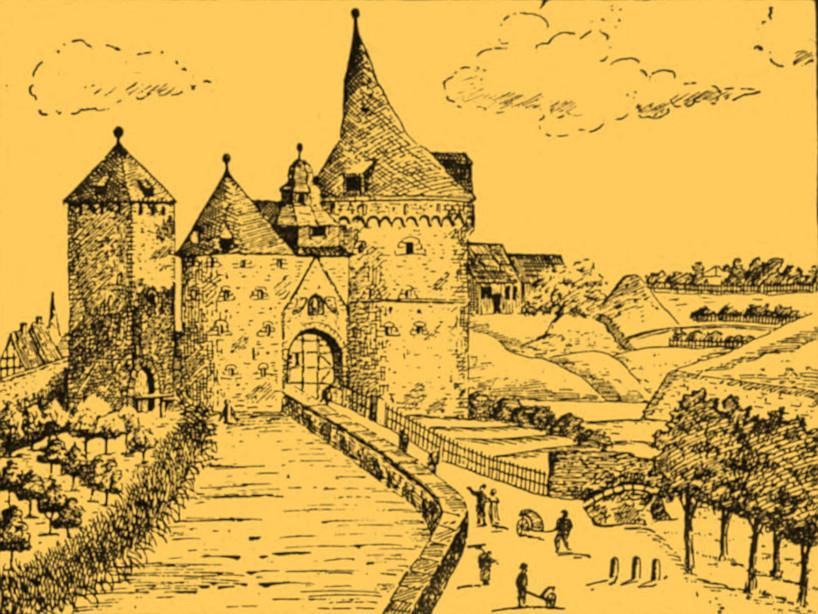
[6] Travelers from Clausthal entered Goslar through the former Klausthor, or Klaus Gate, built 1503–7, torn down 1820 and 1828; Caroline and her husband presumably departed Goslar from the other side of town, through the Broad Gate, which directed travelers southeast to Oker; here the location of both gates in an illustration from Heinrich Pieper, Illustrierter Führer durch Goslar am Harz, 7th ed. (Goslar 1908), 4:
Here a drawing of the Klaus Gate, through which Caroline and her husband entered the town (ibid., 8):
And the Broad Gate viewed from the north (excerpts from illustrations by [1] Matz Sincken [1574] and [2] Matthäus Merian [ca. 1653]); Caroline would have exited the town from right to left and driven east and southeast toward the Oker Valley:
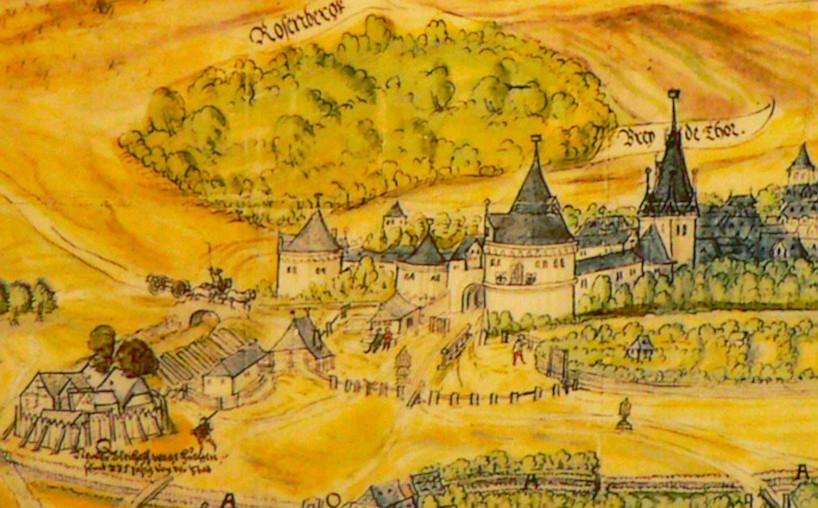
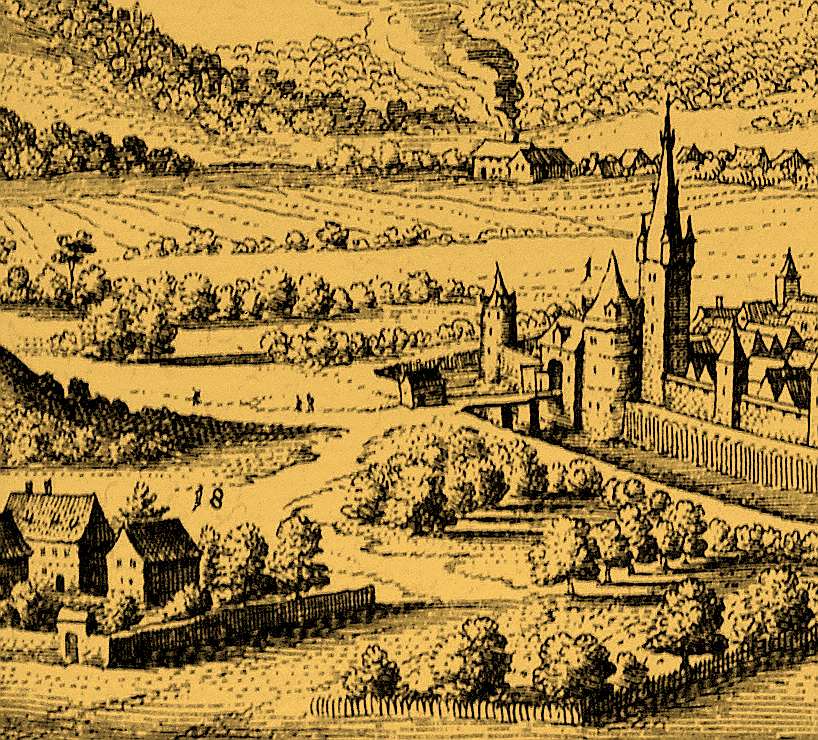
[7] Erich Schmidt (1913), 1:682, was unsure about this reference to the knight Sir Lauer and suggested perhaps some connection with the “Lauers from Gotha” (letter 113). The Biographisch-Bibliographisches Quellen-Lexikon Der Musiker Und Musikgelehrten Der christlichen Zeitrechnung bis zur Mitte des neunzehnten Jahrhunderts, vol. 6, ed. Robert Eitner (Leipzig 1902), 74, does indeed attest a certain Johann Friedrich Lauer in 1786 as a lieder composer in Gotha, and in Max Friedlaender, Das deutsche Lied im 18. Jahrhundert: Quellen und Studien, vol. 1, section 1: Musik (Stuttgart, Berlin 1902), 44, he is attested as having published Liedersammlung, in Musik gesetzt in Eisenach in 1788. Caroline’s later comments in the present letter (“And Lauer’s beloved lives here!” in the present tense) suggests that Lauer was betrothed or otherwise involved with a woman in Goslar, and that Caroline is simply ironically admiring his “knightly” courage in braving “such” a town for the sake of his beloved.
In any event, Caroline is otherwise alluding to the Greek legend according to which Thetis dipped Achilles in the River Styx to ensure his invulnerability; see Caroline’s letter to Julie von Studnitz on 3 September 1781 (letter 25), note 3. Back.
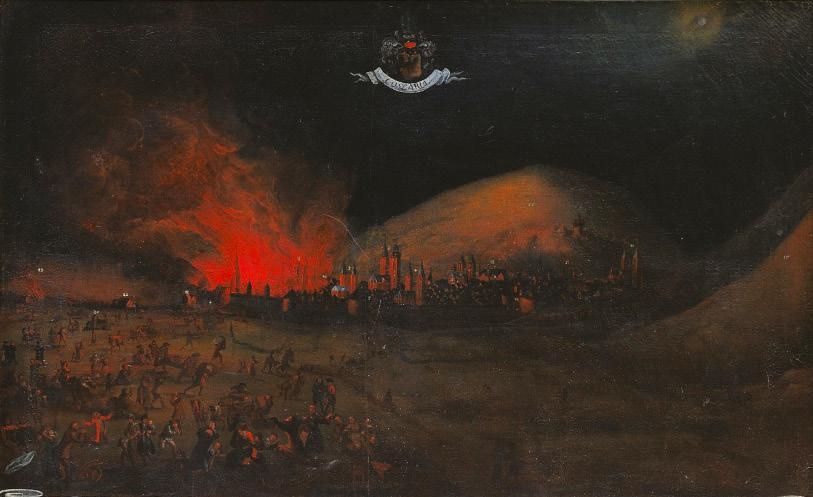
[8] Goslar suffered devastating fires on 26–27 April 1728 and 23 March 1780, with the fire of 1780 also consuming the area around the market. Here an anonymous painting of the fire of 1780 (Goslarer Museum, photography: Bernhard Heinze):
[9] Uncertain reference, but see James R. Duncan Owls of the World: Their Lives, Behavior and Survival (Buffalo 2003), 101: “The Dutch of the 16th and 17th centuries often used owls in their paintings and viewed owls negatively because, owls being mostly nocturnal creatures, they avoided light and appeared to stagger about when caught by day. . . . Indeed, for the Dutch, the term ‘uilskviken,’ meaning a ‘nest of owls,’ was the equivalent of calling someone a ‘nincompoop.'” Back.
[10] Concerning Caroline’s language in this sentence, specifically the word “toadlike, toadish, toady” (Germ. lorkig, from Lurch, amphibian, toad), see Gottfried August Bürger’s comments on his own use of the word in the poem “Adler und Lork” (Eagle and amphibian) in the Göttinger Musenalmanach (1787), 49: “Pardon me for using this Low German word! But no High German word so powerfully expresses this sense of contempt.” After praising several of the poems Bürger included in this issue of the Musenalmanach, a reviewer in the Allgemeine Literatur-Zeitung (1787) 165b (Wednesday, 11 July 1787) 89 remarks, “But Das Bekenntnis as well as Adler und Lork seem to us to sink beneath the vernacular to a tone that cannot possibly coax even tolerance, much less approval, from its readers.” Back.
[11] Mr. (Geisler) in English in original. Although the specific allusion is uncertain, Caroline seems to be referring to a publication already familiar to Lotte, presumably an undetermined issue of Adam Friedrich Geisler’s (see also Caroline’s letter to Luise Gotter on 3 April 1784 [letter 40]) Archiv weiblicher Hauptkenntnisse für diejenigen jedes Standes, welche angenehme Freundinnen, liebenswürdige Gattinnen, gute Mütter und wahre Hauswirtinnen sein und werden wollen, a woman’s journal Caroline may well have read as a young bride — “Archive of the most important feminine knowledge for those of every class wishing to be and become pleasant friends, amiable spouses, good mothers, and genuine housekeepers etc.” — appearing between 1787 and 1790; considering that Caroline left Clausthal in the early autum of 1788 after Böhmer had died in February 1788, she is likely referring to an issue in 1787, i.e., vol. 1. See the anonymous review in the Gothaische gelehrte Zeitungen (1787) 73 (12 September 1787), 593–94:
Archiv weiblicher Hauptkenntnisse für diejenigen jedes Standes, welche angenehme Freundinnen, liebenswürdige Gattinnen, gute Mütter und wahre Hauswirtinnen sein und werden wollen. Herausgegeben von einer Gesellschaft von zwei und vierzig deutschen Frauen, und besorgt von A. F. Geisler dem Jüngern in Leipzig. Mit einem Titelkupfer, 2nd ed. (1787). Octavo. . . . No. 1, January,–No. 6, June. 368 pages. . . .
Leaving in abeyance for the moment whether this monthly really is edited by 42 German women, or whether Mr. Geisler the Younger, à la Grossing, merely invented such an assemblage, and is instead the author, editor, and responsible party for the entire publication, let us instead merely enumerate the primary essays in these six issues:
(1) General sketch of human beings;
(2) the cruder nature of human beings;
(3) the wild and sociable person, and on renunciation of the flesh;
(4) the nature and power of human beings.Actual tasks associated with how a woman is to run a household; bread and its preparation; cellar; kitchen; baking; toiletries.
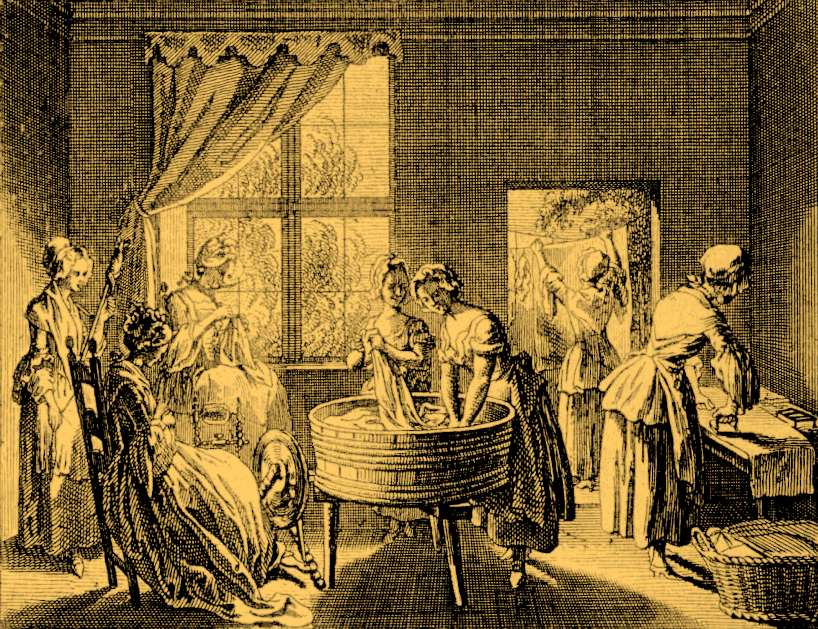
[Daniel Nikolaus Chodowiecki, “Frauenzimmerarbeiten im Nähen, Spinnen, Waschen, Plätten usw.” (the various tasks of women) in (Kupfersammlung zu J[ohann] B[ernhard] Basedows Elementarwerke für die Jugend und ihre Freunde: Erste Lieferung in 53 Tafeln. Zweyte Lieferung in 47 Tafeln von L bis XCVI (Leipzig, Dessau, Berlin 1774), plate xix b:]
(1) On the locus of beauty in one’s face, and considerations on what enhances or detracts from beauty.
(2) Safe and effective means of maintaining and complementing natural beauty.
(3) Essay on erroneous facial coloring and other facial shortcomings, their causes, and remedies.The ultimate female vocation, or the destiny of every girl to be a spouse and mother, in letters from a mother to her unmarried daughter
(Leipziger Taschenbuch für Frauenzimmer zum Nutzen und Vergnügen aufs Jahr 1789):
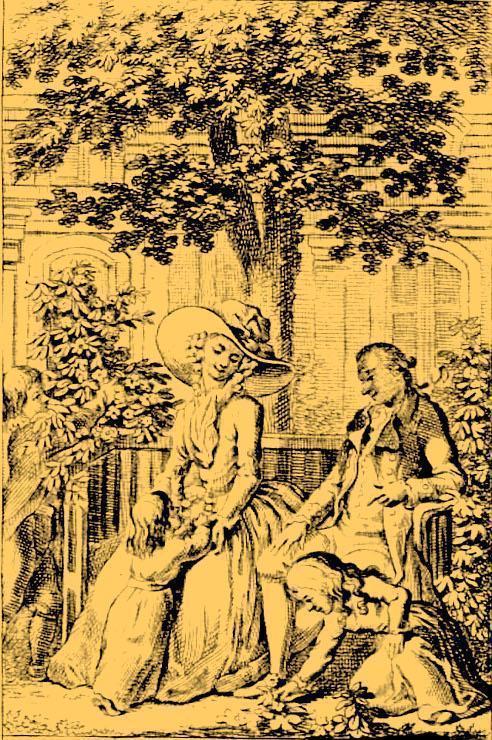
and on various subjects with respect to her new status, on the duties of a pregnant women, and that a mother ought to nurse her children with her own milk; how one should teach children, and how they ought always to be well supervised.
[Here the title vignette from vol. 2 (1788) no. 1 (January), a volume more narrowly devoted to mothering and wet nursing (vol. 1 [1797] presently unavailable)]

Brief fashion dictionary, or explanation of foreign words and idioms that appear in everyday life and popular books. Training of young girls to become pleasant companions and amiable girlfriends, in all the circumstances of every class, general portrayal of the young woman according to the stages of her development and age, her situation, her vocation; the value of a woman and the lack thereof; on society, friendship, sociability, etc. Diet, or rules to promote and maintain good health to the furthest extent possible. Gardening; fashion; cleaning; sewing; washing. Worldly feminine wisdom, in a letter from an English lady to her seventeen-year-old daughter. Self-knowledge with respect to one’s own body and emotional inclinations. Proposal to our young ladies and gentlemen concerning a specifically German fashion à la Leopold, alongside two engravings illustrating such proposed fashion. The title engraving allegedly portrays wisdom in her original dignity in an allegorical habit, and the true portrait of the head of the society of 42 German women as the collective editors of the Archiv; additional allegorical figures as well about whose identities one can read but probably not otherwise guess.
Caroline may be referring to a passage in the earlier topics “the cruder nature of human beings” or “the wild and sociable person, and on renunciation of the flesh.” Back.
Translation © 2011 Doug Stott