
• 85. Caroline to Luise Gotter in Gotha: Clausthal, February 1788
[Clausthal, February 1788] Monday evening, 9:00
|169| These hasty lines are prompted by my desire to commend a dear acquaintance of our house to you and your husband more directly than would otherwise be the case. I believe, my dear Louise, that I have not yet written to you personally — though you know my letters to Wilhelmine are also wholly meant for you as well, just as if |170| your address, too, were on them. Herr Blankenhagen [1] will relate to you that I am doing fairly well — I cannot be so precise in reckoning such difficult hours. [2]
He will probably also tell you that I seem tolerably calm, and with that your friendship is certainly permitted and indeed must comfort itself for now. Suffering gently is requiring the most strenuous effort of which I am capable just now, and is certainly necessary, for the eruptions of my grief, the violent tears of mournful misery do nothing but harm me straightaway. One gains considerably if one manages to suppress them, and sinks into a kind of dreamlike daze. [3]
It is not as if I were trying to empty myself of all feeling or as if the images of the past were less vivid — your Caroline is a living monument to the deceased, he lives in my heart with the most vivid presence [3a] — the reflection of that final, smiling, grateful look in his eyes is still in mine — that is how I feel now — and yet, precisely because these images, perpetually hovering around me as they do, draw me away from reality, they make my condition easier. [4] The bearer of this letter can also tell you whatever you want to hear about my children. He saw them daily.
God bless you, my precious, along with your family.
Caroline B.
Notes
[1] Erich Schmidt (1913), 1:687, wondered whether Peter Heinrich Blankenhagen (1723–94), a numismatist from Livonia, might be meant. In a letter to her daughter in mid-April 1802 (Therese Huber Briefe, 1:345), however, Therese Huber mentions that Blankenhagen’s son, also named Peter Heinrich von Blankenhagen (1765–1802), who had been a student in Göttingen from 1785, had been “passionately in love with Lotte Michaelis, whom you had heard me mention often, even having promised to marry her, but then apparently forgot about her during his travels in France.” Back.
[2] Franz Wilhelm Böhmer seems to have died on 4 February 1788 according to Erich Schmidt (1913), 1:687 and Georg Waitz (1871), 1:44n1, both of whom likely follow Caroline’s dating in her letter to Luise Wiedemann on 22 February 1808 (letter 429). The Allgemeine Literatur-Zeitung (1788) 53b (Saturday, 1 March 1788) 584 dates his death to 5 February 1788, perhaps with the understanding of “the night of 4/5 February.
Johann Franz Wilhelm Böhmer, the son to whom Caroline subsequently gave birth in Göttingen, died quickly thereafter as well, apparently that autumn. The eulogies for Caroline’s husband appeared in the Allgemeine Literatur-Zeitung (1788) 53b (Saturday, 1 March 1788) 584 and, by Georg Christoph Dahme, in the Annalen der Göttingenisch-Lüneburgischen Churlande, vol. 2 (1788), 94–97 (both texts see supplementary appendix 85.1). Back.
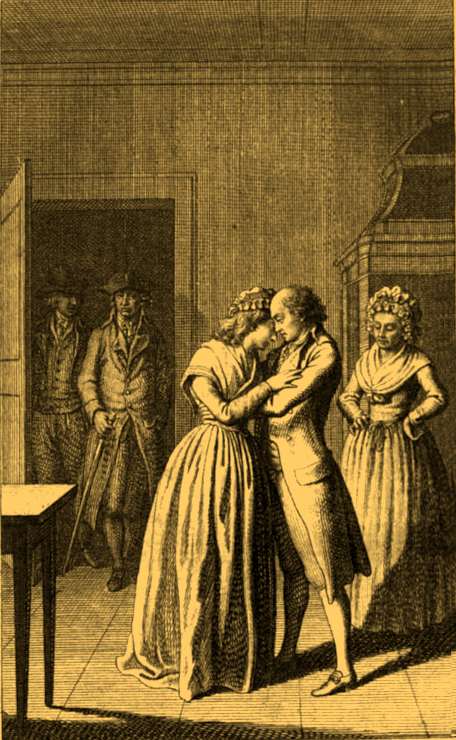
[3] Frontispiece to Franz Xaver Bronner, Leben, vol. 2 (Zurich 1796):
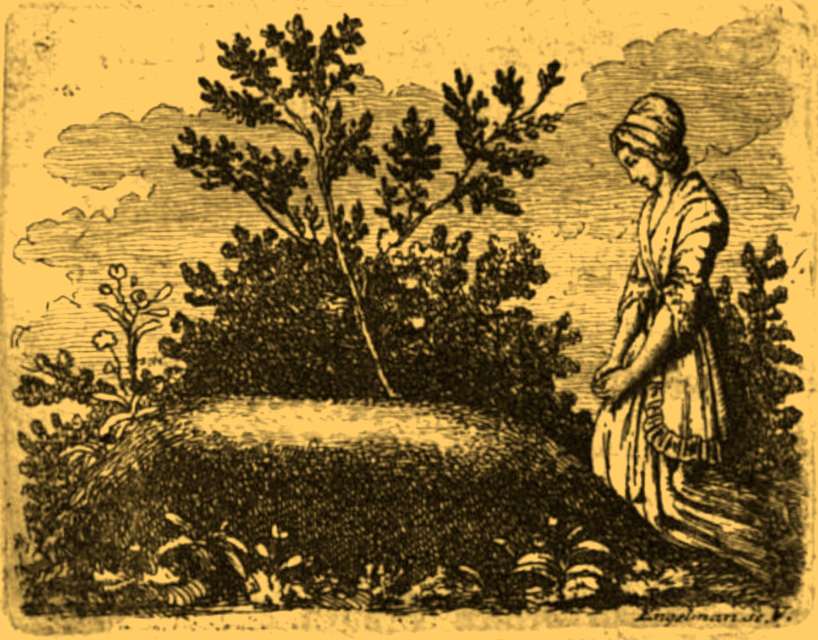
[3a] Liebreich, Unterhaltliches Taschenbüchel für Fräulein, Mademoisellen, Jungfern, und Stubenmädchen (Vienna 1783), unpaginated:
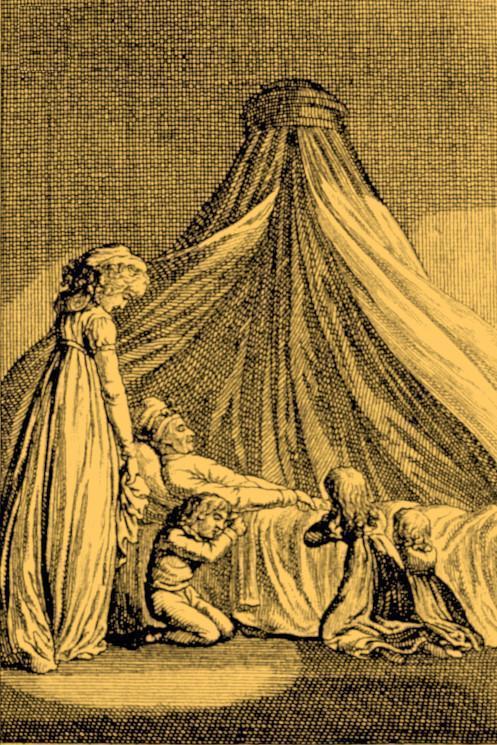
[4] Here two representative illustrations of attendants and a woman at the side of a dying man; the illustrations offer a poignant evocation of the situation Caroline here describes (Daniel Nikolaus Chodowiecki, [1] O grosses Wesen! [1782]; Herzog Anton Ulrich-Museum; Museums./Signatur DChodowiecki AB 3.497; [2] Heiliger Herr Jesus, sei uns gnädig, rief hier der ehrliche Pater Vinzent [ca. 1742–1830]; Herzog August Bibliothek; Museums./Signatur Uh 4° 47 [252]):

Chodowiecki similarly did illustrations of the grieving widow and children immediately after the death of the husband and father as well as one of the grieving widow alone (Göttinger Taschenkalender [1798, 1799]):

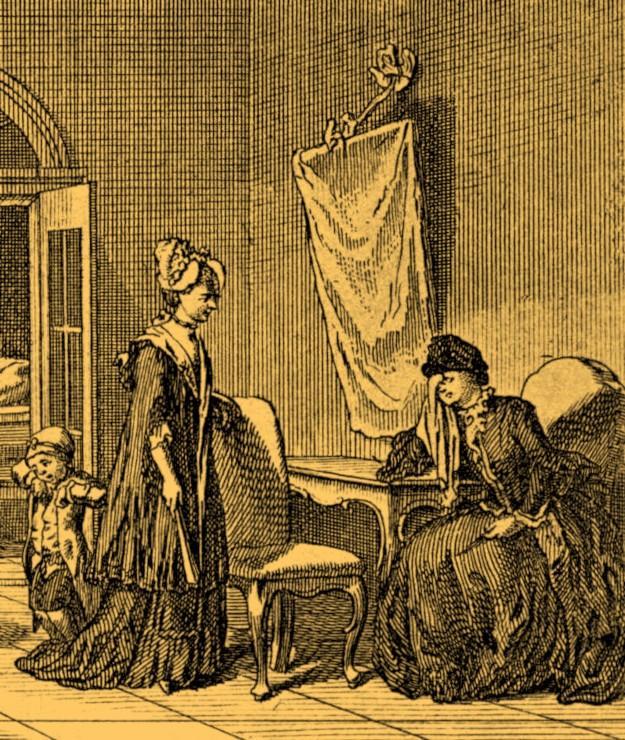
Here grieving widows receive the condolences of friends; note the sheet-covered portrait of the husband on the wall (Daniel Nikolaus Chodowiecki, [1] Die Traurigkeit an einer Witwe, das Mitleiden an ihrer Freundin, Kupfersammlung zu J[ohann] B[ernhard] Basedows Elementarwerke für die Jugend und ihre Freunde: Erste Lieferung in 53 Tafeln. Zweyte Lieferung in 47 Tafeln von L bis XCVI [Leipzig, Dessau, Berlin 1774], plate xxvii.c; [2] Göttingen Taschenkalender [1799]):

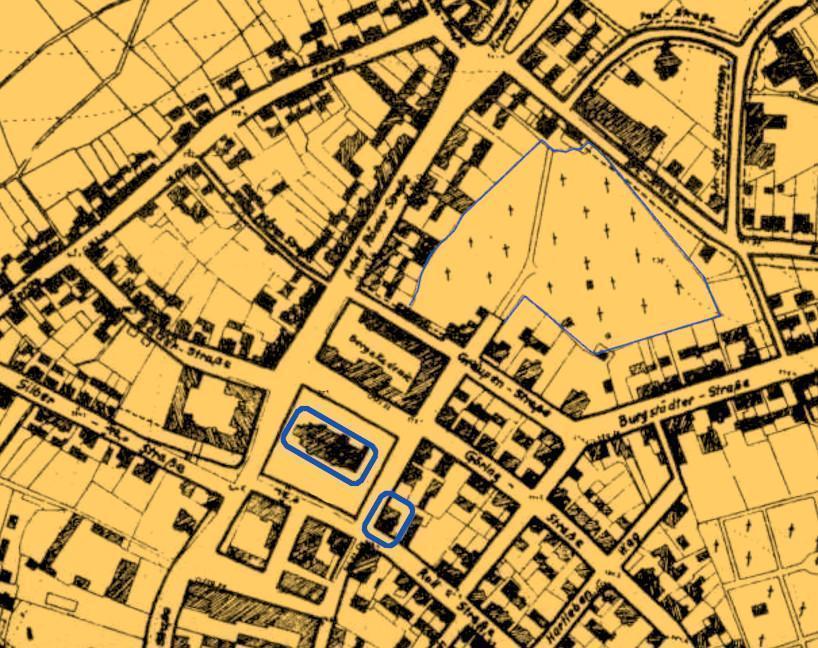
Franz Wilhelm Bohmer was buried in the old cemetery in Clausthal, located at the northern edge of town not far from Caroline’s house. Its chapel, like Caroline and her husband’s residence, burned down during one of Clausthal’s numerous fires over the years, and the cemetery itself has since been abandoned as such and today retains only a few headstones. His grave location is unknown (Brigitte Rossbeck, Zum Trotz glücklich: Caroline Schlegel-Schelling und die romantische Lebenskunst [Munich 2008], 61, with footnote 48).
Here a town map showing the Church of the Holy Spirit on Market Square at left, Caroline’s residence in the southwest corner of Market Square, and the old cemetery outlined at top center-right with cross icons ([1] Bebauungsplan Clausthal-Zellerfeld [1923–35]; [2] Rudolph Zacharias Becker, Das Noth- und Hülfs-Büchlein Oder Lehrreiche Freuden- und Trauer-Geschichte Des Dorfes Mildheim, vol. 2, rev. ed. [Gotha 1815], 793; [3] Daniel Nikolaus Chodowiecki, Höltys Elegie auf ein Landmädchen [1794]; Herzog Anton Ulrich-Museum; Museums./Signatur DChodowiecki AB 3.985):


Translation © 2011 Doug Stott