
263a. Dorothea Veit to Schleiermacher in Berlin: Jena, 16 June 1800 [*]
Jena, 16 June 1800
. . . For now we are still sitting here quite calmly and waiting for things to take their course. [1]
Hence we will not be coming to Berlin; but whether we will be staying here for now or going to Dresden depends on a great many lesser circumstances. As you have doubtless seen from my letter, I asked Veit for a meeting, which should resolve a great many things. Could one but have a proper discussion with him! Yet even if I speak resolutely and forcefully with him, will he not merely end up trying to move me by weeping again? indeed, I fear that more than any strong resistance.
Everything would be solved could he but be persuaded to let me have Philipp, including were I to wed Friedrich! [2] Friedrich can indeed do a great deal for Philipp, and is certainly willing to do so, except that he says Philipp would have to be genuinely left to his care, and he not always have to live in fear that Philipp would be taken back away from him; it is precisely these reservations that are keeping his heart closed off from the boy.
But no one would think of taking him from us as long as we did not marry, so I cannot quite comprehend what is preventing Friedrich from taking greater interest in him. Why are all of you so set on us getting married? Friedrich, too, is urging it. He is simply expecting too much from this crisis. [3] After all, it is merely something external! though even as such I certainly do not reject it entirely, it is simply that one cannot expect any internal advantage from it, and as far as the external one is concerned, well, one must simply wait for the most favorable moment, which has not yet arrived. It is simply not yet the right thing, and indeed could only increase the confusion already here. —
Philipp has again had a serious fever, so I certainly cannot send him off yet. And if he is indeed left to us, why should we not be able to treat him and instruct him basically just as well as some boarding-school master? it would admittedly be a bit different with Hülsen, may heaven grant that his wife’s health improves. [4]
Moreover, I myself would need to see things first, and speak with the woman myself. So you see, my dear friend, all these threads are truly a tangle, and one must wind one’s way through them a little at a time; although simply cutting through them all is certainly quicker, afterward they are all utterly useless. Friedrich is mainly interested in our being married so that we could live with Charlotte; I, too, would be delighted with that, but these things cannot be hurried. . . .
Whether and even if Caroline will be returning is still a mystery to us all; [5] it is all the same to us, since we will absolutely not be remaining here in the house in any case, even if we remain here through the winter.
I have in the meantime become rather intimately acquainted with Madam Paulus, and she wants to help arrange some modest living quarters for us near her. She is a quite charming woman, and by far the brightest among the women with whom I have become acquainted here. Goethe dallied with her for a while, finally abandoning her just as he does all of them; [6] and yet he is still well disposed toward her, soliciting her more often than the others when he has company.
Paulus himself is a smart, bright man; they live together in a quite charming style, with nothing unseemly or improper ever peeking out, not in any way or from any corner; you realize that this sort of thing must come about through both parties; as soon as one has to make up for something ridiculous the other has done, that is just the way it stays, remaining ridiculous and wretched regardless of how well that other person tries to fix it. But because such is never the case with Paulus and his wife, even though there is not a trace of any real marriage with them, for that reason alone they are to be respected as genteel people.
They have an extremely pretty child, a daughter, whom they are raising with great care. I think Madam Paulus would please you quite well indeed, there is something capricieuse about her that in a very charming way takes the place of any more profound character, and in company she is quite light and pleasant; but I merely go about with her, nothing more, since she has not the slightest intimation of the divine. [6a]
I have begun reading your Lucinde letters and must express my thanks; it is indeed true, you have taught me to understand much in Lucinde better, or at least shown me clearly and precisely where certain things belong; [7] these letters are a refreshingly mature fruit that has come forth from the blossom of Lucinde, of which Eleonore’s fragments are the sweet center for me. [8] I do not think you have written anything yet as insightful and light and clear; Friedrich has also praised their religious conscientiousness. . . .
That the letters to and from Leonore are my favorite should certainly not surprise you! [9] —
If I might answer Eleonore in Lucinde’s name and in her soul, I would say the following with respect to what she senses to be a discordant note in the duet: [10] precisely because the foundation is based on the eternity of love, she must be able to renounce without fear of shattering love. She must be willing to renounce, or she must not desire to possess. Quite apart from being Julius’s beloved, Lucinde is also a free being; anyone not willing to renounce will ultimately have to do so. —
I dare not contradict in Julius’s name the second discordant note Friedrich claims to have found in the duet, [11] since it is veiled by the impenetrable curtain of individuality, which not even Lucinde could likely ever lift and before which she instead withdrew out of a sense of sacred reverence. —
So, you can see how attentively I have studied the letters, and how much they interest me. And yet I must also tell you that for me, they seem to be at least as bold as Lucinde itself, and that with their thoroughness they will hopefully quite turn the world’s head around. . . .
Notes
[*] Sources: Briefe von Dorothea Schlegel an Friedrich Schleiermacher 73–80; KGA V/4 87–89; KFSA 25:121–22; see esp. notes 42, 48 on 25:466–67. Back.
[1] In her previous exchanges with Schleiermacher during the winter and spring of 1800, Dorothea had discussed various plans involving returning to Berlin at least for a time, traveling to Dresden placing her son Philipp in the boys school directed by August Ludwig Hülsen, converting to Christianity, and legalizing her relationship with Friedrich through marriage, among others, many of which involved coming to an understanding with her former husband, Simon Veit (Post Karte Durch ganz Deutschland, ed. J. Walch [Augsburg 1795]):

[2] See Dorothea’s letter to Auguste in June 1800 (letter 263), note 5. Back.
[3] The “crisis” is presumably the pressure on Dorothea to marry Friedrich (and possibly: to convert to Christianity); such was, moreover, taking place lamong the anticipated dissolution of the living circumstances among the Jena Romantics at Leutragasse 5, Friedrich’s difficulties earning a living and his and Dorothea’s general financial problems, and the anticipated necessity of finding affordable living arrangements. Back.
[4] It did not; Leopoldine Hülsen died at 3:00 a.m. on 8 October 1800 from what was thought to be liver disease and consumption; she was only twenty-five years old. Hülsen took the loss extremely hard ([1] frontispiece to Johann Christian Brandes, Meine Lebensgeschichte, vol. 3 [Berlin 1800]; [2] N. Monciau and Pierre Philippe Choffard, Trauriger Mann auf einem Friedhof [ca. 1776–1800]; Herzog August Bibliothek; Museums./Signatur Graph. A1: 444a):
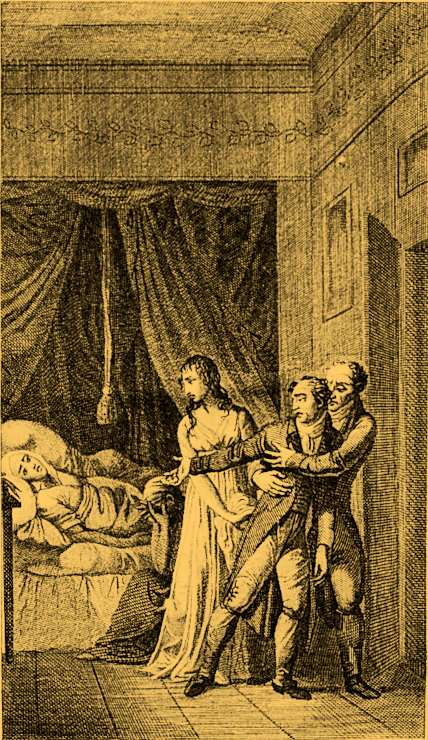

Hülsen soon abandoned his boarding-school project altogether. Back.
[5] Caroline and Auguste had likely left Bamberg and journeyed on to Bocklet on 12 June 1800; Schelling, whose brother had died in Genoa, had departed Bamberg on 1 or 2 June to journey to his parents’ home in Schorndorf (see the editorial note to Auguste’s letter to Schelling on 4 June 1800 [letter 261] concerning the circumstances prompting Schelling’s journey). Back.
[6] See Dorothea’s brother Abraham Mendelssohn to Karl Friedrich Zelter on 12 August 1797 (Goethe: Begegnungen und Gespräche, vol. 4, ed. Renate Grumach [Berlin, New York 1980], 321): “The only other thing I need to tell you is that Goethe is quite closely attached to Madam Paulus, reads all his things to her before having them published, and thinks quite highly of her judgment.” See in general the supplementary appendix on Karoline Paulus’s reputation. Back.
[6a] The “divine” possibly, or even likely, a reference to Friedrich Schlegel; see Dorothea’s references to “Friedrich the Divine” and to his “divine intellect” in her letters to Rahel Levin on 28 April 1800 (letter 259l) and 23 January 1800 (letter 258j).
That said, Dorothea’s later letters to Karoline Paulus are of a decidedly different nature that arguably borders on the erotic. Back.
[7] Schleiermacher’s Vertraute Briefe über Friedrich Schlegels Lucinde (Lübeck, Leipzig 1800), consisting of nine letters between Eduard, Friedrich, and three women, Ernestine, Karoline, and Eleonore. See in this regard also his review of Lucinde in the Berlinisches Archiv der Zeit und ihres Geschmacks (supplementary appendix 257a.1). For an examination of the letters in English, see Richard Crouter, Friedrich Schleiermacher between Enlightenment and Romanticism (Cambridge 2005), 109–19. Back.
[8] Letter 7, “Eleonore an mich” (Eleonore to me), Vertraute Briefe über Friedrich Schlegels Lucinde, 109–21, included an addendum of fragments (122–32); this letter possibly reflects letters Eleonore Grunow wrote to Schleiermacher; see Hans Landsberg’s introduction to Henriette Herz. Ihr Leben und ihre Zeit (Weimar 1913), 62:
At the time, Schleiermacher came to the defense of his besieged friend with his Vertraute Briefe über Lucinde, which reflect his personal relationships with Henriette Herz and Eleonore Grunow just as faithfully as does Lucinde the relationship between Friedrich Schlegel and Dorothea Veit.
Henriette Herz maintained that “some of these letters” were actually written by Eleonore Grunow (Henriette Herz in Erinnerungen, Briefen und Zeugnissen, ed. Rainer Schmitz [Leipzig, Weimar 1984], 58), and Schleiermacher himself remarked to Ehrenfried von Willich in May 1801 (KGA V/5 126) that he
had real people in mind when introducing the various characters, and especially the most striking, namely, Eleonore, is literally a real woman; everything said in her name is exactly what she thought, and to a large part even her own words.
By contrast, August Ferdinand Bernhardi apparently initially thought Henriette Herz had written the letters in Schleiermacher’s Vertraute Briefe that were attributed to women (letters 3, 4, 7), to which Dorothea responded in a letter to Schleiermacher on ca. 1 August 1800 (Aus Schleiermacher’s Leben 3:211; KGA V/4 182; KFSA 25:150):
Bernhardi was probably trying to make it clear that he himself believes that in part Jette wrote the feminine letters. If that assertion was supposed to be a reproach, then he is certainly on the wrong track, and has merely demonstrated how feminine they are. Back.
[9] Letter 7 “Eleonore to me,” letter 8 “To Eleonore.” Back.
[10] The “duet” is the reflection between Lucinde and Julius, “Sehnsucht und Ruhe,” in Lucinde. The statement by Lucinde to which Eleonore is referring is the following (in the reflection “Yearning and Peace,” in Friedrich Schlegel’s Lucinde and the Fragments, trans. Peter Firchow [Minneapolis 1971], 125–27, here 127):
So too shall the eternally cold and earnest day of life in time destroy the warm night, when youth departs and I give you up as you once, in a more noble fashion, sacrificed your great love.
In the fragments to which Dorothea refers, Eleonore writes the following concerning that “duet” (Vertraute Briefe über Friedrich Schlegels Lucinde, 131):
He, who produced this delightful duet, complains that he cannot sing? It awakened from a long, ancient slumber everything musical that yet lives inside me. It is too beautiful and to sacred even to speak about it, and were I to read it aloud, it would vex me were anyone to say even a word about it. But how did that one tone find its way in? the tone that so wondrously disturbs me? I do not understand it. Does it not inevitably constitute a discord with the fundamental tone, which proclaims the eternity of love?
See esp. Friedrich Schlegel’s own words in a letter to Caroline on 27 November 1798 (letter 210):
Just now, when we are both still young, it does not really make any difference at all that she is seven years older. But when it is no longer proper for her to be my wife in this sense, I will still be quite young, and, if I judge myself entirely without other considerations, as a stranger would, then I will as little be able to live without a wife as simply to make do with a female companion. She would probably not be my last love even were she my only one, just as her love for me is not her first. Back.
[11] The letter writer “Friedrich” in Schleiermacher’s Vertraute Briefe (Dorothea has obviously noted the name, with which Eleonore addresses the letter writer [114]: “But tell me, Friedrich, is it with love, and only with love, that we find everything else”) remarks in the eighth letter, “To Eleonore” (Vertraute Briefe, 134–35):
In the face of love, any friendship between a man and a woman seems to me to have something unnatural about it, and to be an empty or even reproachable or inexcusable enterprise, since for those who are, after all, involved in experiments in love, why should not everything that by nature is suitable for such not constitute precisely such an experiment? Is it not something entirely different, however, if love is indeed already somewhere? There are doubtless very few masculine natures of the noble sort — and they have to be in as extraordinary a condition as is Julius — in whom love could emerge for a woman whom from the very first moment they are already viewing as foreign property; how such love can yet remain behind as love after a better and more perfect love has arisen, one nourished by the most beautiful reciprocated love, however, I find utterly incomprehensible, hence there are for me two tones in this otherwise beautiful duet that I do not comprehend. Did you not notice this one? or does it resonate brighter for you?
In that “duet” in Lucinde, Julius is speaking about his “unknown lady friend” whom he once had renounced. To Lucinde’s previously cited lines, “and I give you up as you once, in a more noble fashion, sacrificed your great love,” Julius responds
Julius. Oh, that I might show and make my friend known to you; and show her the wonder of my wonderful happiness.
Lucinde. You still love her and shall love her as eternally as you shall love me. That is the great wonder of your wonderful heart.
Dorothea knows, of course, that the earlier woman whom Julius renounced (Friedrich Schlegel’s Lucinde and the Fragments, 91: “He renounced all expectation of happiness, but resolved to be worthy of it and become master of himself”) was modeled on Caroline. See supplementary appendix 132a.1. Back.
Translation © 2014 Doug Stott