
259f. Wilhelm Schlegel to August Ferdinand Bernhardi in Berlin: Jena, 11 April 1800 [*]
Jena, 11 April 1800
Please forgive my lengthy silence, good friend. Since you had drawn my attention to the January issue of the Archiv der Zeit, I wanted to read it first; but it took a long while for us even to receive it, though in return we did read your essay with doubled pleasure. [1]
You do indeed have a remarkable talent for dealing with subjects such as Jenisch and Merkel, and are for them a true scourge of God. You also thereby quite contribute to the common cause, since something of this sort makes a completely different impression coming from someone whom these children of man have not yet publicly berated.
We have coincided utterly with respect to Voss. Tell me what you think of the “Wettgesang” and the sonnet; I am really hoping for the approval of connoisseurs in this matter. [2]
I must remain firm in my disinclination to grant your critical wit and talent to the Archiv. Perhaps Schleiermacher has already told you that I am flattering myself with the hope that you might soon enter into common activity with us as well. [3]
To my considerable distress I hear that through the fault of the publisher himself your Sprachlehre, which I am quite eager to see, will not be appearing as quickly as anticipated. [4] But such is indeed merely part of the annoyances with which all writers must inevitably contend. In the meantime, however, this particular vocation does remain my favorite of them all.
Enclosed you will find my Gedichte. You will see that at the very least I have been quite diligent; over a third of the entire collection was composed since last summer. I hope you find some pieces in it to your liking. [5] . . .
[Tieck] sends his regards, though for the rest he is not entirely satisfied with your letters, wanting you to write more frequently and with more detailed news. Please also send him your current address. His health has in the meantime improved again. —
As you know, illness has been regnant in my house for six weeks now: my wife had a serious nervous fever, and her recovery is proceeding only very slowly. I myself am healthy, and my brother and Madam Veit have also been doing tolerably well.
Friedrich is working diligently on the continuation of Lucinde. [6]
Let me know what you learn about reactions to the latest issue of Athenaeum. [7]
I am curious to know whether the editors of the A.L.Z. have assigned you one of my brother’s pieces to review. They are presumably once again angry with him. [8]
Please extend my kindest regards to your spouse, and stay well.
Yours,
A. W. Schlegel
Notes
[*] Josef Körner, (1930), 108–9 . Back.
[1] Bernhardi’s “Neueste Litteratur,” contiguous with the review of the “Musenalmanach für 1800, von Johann Heinrich Voss,” Berlinisches Archiv der Zeit und ihres Geschmacks (1800) 1 (January), 28–38, in which in an introductory footnote he explains why “despicable publications” such as Daniel Jenisch’s Diogenes Laterne (Leipzig 1799) would be wholly excluded from such an overview of recent literature. See in this regard Dorothea Veit to Sophie Bernhardi on 16 January 1800 (letter 258f), note 10. Back.
[2] Wilhelm’s critical examination of poetic elements and stylistic considerations in Friedrich von Matthisson, Friedrich Wilhelm August Schmidt (known as Schmidt von Werneuchen), and Johann Heinrich Voss, Athenaeum (1800) 139–61, and his “competition” parody, “Wettgesang,” between those three poets, 161–64; concerning the latter, see Caroline’s letter to Johann Diederich Gries on 27 December 1799 (letter 258), note 19.
Concerning the chastising sonnet on Garlieb Merkel, which Wilhelm and Ludwig Tieck composed collectively in October 1799 and then had distributed as a flyer in Berlin, see supplementary appendix 252.1. Back.
[3] An allusion to the unfortunately unsuccessful attempt to establish a new critical journal for the Romantic school (basic documentation in later letters in this edition; see esp. Rudolf Haym’s discussion of the Romantics’ Jahrbücher project). Back.
[4] August Ferdinand Bernhardi, Sprachlehre, 2 vols. (Berlin 1801–3); Wilhelm subjected it to an exhaustive review in Friedrich Schlegel’s later periodical Europa: eine Zeitschrift 2 (1803) 193–204 (Sämmtliche Werke 12:141–53). Back.
[5] Wilhelm’s Gedichte (Tübingen: Cotta, 1800); Bernhardi reviewed them in the August issue of the Berlinisches Archiv der Zeit und ihres Geschmacks (1800) 2:124–33, though Garlieb Merkel did so as well — negatively, of course — in his Briefe an ein Frauenzimmer über die wichtigsten Produkte der schönen Literatur 1 (1800) 244–56, 272[correct: 273 (printer’s error)]–84; Merkel begins his review (here 245–46):
Were I to give you a collection of poems in which some were permeated by the vivifying breath of the poetic spirit, others by the most flaccid banality; in which some were composed and polished with the most careful poetic artistry, others such that even the most pathetic hack, one not the least familiar with either meter or rhyme, could not have more completely botched; and in which some were profoundly emotional, others bombastic, insipid, and empty to the point of tastelessness: — you would conclude that they could not possibly be from one and the same author.
And yet with regards to the present collection — which is exactly the one I am describing — you would seemingly be quite mistaken; for Herr Schlegel has indeed acknowledged both the good and the bad versifications as being products of his own quill, — but, as I said: only seemingly, for although Herr Schlegel has indeed versified them all, neither the spirit, nor the style, nor, for the most part, the ideas in these poems belong to him. . . .
Based on this collection, Herr Schlegel is a poet the way our actors are sometimes princes — both good and evil — yet always only seemingly, and only for a few hours during which they recite what has already been written for them. Once they are finished, they put on their quotidian clothes and go out to have a glass of beer or wine, and then tomorrow we see them perhaps as rogues.
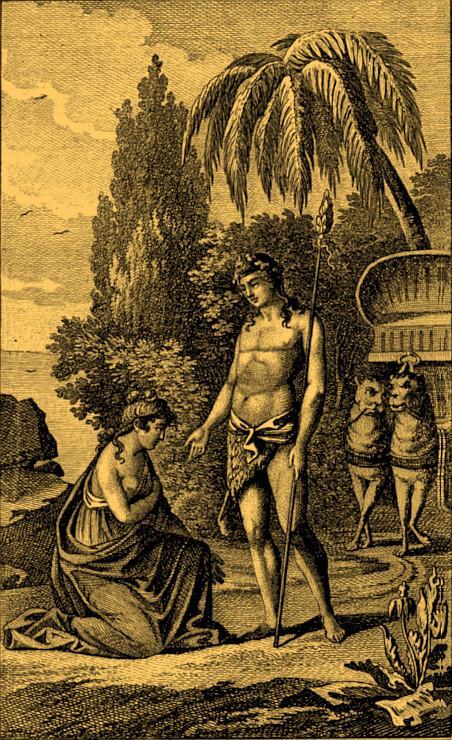
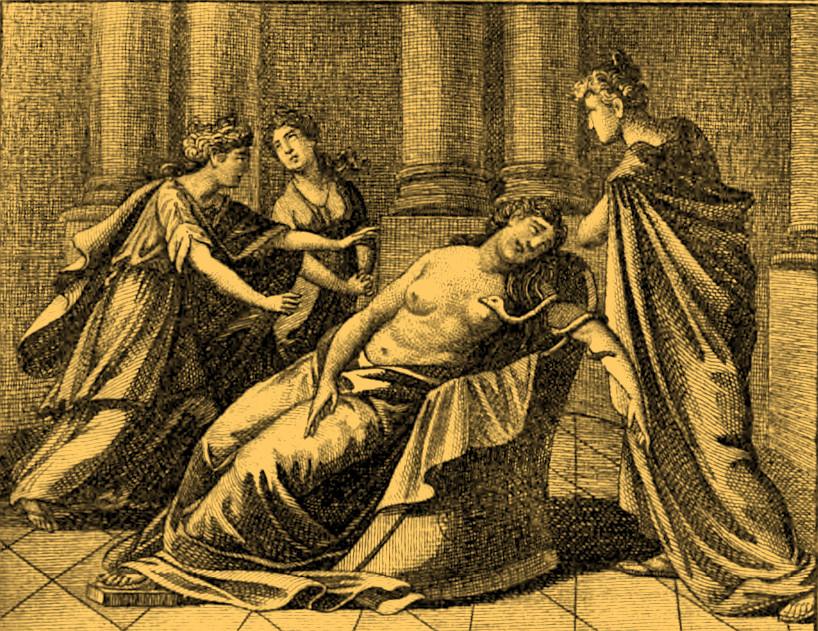
Wilhelm’s collection was reprinted in 1804 with a copper-plate frontispiece (Ariadne) and title vignette (Cleopatra), Gedichte (Vienna, Prague 1804):
[6] Friedrich never finished the continuation to Lucinde. Back.
[7] The fifth issue of Athenaeum, the penultimate issue overall and the first of 1800, appeared at the beginning of April 1800. Back.
[8] The Allgemeine Literatur-Zeitung did not publish any more reviews of Friedrich’s works. Back.
Translation © 2014 Doug Stott