
258q. Dorothea Veit to Schleiermacher in Berlin: Jena, 10 March 1800 [*]
Jena, 10 March 1800
Whoever would have told me earlier that Veit going out of town on a trip would one day be unpleasant to me, — well, that time has now come and taken its revenge. [1]
This trip is surcroit de confusion! [2] What in the world? did he have to go out of town just now? Listen, you know that Veit promised me he would pay Fichte the 6 louis d’or, do you not? I told Fichte and tried to exchange the assignation addressed to Mendelssohn for one to Veit, but he declined, thinking it unnecessary, since he himself intended to present it to Veit in Berlin.
But now he is not yet going to Berlin and has instead sent the assignation to Fessler for the second time without saying anything to me about it, and he, of course, sends it quite correctly directly on to Mendelssohn again, and it is declined for the second time and for the second time comes back to me, to my great shame! —
I wrote immediately to Veit to send these eternal 6 louis d’or to Fessler for a receipt, and at the same time told Fichte that I had written to Veit and that it would definitely be paid to Fessler; he made arrangements accordingly and wrote to Fessler in that regard. And now I receive news that Veit never even received my letter! Only imagine the confusion now!
I am expecting Fichte to send it to me again at any moment because Fessler will no doubt write and tell him that he has not received the money! So now I have written Mendelssohn and told him he has to pay the 6 louis d’or. Should Mendelssohn not believe me, you can attest that Veit did indeed promse me he would do it. But I should not expect such brutality from him! —
But if in this wretched period, as may well happen, Satan should be toying with us and Mendelssohn also be out of town, then let me ask that you ask my brother Abraham for advice; he can and must help me. He should simply open my letter to Joseph, he will then doubtless see he will be risking nothing, and that everything is in order, he can, after all, have the 6 louis d’or withdrawn either from Mendelssohn’s or Veit’s comptoir; in a word, just consult with him, he will surely not leave me in such an embarrassing position and expose me to such shame in front of Fessler.
But if this, too, should not work, should Abraham either not be there or enfin [3] . . . then please be so good as to take the 6 louis d’or from the Athenaeum money; [4] Fessler must be paid soon.
But I still hope to God it will not be necessary to pull this short sheet from this end as well; surely one of my brothers will be there. And after all, it is only a small favor, basically just an advance until 1 May! for you cannot imagine how distressed and short on money we are here just now! Wilhelm is being quite big about it, and will continue to give as long as he can, but how much longer can this go on? he, too, is beginning to run low. —
God, my dear friend, please excuse my confused and brusque style! — it really is just so hard! Let me get myself together a bit before I continue writing. [5] — —
Well, my dear Schleiermacher, my thoughts are that you should not think about it any longer, but only go ahead and borrow the money from Veit! — I hope you will trust me, namely, that were I not convinced you could do it honorably and with a good conscience, I would absolutely not ask you to! —
You believe that Veit would not fail to realize for whom you are asking it? Well, what does that hurt? He will not deny it to you, since your credit is in good standing with him, and he is always glad to do favors of this sort for reliable people; and since you are standing surety for it, it is of no import to him for whom it is really intended. After all, as Friedrich’s friend, you have absolutely no reason to deny you are doing him this favor.
And do you think that Veit would be so mean as to decline under this pretext? You can be sure he will not do that. To the contrary, I myself would be glad to ask for such a loan from him without fear of a refus, but with the one difference in our circumstances: what you can quite legitimately ask as a friend for a friend, I cannot really do without appearing somewhat brazen.
In a word, dear Schleiermacher, I am convinced you can do it! —
But what will come of all this, will he assign you money? for who knows when he will be returning? and we must pay Madam Lange? [6] The Athenaeum money will not be enough by far, even if Bütow [7] waits; here you are quite right, namely, that the latter must wait! but then what? Wilhelm, who has taken over the business side of Florentin, [8] absolutely does not want to ruin his excellent credit with Unger, and does not want to accept any money until the thing is printed! and yet Madam Lange must have her money next month!
And for the following reasons I do not think it good to write to Mlle. Levin for the 100 rth.: first, I promised it to her quite definitely for Easter, and also arranged the exchange thus, since she herself could not give it to me, so she found a source that is no more spotless and probably no more genteel than my own with Madam Lange, so if I now ask her for a postponement, she will have to soil herself anew for me, which is why I really do not want to importune her with it, I know she had to put up with considerable unpleasantness at the time for my sake; and then I must also pay 10 per cent interest there for six months, whereas we only give Veit 5 per cent for the whole.
During these current six months I have, in this emergency situation, had to bite into a quite sour apple; but if possible, by any possible means, I really would like to save this 15 per cent, that is our concern, my dear friend! — God knows when I can pay Mlle. Levin, since I cannot draw the money from Unger until it is finished! and if my poor head must be so laden with worry, then I myself am curious to know how it can be done, for I can think of absolutely nothing but money. One thing that has hindered me this past week is that Caroline has been sick with some sort of nervous fever; so I must spend a lot of time with her. And in general
'Tis all a topsy-turvy whirl,
Mouse-droppings, coriander all in a swirl. [9]
Though I will say that the primary source of confusion does not really bother me much now, I merely watch calmly from afar, treated quite well by both parties and generally respected; [10] I only wish the snow were gone, and Caroline healthy again, what an enormous disruption! And Tieck, too, is still sick, and lame; [11] and in the republic of despots, by the way, the Tiecks are the outlaws. [12] . . .
Notes
[*] Sources: Aus Schleiermacher’s Leben 3:159 (frag.); Briefe von Dorothea Schlegel an Friedrich Schleiermacher 41–45; KGA V/3, 415–20; KFSA 25:69–72.
Dorothea spends the first several pages of this letter talking about her and Friedrich’s financial problems; although a great many other letters might be adduced as well in this regard, I am including this particular, admittedly lengthy and certainly tedious discussion as, unfortunately, representative for much of Dorothea and Friedrich’s correspondence with Schleiermacher during this period, and to demonstrate the financial tension that had begun to plague the couple during what was already becoming a difficult winter in Jena among the group. Back.
[1] Dorothea did not enjoy satisfactory marital circumstances with Simon Veit; the implication here is that during their marriage, she was always happy to have him go out of town (Daniel Nikolaus Chodowiecki, Überdruss / Ennui [1788]; Herzog Anton Ulrich-Museum; Museums./Signatur DChodowiecki AB 3.771):

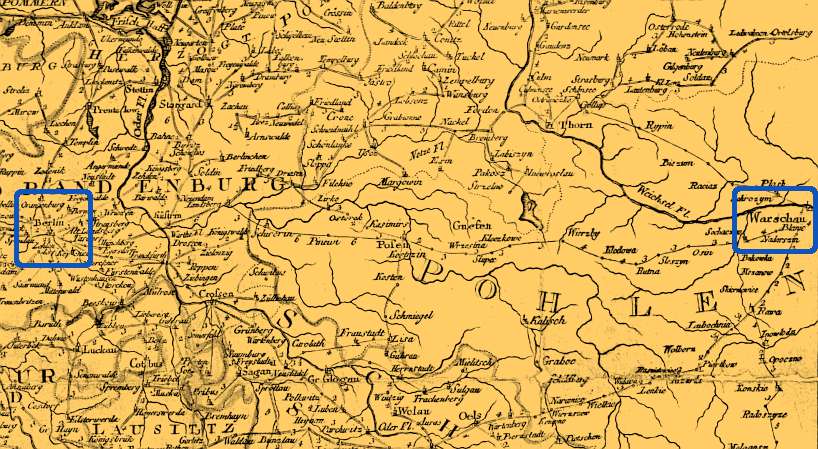
In any event, Simon Veit, was away from Berlin at the time on a lengthy visit to Warsaw (KFSA 25:426fn1) (Post Karte Durch ganz Deutschland, ed. J. Walch [Augsburg 1795]):
Concerning the advance Dorothea wanted Schleiermacher to secure from Veit, see her letter to Schleiermacher on 14 February 1800 (letter 258m). Back.
[2] Fr. “surplus of confusion.” Back.
[3] Fr., here: “in a word, in short.” Back.
[4] Schleiermacher was taking care of the business side of Athenaeum in Berlin. Back.
[5] KFSA 25:427fn14: “In what follows the ductus of Dorothea’s handwriting becomes smaller and calmer; she has gotten herself together.” Back.
[6] Otherwise unidentified woman in Berlin to whom Dorothea owed money; see her letter to Schleiermacher on 14 February 1800 (letter 258m). Back.
[7] Berlin merchant. Back.
[8] Dorothea’s still unpublished novel, Florentin. Ein Roman herausgegeben von Friedrich Schlegel, vol. 1 (Leipzig 1801). Back.
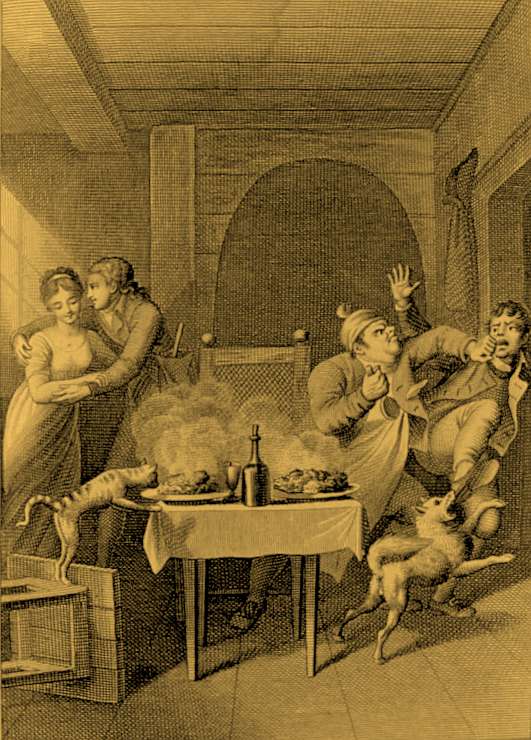
[9] Illustration: Frey, Babioles Lithographiques no. 3 [ca. 1850]; Herzog August Bibliothek; Museums./Signatur Graph. C: 319c):

The verse extract is from Goethe’s short satirical play “Ein Fastnachtsspiel, auch wohl zu tragieren nach Ostern, vom Pater Brey, dem falschen Propheten. Zu Lehr, Nutz und Kurzweil gemeiner Christenheit, insonders Frauen und Jungfrauen zum goldnen Spiegel,” in Neueröfnetes moralisch-politisches Puppenspiel (Leipzig, Frankfurt 1774), 43–68, here 57–58; the play satirizes Franz Leuchsenring, who once tried to press his attentions on Caroline Falchsland, Herder’s fiancée, during Herder’s absence; the passage evokes an image of general discord between neighbors and relatives (Taschenbuch für das Jahr 1818: Der Liebe und Freundschaft gewidmet; Inhaltsverzeichnis deutscher Almanache, Theodor Springmann Stiftung):
A wealthy, noble man am I,
With money, goods, high as the sky,
The most comely villages to give the eye.
Yet do I lack the proper man
To govern all this as he can.
'Tis all a topsy-turvy whirl,
Mouse-droppings, coriander all in a swirl.
Neighbors live in quarrel and strife,
'Tween brothers of old: disharmony rife,
Maids a-sleeping with knaves of low life,
Children putting the parlors awry,
I fear, I fear the Last Judgment is nigh. Back.
[10] The “primary source of confusion” was the tension between Friedrich and Caroline because of her relationship with Schelling, and the reaction to that tension and relationship on the part of the others in the group, including the Tiecks (Taschenbuch für das Jahr 1825: Der Liebe und Freundschaft gewidmet; Inhaltsverzeichnis deutscher Almanache, Theodor Springmann Stiftung):

[11] Concerning Ludwig Tieck’s gout, see Wilhelm’s letter to Goethe on 28 February 1800 (letter 258o). Back.
[12] Concerning the “republic of despots,” see Dorothea’s letters to Schleiermacher on 16 January and 14 February 1799 (letters 258g, 258m). Dorothea wrote the word “outlaws” in English. Back.
Translation © 2013 Doug Stott