
• 237c. Friedrich Schlegel to Auguste Böhmer in Jena: Berlin, June? 1799 [*]
[Berlin, June? 1799]
Dear Auguste,
|643| Tell your mother that the Tiecks will be departing here in 8 to 12 days. More details soon.
As far as we are concerned, we are now firmly resolved to spend the winter in Jena, and it may happen that if all of you do not come here, I may send Dorothea to you there 4 to 6 weeks earlier than I myself come, as soon as an appropriate opportunity presents itself to get to Leipzig. [1]
Listen, why are you not writing me at all anymore? — Steffens has spoken to us (not for a long time) in a dream. [2] Has he written to all of you there?
|644| Henriette writes me much more often than you do. She is doing well and poorly and so-so, sometimes this way, sometimes that. [3] Yes, yes, so it goes in this world, and whatever one shouts into the forest is exactly what echoes back; nor is that necessarily the last we have heard of it, for much can still happen. [4]
Are you reading Don Quixote diligently? [5] If ever we perform it, you must definitely play the part of cruel Mariolla. [6] I possess the most appropriate disposition for Cardenio, especially when he is mad. [7]
Stay well and please finally write. Dorothea sends her regards.
Friedrich
Notes
[*] Source: Schmidt (1913), 1:643–44 (letter 31); Waitz (1871), 1:374; reprinted in KFSA 24:290. — No date in Schmidt (1913); approximate dating from KFSA 24:463n179.1 based on Friedrich’s reference to Ludwig Tieck’s departure from Berlin for Johann Friedrich Reichardt’s estate Giebichenstein near Halle; Amalie Tieck and Johanna Reichardt were sisters. Tieck would take a side trip to Jena in mid-July. — Concerning the textual history of Friedrich Schlegel’s letters to Auguste Böhmer, see supplementary appendix 181d.1. Back.
[1] Friedrich would arrive in Jena on ca. 2–5 September 1799, Dorothea on 6 October 1799 with her son Philipp Veit (Post Karte Durch ganz Deutschland, ed. J. Walch [Augsburg 1795]):

[2] Concerning Henrik Steffens in Berlin, see Friedrich’s letter to Wilhelm and Caroline in May 1799 (letter 237).
The words “Steffens has spoken to us (not for a long time) in a dream” allude to the song (described as a Romanze for bass voice) “Zu Stephen sprach im Traume” from the operetta Der Irrwisch, oder endlich fand er sie, by Christoph Friedrich Bretzner (1748–1807), published in Bretzner’s collection Operetten (Leipzig 1779), “music by Preu”; also composed by Ignatz Umlauff (Vienna 1782).
Piano variations on the melody were composed by Christian Heinrich Rinck in Darmstadt and Anton Eberl in Vienna, the latter of whose variations were long attributed to Mozart. Max Friedlaender, Das deutsche Lied im 18. Jahrhundert: Quellen und Studien, vol. 2, Dichtung (Stuttgart, Berlin 1902), 469, published Umlauff’s variation of the song, the melody to which was allegedly popular well into 1850s and was the most popular tune from the operetta; Friedrich was likely familiar with this version:
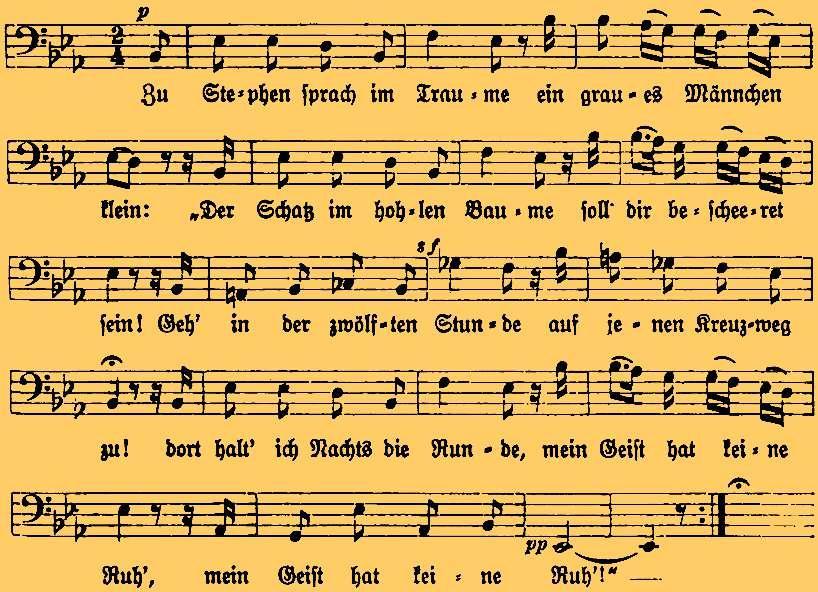
(Approx. rendering: “A little gray man spoke to Stephen in a dream: ‘The treasure in the hollow tree is to be given to you! Go in the twelfth hour toward that crossroads! there each night I walk my rounds, for my spirit has no peace, my spirit has no peace.'” Back.
[3] In his undated letter to Wilhelm Schlegel and Caroline in May 1799 (passage not included in letter 237), Friedrich remarks that “we have not yet heard anything more from Henriette since Dresden” (see Henriette’s letters to Dorothea on 16, 18, 19 April 1799 [letters 230c,d,e]). Back.
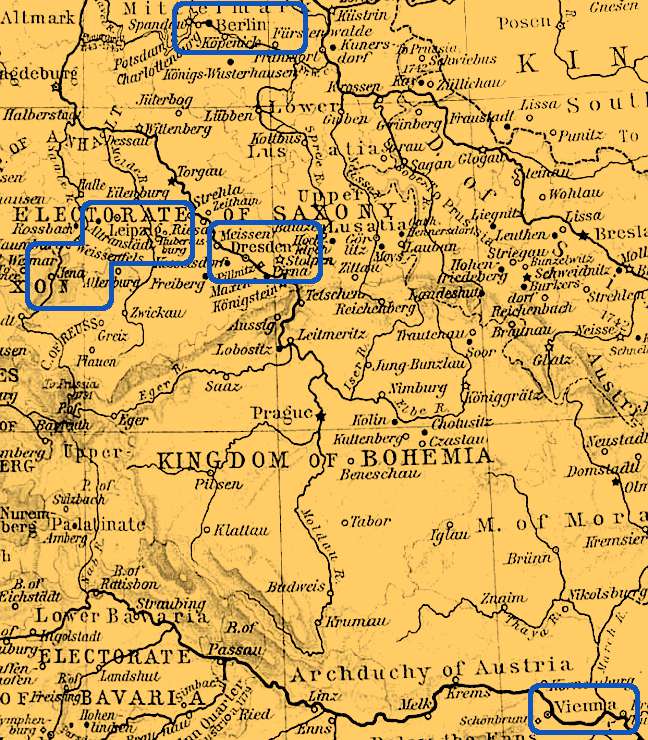
[4] Henriette was disappointed with her position in Vienna and left in 1801 (W. R. Shepherd, Historical Map of Central Europe about 1786 [1926]):
[5] Tieck’s translation of Cervantes; see Friedrichs letter to Auguste in February 1799 (letter 217a). Back.
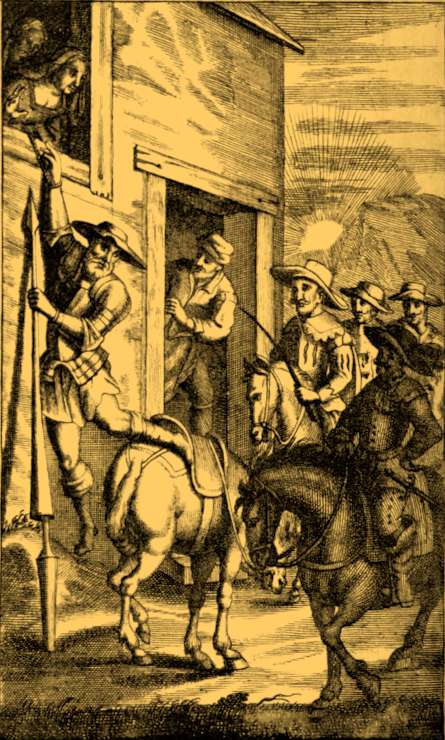
[6] See KFSA 24:463n179.2 (illustration: The History Of the most Ingenious Knight Don Quixote De la Mancha, rev. trans. of Thomas Shelton by John Stevens, 2 vols. [London 1706], vol. 1, plate following p. 350):
No “Mariolla” appears in Don Quixote. Friedrich Schlegel is probably thinking of the ugly Asturian maid in the tavern, who in Cervantes bears the name “Maritornes,” and in Tieck’s translation “Maritorne.” She appears first in part 1, chapter 16 (in Tieck’s edition: in book 3, chapter 2). In chapter 43 (Tieck: book 6, chapter 2), she hangs Don Quixote on a doorknob when he solemnly offers her his hand.
For the text of this piquant scene in Don Quixote and an illustration, see supplementary appendix 237c.1. Back.
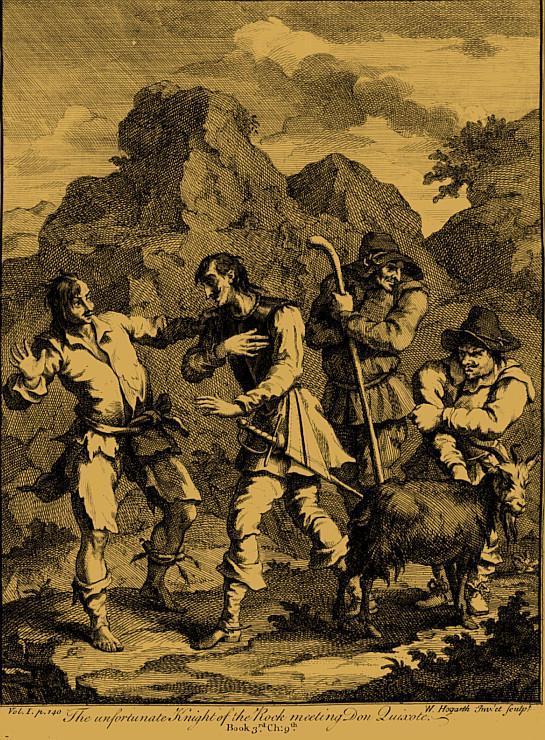
[7] In Don Quixote, part 1, chaps. 24–28, “Cardenio is the Ragged Knight, who, driven mad by the loss of his loved Lucinda, haunts the Sierra Morena and is eventually reunited with her” (Oxford Companion to English Literature, ed. Margaret Drabble [Oxford, New York 1998], s.v. “Cardenio”; here: William Hogart, The unfortunate Knight of the Rock meeting Don Quixote [ca. 1726–56]; The Trustees of the British Museum; Museum no. Cc,2.249):
Translation © 2013 Doug Stott