
• 121. Caroline to Friedrich Wilhelm Gotter in Gotha: Mainz, 18 March 1793
Mainz, 18 March [17]93
|281| A few days ago I related my travel arrangements to dear Mother Schläger [1] — shortly thereafter I received your letter, which offered me the pleasant prospect of not being received badly at all by my friends. Because I am so in need of this comforting prospect in parting from this area, let me offer you twice the heartfelt gratitude for it. Blessed those fortunate enough to find such a place of refuge!
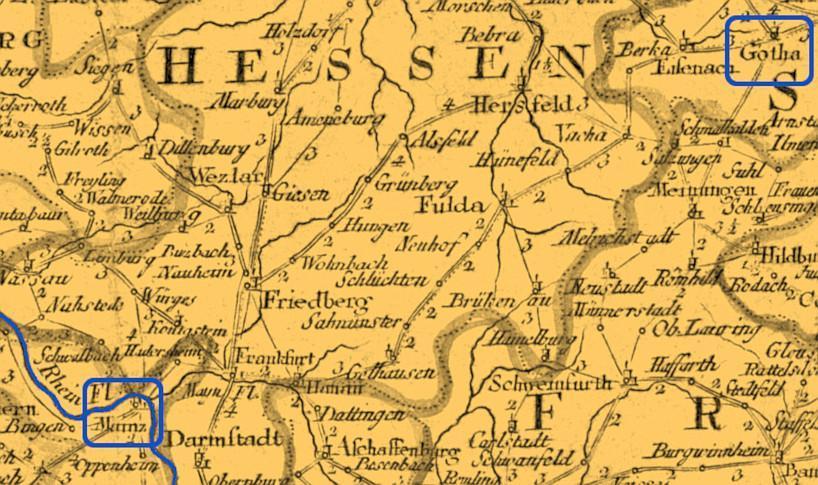
Although my journey will be quite difficult — I nonetheless hope to get through it by the most straightforward route possible. A large portion of my hope is resting on a carriage that comes from Gotha — should the Frankfurt fair not facilitate this project? [2] —
If I wanted to go by way of |282| Mannheim, nothing would be easier than to get a passport — it is only that I would like to spare myself the detour. For that, a passport from Braunschweig would have been necessary — we will have to try different means now, and then I will tell you of all my adventures. My name has been proscribed [3] — of that I am aware — it is good that I did not bring this curse down upon it myself, since not every curse is as dignified as the next.
Let me embrace all my friends in anticipation, and you two especially with heartfelt gratitude. Although I am not planning on imposing on your hospitality for very long, I greatly appreciate the service you are rendering to me by taking me in for the first stage.
Caroline B.
Notes
[1] Caroline was planning to leave Mainz and travel to Gotha, possibly by way of Mannheim. Concerning those plans, see Erich Schmidt’s introduction to Mainz, note 5. Caroline’s general plan was to reach Gotha by the most direct route possible (Post Karte Durch ganz Deutschland, ed. J. Walch [Augsburg 1795]):
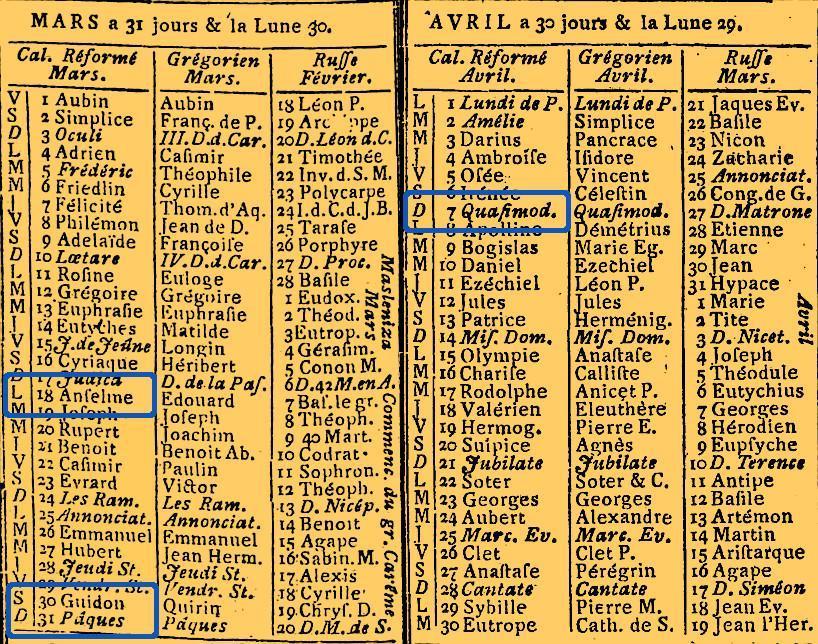
[2] Caroline, writing on Monday (L[undi] on the calendar below), 18 March, is presumably referring to the Frankfurt book fair, which after 1706 began on the first Sunday after Easter (quasimodogeniti). Pâques, or Easter Sunday [D[imanche] on the calender below), fell on 31 March in 1793, quasimodogeniti on 7 April, less than three weeks after Caroline is here writing. As it turned out, Caroline was unable to make the journey — “by the most straightforward route possible” — in that carriage from Gotha, departing instead on the Saturday (S[amedi]) before Easter, 30 March (Almanac de Gotha Pour l’année 1793 [Gotha 1792]):
[3] Because of her alleged association with the events in Mainz (coincidentally, the Rheinish German National Assembly had established the breakaway Mainz Republic the day before this letter) and with the family of Georg Forster, who the day before had been elected vice president of the Jacobin Club, which he had joined in November 1792.
He himself would be leaving Mainz a week later (25 March 1793) for Paris, where he would present the Mainz Republic’s petition for incorporation into the French Republic. Emperor Franz II had already imposed an imperial ban on Forster, according to which anyone encountering him on his way to France and delivering him over to the Prussians would received a reward of 100 Ducats.
Whether Caroline had already also been incorrectly identified as the wife of her brother-in-law Georg Wilhelm Böhmer, however, is not clear but certainly possible given her next sentence. Back.