
111b. Friedrich Schlegel to Wilhelm Schlegel in Amsterdam: Leipzig, 11 February 1792 [*]
Leipzig, 11 February 1792
. . . I wish you would reconsider all your earlier plans — the narrative on Dante — the tragedy [1] Ugolino — the tragedy Cleopatra — the essay on atheism. [2] — Perhaps then you will find yourself in a better mood. Even though love cannot be coerced, I do not believe that everything depends so completely on the grace of God, or that arbitrary volition is completely incapable of accomplishing anything.
As far as your prose style is concerned, [Caroline] B[öhmer] is correct insofar as it is not always the same. Your essay on “Das hohe Lied,” on the “Künstler,” and finally on Dante are all different, [3] as are even your letters as well. Your mode of speaking adjusts itself to the subject matter quite closely, powerfully striding forward with your own spirit. [4] Far be it from me to view that as a shortcoming. Many of the greatest writers have taken the same path. Your style is characterized by excellent periodic structure, subtle selection, and ingenious ideas. The only things one might perhaps criticize are the excess of foreign words and expressions and lack of succinctness here and there. . . .
Notes
[*] Sources: Walzel, 36–37; KFSA 23:42. Back.
[1] Germ. Trauerspiel, whose translation has lately undergone discussion, being variously rendered as mourning-play or lament-play, or left untranslated. See, among a host of others, S. Brent Plate, Walter Benjamin, Religion, and Aesthetics: Rethinking Religion through the Arts (New York 2005), 41–45. Being less concerned with genre-specific distinctions here, and as such are generally not under discussion in these texts, I am generally translating the term with the traditional, if not always entirely satisfactory term “tragedy.” Back.
[2] Wilhelm had apparently been experiencing doubts concerning his own literary capabilities. Concerning the pieces mentioned: “Dante. Über die göttliche Komödie,” eventually published in Gottfried August Bürger’s Akademie der schönen Redekünste (1791) vol. 1, no. 3, 239–92 (Sämmtliche Werke 3:199–381); anticipated plays on Ugolino (in Dante’s Inferno, Canto 32, lines 21–25) and Cleopatra; the essay on atheism was never finished. Back.
[3] Wilhelm reviewed Gottfried August Bürger’s “Das hohe Lied der Einzigen” in the Neues deutsches Museum 2 (1790) 205–14; 306–48, and Schiller’s “Die Künstler” in the Akademie der schönen Redekünste (1791) vol. 1, no. 2, 127 (Sämmtliche Werke 7:3–23). Back.
[4] Here as an example the initial lines of Wilhelm’s review of Gottfried August Bürger’s “Das hohe Lied der Einzigen,” mentioned above, Bürger’s paean to his deceased second wife, Auguste, née Leonhart, who had died in childbirth in January 1786.
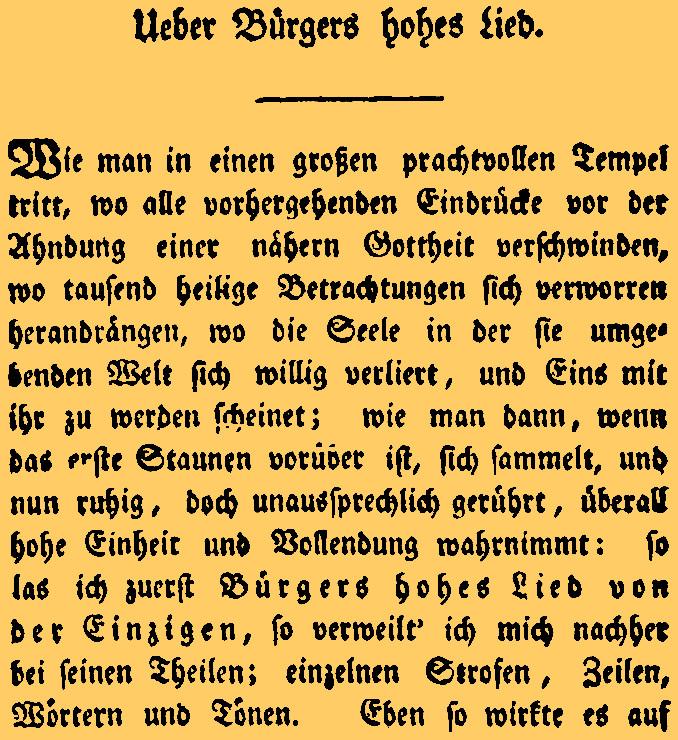
As if entering a grand, magnificent temple where all previous impressions recede before the intimation of more proximate deity, where a thousand confused, sacred impressions surge forward, where the soul voluntarily loses itself in its surroundings and seems to become One with them; and then, when the initial astonishment has passed, one collects oneself and, calm and yet inexpressibly moved, everywhere perceives sublime unity and perfection: thus was my first reading of Bürger’s paean to his beloved, his Hohes Lied von der Einzigen, thus did I afterward linger with its various parts, its individual stanzas, lines, words, and tones. Back.
Translation © 2011 Doug Stott