
• 101. Caroline to Franz Oberthür in Würzburg: Marburg, 22 March 1791
Marburg, 22 March [17]91
|212| I am so ashamed, esteemed sir, for having waited to be prompted to demonstrate to you that I was only too pleased to have contributed even a little toward providing one more pleasant resting place in your room for your eyes — that any words of gratitude on your part are utterly superfluous. You can easily guess the source of that prompt. — Mademoiselle Robert [1] related to me a letter from you attesting to me your beneficence from more than one quarter and bringing back all sorts of memories.
The period of my happy, unconscious youth during which I first made your acquaintance quickly made the connection with the present situation destiny has assigned me, a destiny rich in the many rather bitter experiences I have had in the meantime, many of which were visible to the world and not a few of which necessarily escaped its view. When I compare the kind of reflection of which my intellect is now capable with that former untroubled cheerfulness — I could easily become melancholy — but I do not! I became poor in hopes before I had hardly even begun to entertain them — but I will never be poor in serenity, since the source from which my activities and interests flow is inexhaustible, and because I have abandoned the kind of stubbornness that thinks it can find happiness along only one path.
You have probably had no dearth of news from Göttingen, |213| and I can imagine you found the news concerning Less no less gratifying than did his other friends. [2] His transfer has removed him from an ambiguous position and enabled him to look forward to a more peaceful old age. One extremely difficult aspect of the estate of the professor is that they run the risk of outliving their own fame despite their unquestionable and useful accomplishments, and often without being even the least bit culpable in causing that situation through neglect or slackening — a situation quite difficult for the affected individual even though I do understand that in the larger sense it likely cannot and must not really be any other way. [3]
Each person contributes as much as he can to advance the whole — though that which exhausts an individual person’s capacity is not for that reason also the limit of the demands of the whole, the limit neither of just demands nor even of those that the mere desire for novelty and change generate. — Spittler’s household was recently in a sad state of mind — though I now hear that his wife is out of danger. [4] — Meiners gets ever more deeply entangled in hypotheses while simultaneously presenting ever weaker proofs for them.
Among more recent books, Forster’s Ansichten has doubtless given you much pleasure. [5]
As for a report on Marburg itself — let me leave that for your correspondent Mademoiselle Marie, [6] who is more indigenous here than I and who participates more directly in its life and activities, which genuinely seem to have acquired a bit more spirit since the amateur theater was introduced. [7] I am also glad to yield to her because I am quite fond of her and am happy to give her the chance to entertain you a bit. . . .
My brother is keen that I pass along his regards to you, and may I also request the continuation of your remembrance, whose value I believe I can justifiably claim to appreciate.
Caroline Böhmer
Notes
[1] From the family of Karl Wilhelm Robert. Presumably also the “Mademoiselle Marie” mentioned at the end of the letter. Back.
[2] Gottfried Less became court preacher in Hannover; unfortunately, his wife would die there on 30 November 1791. Back.
[3] Caroline had recently found that her own father had slipped into this situation; see her undated letter to Philipp Michaelis from late 1790 (letter 99). Back.
[4] Uncertain reference, though Spittler’s daughter Christiane Friderike Spittler, born on 20 January 1776, would die on 9 August 1791, presumably on a trip she and her parents took to Stuttgart, since that is where she is buried. Back.
[5] Georg Forster, Ansichten vom Niederrhein, von Brabant, Flandern, Holland, England und Frankreich im April, Mai und Junius 1790, 3 vols. (Berlin 1791–94), the fruit of an extended journey he took with the young Alexander von Humboldt. Here the frontispieces to vols. 1 and 3 (1791, 1794):
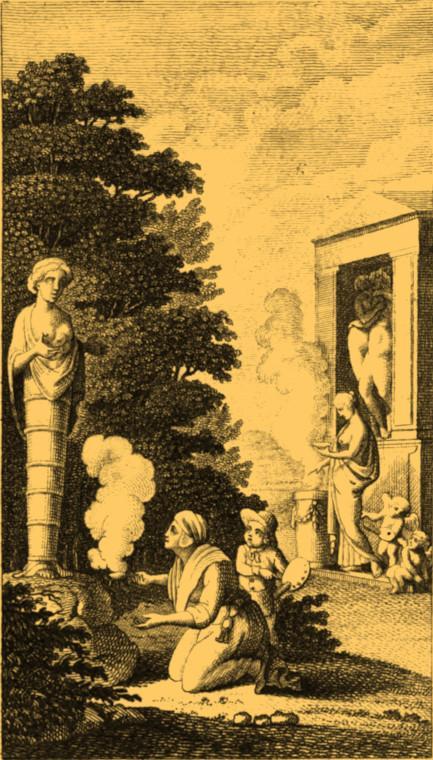
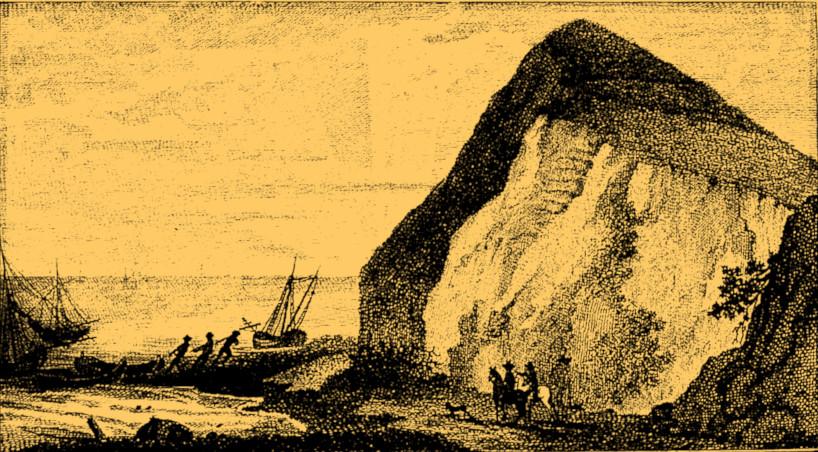
Forster’s book represents one of the literary antecedents of Wilhelm Schlegel and Caroline’s considerations of the plastic arts in their dialogue “Die Gemählde. Ein Gespräch von W.,” in Athenaeum (1799) 39–151. Forster’s descriptions and impressions of specific paintings that he viewed during the trip include several also discussed in the Athenaeum piece, and in fact deviate in their assessment of, e.g., the style of Rubens, from what for Forster are its earthy realism and colors, on the one hand, while yet largely concurring with them with respect to Raphael’s more noble and sublime style in the rendering of religious themes, on the other. Forster comes to view the latter, much as does Die Gemählde almost a decade later, increasingly as an intermediary between art and religion. See esp. Margaret Soljar, Athenaeum: A Critical Commentary (Bern, Frankfurt 1973), here 57–56.
Forster also, however, and not incoincidentally, mentions his earlier encounter with Raphael’s Sistine Madonna in Dresden, a painting the Romantics similarly viewed and which constitutes the high point and culmination of the later dialogue Die Gemählde (Georg Forster, Ansichten vom Niederrhein [Berlin 1793], 1:152):
In Dresden I saw Raphael’s grand treatment of this subject. There it is the queen of heaven who returns to the throne that is her true possession. Rather than merely hovering, she simply stands, more reflective than cheerful; the Divine is departing this world to which she never belonged. Back.
[6] Presumably the “Mademoiselle Robert” mentioned earlier in the letter. Back.
[7] A correspondent from Giessen reports on 13 March 1778 (Theater-Journal für Deutschland [Gotha 1778] no. 6, 101):
Since even Marburg now has its own amateur theater, directed by Herr Professor Luetius [correct: Curtius], our students, too, wish to avoid getting too far behind. Hence the day before yesterday a modest stage was opened in connection with the Brandes Tavern in our university building. The group’s first attempt was quite properly done.
Another or the same correspondent then writes again from Gießen in 1779 (Theater-Journal für Deutschland [Gotha 1779] no. 9, 74) that, as a matter of fact, the amateur theater in Marburg mentioned earlier had been prohibited after only two performances (cited in Anne Fleig, Handlungs-Spiel-Räume: Dramen von Autorinnen im Theater des ausgehenden 18. Jahrhunderts [Würzburg 1999]; also diss. Marburg 1997). The background to Caroline’s reference to the reestablishment of this amateur theater is uncertain. Back.
Translation © 2011 Doug Stott