
G. P. Gooch, Germany and the French Revolution (London 1927)
Introductory Paragraphs to
Chapter 1: “Before the Revolution,” 1–4
During the years immediately preceding the French Revolution Germany presented a curious spectacle of political decrepitude and intellectual rejuvenescence. The Holy Roman Empire, in regard to which Voltaire caustically inquired in what respect it was holy or Roman or an Empire, was afflicted with creeping paralysis. Its wheels continued to revolve; but the machinery was rusty and the output was small.
“The Holy Roman Empire, / How does it hold together?” shouted Goethe’s revellers in Auerbach’s Keller [in Faust]. “No [Marcus] Curtius,” remarked Justus Möser in 1781, “leaps into the abyss for the preservation of the Imperial system” — a system which offered no security against foreign invasion or civil war, and which had long ceased to command the respect either of its own members or of the world. Germany, cried Friedrich Karl Moser [1723–98] in the bitterness of his heart, is a great but despised people. Every nation, he added, had a governing principle. In England it was liberty, in Holland trade, in France the honour of the King, while in Germany it was obedience. Many a pamphleteer lamented the anaemia of the Fatherland; but not one of them could produce a restorative. The Imperial system was the consecration of anarchy, and Germany was racked by an incurable particularism. “In my childhood,” wrote Wieland,
I was told a great deal about duties; but there was so little about the duty of a German patriot that I cannot remember ever hearing the word German used with honour. There are Saxon, Bavarian, Frankfurt patriots; but German patriots, who love the Empire as their fatherland, where are they?
The Empire, in fact was not even German. The King of England was a member as Elector of Hanover, the King of Denmark as Duke of Holstein, the King of Sweden as Lord of Pomerania , while Belgium participated as an appanage of the House of Hapsburg.
In theory the Imperial crown was elective; but in practice it was found impossible to override the traditional claims of the Hapsburgs, as Charles VII of Bavaria and his champions learned to their cost in the war of the Austrian Succession. The Empire appeared to revive for a moment in the coronation pageantry at Frankfurt, when the Emperor received the homage of the Estates on bended knee and the herald brandished his sword towards the four quarters of heaven in token that all Christendom was subject to his sway; but in the eighteenth century it was nothing but a picturesque survival.
The Emperor was still the fount of honour; but, except for the grant of titles, his prerogatives had disappeared. As a German jurist aptly remarked: to prevent him from doing harm, he was prevented from doing anything. Such powers as he possessed he owed not to the crown of Charlemagne and [Emperor] Barbarossa [1122–90], but to the territories and resources of the House of Hapsburg. The Golden Bull of Charles IV limited the Electors to seven, three of whom were the Archbishops of Mainz, Cologne, and Trier. The secular princes were the rulers of the Palatinate, Bohemia, Saxony, and Brandenburg, to which Bavaria and Hanover were added in the seventeenth century.
The first in rank was the Elector of Mainz, the Arch-Chancellor of the Empire, who crowned the Emperor at Frankfurt. The legislative power was exercised by the Diet at Regensburg, to which ambassadors were accredited and from which the army of the Empire took its orders. Since 1663 it sat in permanence; but this change decreased instead of increasing its importance, as it was only attended by delegates- — and most members of the Empire never troubled to be represented.
It consisted of three Colleges, the Electors, the Princes (ecclesiastical and secular), and the Free Cities, sitting separately. If two Colleges agreed, and their wishes were sanctioned by the Emperor, the resolution became an Imperial law; but its execution depended on the separate decision of each separate unit, large or small, of which the Empire was composed.
(J. Walch, Neueste Post-Karte von Deutschland und dessen angrenzenden Laendern [Augsburg 1813 ])
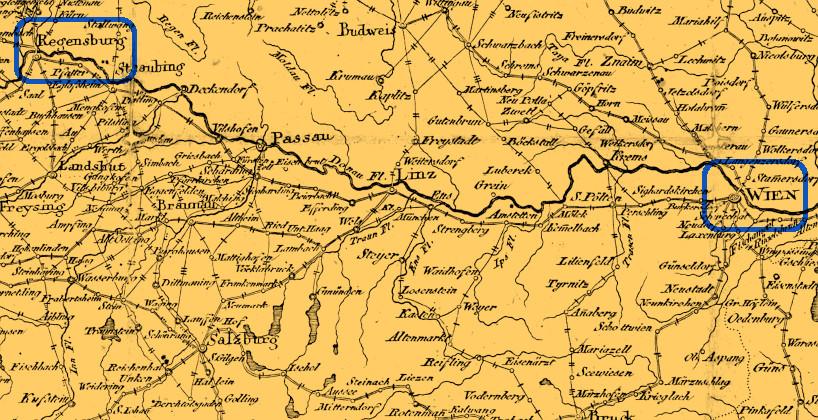
It was only at Regensburg that “Germany” could be found; but the significance of the Diet had waned with the strength of the Empire, and its time was largely wasted in solemn trifling and hoary pedantries. While the Emperor resided at Vienna and the Diet sat at Regensburg, the Supreme Court of the Empire was moved in 1693 from Speyer to Wetzlar [just north of Frankfurt am Main], a town which owes its later fame rather to Werther and Lotte [Goethe’s Die Leiden des jungen Werthers (Leipzig 1774)] than to its Imperial associations.
The Court had earned an unenviable reputation for venality and procrastination; and if a few petty tyrants were thwarted or punished by its decrees, it was too weak to strike at powerful offenders. Young jurists like Goethe spent a few months in the sleepy little town to learn the routine of the law of the Empire; but its prestige was impaired by the fact that most of the important cases were reserved by the Emperor for the usurping Aulic Council at Vienna.
In addition to the Emperor, the Diet, and the Court of Appeal, the machinery of the Empire included ten Circles, or administrative districts, created to counteract the dangers of excessive particularism by the formation of large groups.
[Map: Jakob Gottlieb Isaak Boetticher, A Geographical, historical, and political Description of the Empire of Germany, Holland, the Netherlands, Switzerland, Prussia, Italy, Sicily, Corsica, and Sardinia, trans. from the German (London 1800)]

Each Circle possessed a Diet and a Director, who commanded the troops, controlled the police, and provided for the execution of the Imperial laws. In the course of the centuries, however, great changes had occurred. The Circle of Burgundy had been swallowed up in France. Holland was free. Many territories, again, had become subject to members of the Empire — such as Hungary and the Polish provinces annexed by Austria and Prussia, which were not incorporated in the Empire.
On the eve of the French Revolution there were nine Circles: Upper and Lower Saxony, Austria, Bohemia, Bavaria, Westphalia, the Upper Rhine [Lower Rhine; see explanatory note], Swabia, Franconia. Differing widely in size and importance, they were alike in their invertebrate character. Prussia formed part of three Circles, while Swabia and Franconia presented a bewildering mosaic of petty principalities, ecclesiastical and secular. It was in these Circles of the lower and middle Rhine [sic] that the hundreds of Imperial Knights, who recognised no superior but the Emperor, exercised unfettered sway over their Liliputian territories. Western Germany was the classic land of duodecimo States, which afforded no foundation for healthy political life and offered a tempting prey to the sleepless ambitions of France.
Thus the Empire was a phantom, its machinery rotten and crumbling, its head a mere honorary president. Whatever shadowy sentiment of unity had survived the Wars of Religion and the Treaty of Westphalia, was destroyed in the prolonged duel of Frederick the Great and Maria Theresa; and the short but stormy reign of Joseph II showed that the Imperial dignity had sunk into the tool and plaything of the House of Hapsburg. Emperor and Empire were regarded as strangers, if not as enemies, in the larger States, especially in the Protestant North. So long as the Holy Roman Empire should continue to exist, Germany was condemned to remain a geographical expression.