
• 99. Caroline to Philipp Michaelis in Göttingen: Marburg, late 1790
[Marburg, late 1790]
|201| My dear Philipp, it would have meant a great deal to me had you occasionally written that I in my own turn might have answered you as well, since I always have one thing or another on my mind that I really would like to speak with you about and which I would prefer not simply to present so abruptly. But you dispense with me so curtly — or simply do not respond at all — that I am tempted to think you are indifferent to what I have to say. So let me ask you straightaway whether such is indeed the case.
That notwithstanding, today I must nonetheless — without worrying about whether anything other than my own frankness is lending emphasis to what I say — speak with you about some things I myself have already long come upon but for which I now also have a more specific occasion for mentioning.
There is so much goodness in you and my fondness for you so heartfelt that I cannot persuade myself to keep silent now that I think I have something of an overview of the path you are taking — your own self-esteem cannot wholly reject what is true in my assessment — and concerning that which may not be correct you can at least enlighten me.
So, first of all, my dear — they are complaining about you in our parental home — you have become so dry and monosyllabic with our father, and because our good mother is always trying to defend you, it puts her in an awkward, extremely embarrassing position. [1] What is getting in the way here — compulsion that cannot entirely be overcome and that is extremely oppressive without really being that noticeable — actually a nameless compulsion — I, of course, know it very well indeed, and am certainly taking it into account as well — but you could so easily adopt somewhat milder behavior considering you really are making people less than happy.
Our father is not very happy even as it is — he is so irritable, and his old age is becoming such a burden to him that the mere thought of contributing to the trouble he is already experiencing would terrify me. Consider for a moment this |202| man who has so utterly outlived himself, and precisely where he might yet find a measure of enjoyment — namely, in his children — what do they give him instead?
It is not within our power to give his heart and spirit the breadth and attentive concern through which we might draw him into our way of thinking and feeling and make ourselves of value to him — but it seems to me that we do owe it to ourselves to grant him at least a measure of childlike attentiveness and respect. It is the only thing with which we can reward him for all his worries and trouble, which are surely extremely laborious if not tender or commensurate with our way of thinking — and to reward him not at all or to wrong him outright is something we can desire all the less the more we realize how his horizon, like it or not, has been so obstinately or narrowly reduced, and that although we cannot expand that horizon, we certainly are able to cause him pain and leave him with a negative opinion of us.
Nor does he ask for much — and you, my good fellow, are offering nothing at all — you never even open your mouth — I am familiar with all this from my earlier experience there, and at that time, because there were more of us around, it was not so noticeable. Your inflexible nature refuses to venture even the slightest show of cordiality toward him — I can vividly imagine all the driving forces that have long been at work in making it so laborious for you to overcome your inclinations in that regard — but [they] certainly do not excuse your negligent omissions entirely.
Consider merely that you really are wounding him — and hurting Mother — and if you cannot bring yourself around in this sense, then at least give them some indirect reason for joy in you by being abidingly diligent. [2] No, no one has complained about you in this regard — but might you not perhaps be able to accomplish even more — might justified ambition and pride not perhaps drive you on even higher?!
On the whole, I fear your university studies were too sporadic — you even occasionally reproached yourself |203| on this point — You are perhaps still at the age when one can fill in gaps by rigorously applying oneself and can still impose order on what is otherwise disconnected — once this period passes, you run same the risk through which your brother here is perishing, namely, that of possessing fragmentary knowledge and of exhausting your intellectual talent in perpetually assessing and rejecting others without genuinely creating anything yourself.
I would choose a field and get to know it thoroughly — at least to a certain extent, one of our family weaknesses, though one not coming from Father, is to assimilate a great deal and then, after coming up with a few ideas of one’s own, to dispense with it. You would have to compel yourself to overcome that weakness — all distractions will flee — for you know yourself well enough to acknowledge how little you are able to resist those that are to your taste. Every hour is precious now — and determinative for your life, in which you surely cannot want to play an ambiguous role or end up standing essentially immobile at the beginning of your career with talents still undeveloped.
There really is nothing more wretched than such disconnection in a person’s train of thought — in knowledge — in all of one’s being — and those who merely criticize, something for which you have an extremely strong inclination, always believe very early on that they have already come a long way, and perhaps they have indeed in this particular art — but of what use is it to them? — what do they gain for themselves? — it is a negative accomplishment through which they merely skip all too lightly over what is positive — No — the youth should not judge before having created something himself and before having learned what it really means to create — such a person’s intellect engages this particular inclination to its own disadvantage in every sphere, including the social, where it becomes the critic of the flaws or merits of others without ever really adding anything through its own initiative; conversation becomes dull, inconsequential, and one is quite justifiably disinclined to excuse the inadequacies of those who act so superior |204| — and one is always inclined to ask, “Good friend, open up to us your own treasure, let us see how you are able to enchant and enlighten us!” Only an extremely high degree of merit indeed, or extremely amiable talents, can make one forget this person’s dismissive conceit — these are common truths — but do you understand them as they apply to you yourself?
You know, you have double reason to focus on the obstacles: you must forge a destiny for yourself in this world and as such be mindful not to forfeit, through your own folly, the opinion of intelligent persons — which here is just as surely lost as is that of stupid people. Your worth, my dear boy, is not for this luster — in pride you will miss precisely the destiny that such worth gives you — the love it always earns for you when that luster might not necessarily be visible. Your quiet modesty, the goodness, loyalty, and steadfastness, all of which become beneficently palpable to anyone who gets to know you better, win over hearts for you — but this gain will but bring you loss should you depart from that path.
It is basically undeniable that you have been spoiled by a certain measure of success — and quite early we sisters certainly contributed by supporting your small flirtations, disclosing others’ favorable opinions of you — by recommending you to our own girlfriends, and so on. For your age, you have already had too much to do with females [3] — your seeming sincerity attracts them — they become accustomed to you because of your domesticity and because you do not really put pressure on them, and they take up with you and accept you — in this sort of triumph, your vanity cannot really come to bear in any significant way — and yet it occupies you more than it should.
You have gotten to know amusement and, given the phlegmatic disposition of your physical constitution, you now avoid all the more facilely the strain of real work, allowing yourself to be distracted all too easily and failing to focus on it as what is in fact most important. |205|
If I understand correctly, you must now write a disputation; [4] let me urgently implore you to work on it as if it were a matter of life or death — it will succeed incomparably better than if you merely throw something together in flighty haste and then have a careful look at it only later. Do not let yourself simply be carried along, and instead engage all your powers in getting it going quickly and well.
Even if my request seems somewhat onerous to you now, I know for certain you will remember it from time to time and that it will serve to goad you on. In that way you will be able to balance things out.
[End of sheet.]
Notes
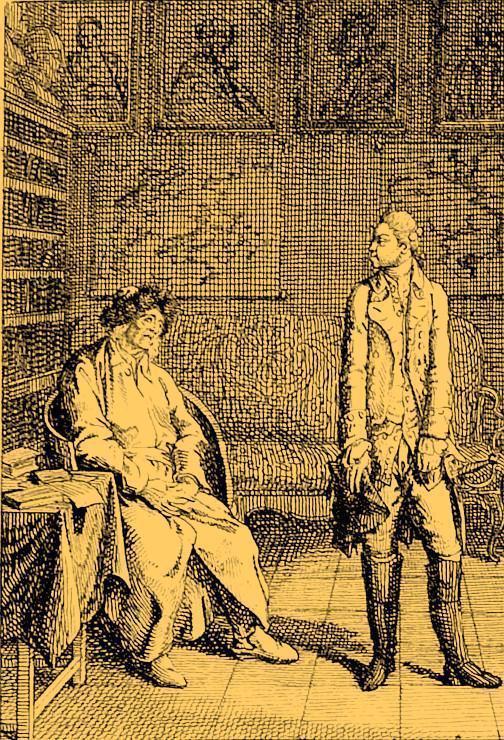
[1] Daniel Nikolaus Chodowiecki, O mein Sohn! Lasst uns aufheben heilige Hände, ohne Zorn und Zweifel [1776]; Herzog Anton Ulrich-Museum; Museums./Signatur DChodowiecki WB 3.17:
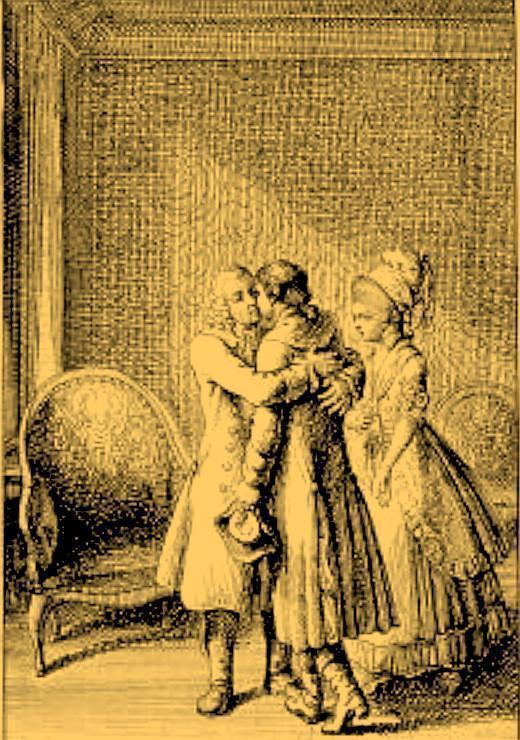
[2] Chodowiecki, Je suis ton père [1782]; Herzog Anton Ulrich-Museum; Museums./Signatur DChodowiecki AB 3.421:
[3] (1) Frontispiece to Carl Friedrich August Frh. von Lütgendorf, Karl von Dahlfeld der Jüngling, oder: der junge Herr und sein Hofmeister als Nebenbuhler (Munich, Leipzig 1788); (2) Göttinger Taschen Calender Für das Iahr 1798; Inhaltsverzeichnis deutscher Almanache, Theodor Springmann Stiftung:
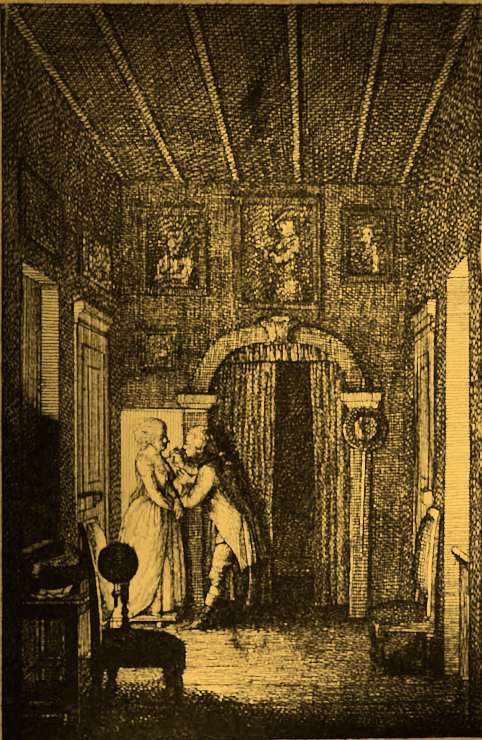
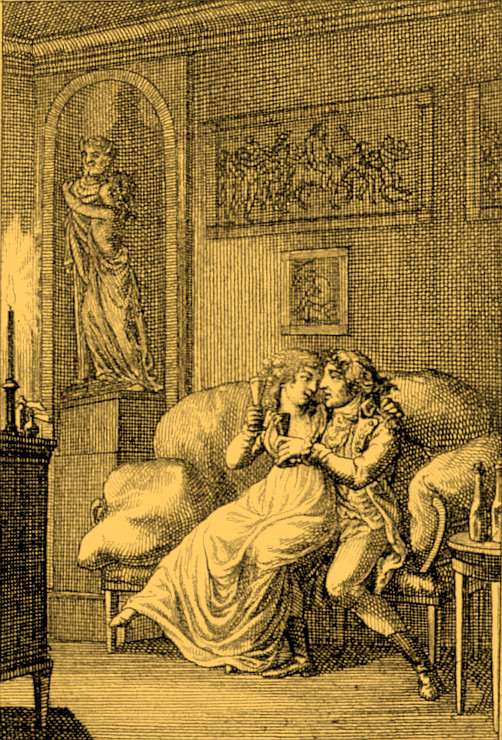
One of those “females” was Gottfried August Bürger’s third wife, Elise, née Hahn, an affair Bürger accused the Michaelis sisters of facilitating. Though Bürger did not marry Elise Hahn until October 1790, and Caroline is here writing in late 1790, Philipp’s relationship with Elise Bürger seems to have begun quite soon after the couple’s arrival in Göttingen, indeed as soon as two weeks after. For a fuller discussion, see Caroline’s letter to Philipp on 22 June 1791 (letter 102) and esp. supplementary appendix 102.1. Back.
[4] Philipp Michaelis took his examinations on 25 September 1790 in Göttingen and received his Dr. med. on 30 December, thereafter, as Erich Schmidt (1913), 1:689, remarks, acquitting himself quite well as both a physician and a human being.
Concerning Friedrich Schlegel’s later disputation in Jena, see Caroline’s letter to Wilhelm Schlegel on 26–27 March 1801 (letter 303), note 14, along with supplementary appendix 303.1. Back.
Translation © 2011 Doug Stott