
• 50. Caroline to Lotte Michaelis in Göttingen: Clausthal, 12 October 1784
Clausthal, 12 Oct[ober 17]84
|104| No matter how much or how long you speak to me about your pain, my dear girl, I am still at a loss as to how to respond, for your topic is inexhaustible and my consolation fruitless. Would you be satisfied were I simply to listen with silent empathy, asking you to continue for the sake of your own peace of mind, your own well-being, and to tell me every, even the most secret emotions in your soul, just as if you were speaking with yourself? [1]
It would do you so much good; the heart alternately fills itself up and then relaxes, breathing in freer air, purer air. Indeed, I almost envy you that innermost feeling of sadness that finds its sweetest reward precisely in its own laments, and your melancholy, enchanting melancholy, that shadow of the lost beloved that occupies us even more rapturously, more delicately than did even the beloved himself. [2] And behold how effortlessly true love dissolves into the enthusiasm of virtue, how gently it blends into the latter. Love can become the next step toward virtue.
But neither can I conceal from you, my dear Lotte, that |105| our ardent power of imagination often, indeed quite often mistakes its own object, chasing after the imaginary being it neither really sees nor distinguishes with full clarity, instead following its own dreams into the meadows of light and perfection and, faster than we might imagine, is awakened by the first object that nudges it. [3]
Although at this moment your own composure and your own disposition are just as they ought and indeed the only way they can be, will you be able to sustain the effort to make them permanent? It is incredible how subtly such a disposition eases off, how one tense emotion after the other gradually slackens, and how the vividly captivating, fresh imagery of our imagination becomes cloaked in soft haze. And will your most sacred resolution not also disappear along with that sense of enchantment?
Everyone knows how little idealistic virtue costs us; such virtue is a lovely but useless smoke contrivance that blazes up toward heaven in spectacular flames. But when the hour of temptation returns — a possibility you have probably not escaped for good — will it be enough to protect you — from the cliffs of vanity, from which you will have to escape through genuine action?
Now would be that hour when your own fire would prompt you, quite unconsciously, to act, except — as truly as you are a human being, things cannot remain so, which is why I implore you, my precious, beloved girl, to try not to sustain this fantasy, and instead summon all your powers of understanding to help you understand and vividly articulate those truths for yourself so that, when it does subside and abate, you are able to come away with something secure. Otherwise you will eternally remain the unhappy plunder of your own emotional susceptibility, the most miserable of creatures, constantly tossed to and fro by your own disposition.
Oh, my dear Lotte, that you might escape forever that greatest and most helpless of all torments, namely, not being at one with yourself! I need to let you know that, although for now your letters are being put away in sacred safekeeping, should you ever become unworthy of having written them, I will summon them as witnesses against you, witnesses before whom |106| I would rather flee to the ends of the earth rather than look them directly in the eye.
Yes, I will grant you your pride here; but you must also be worthy of having loved him and in that particular way. If genuine virtue ultimately be the fruit of that love, then with what bliss will you think back on this time, even though the same years during which youth inexorably fades away may also take that passion along with them.
Love is an early rose,
That blooms but in life’s May — [4]
My beloved sister, let not that rose ever wilt or fade!
Ask yourself honestly, my dear girl, whether the surge of your feelings is not perhaps too restricted to lonely hours. And please understand me: I do not believe you forget him for even a single minute of a single hour; but does it really influence your behavior in either a larger or smaller sense? When the student dandies pass under your eyes, do you really do absolutely nothing — absolutely nothing — that plays to your vanity? [5]
It would be impossible for you to suppress its stirrings entirely, for this is the most involuntary of all original sins, and one we need as little be ashamed of as corns or a toothache. You must merely never take a step either forward or backward that might encourage this failing. Although you cannot avoid enjoying it if your veiled cap suits you, you must guard against setting it more at one person than at another.
I just wanted to point out to you a few of the ways, dear soul, that our own saintliness can deceive us.
You letter seems to be refuting me in anticipation, otherwise I would also remind you to avoid any sort of affectation during your time of sadness. Try to be utterly indifferent to whether people believe you are indifferent or emotionally susceptible or steadfast. Any attention you pay such things merely degrades the sealed sanctuary.
|107| Your Caroline is permitted to look inside — and for that I thank you with all my heart. Do you believe me when I tell you that your love, and every small bit of goodness I can do for you, as well as everything you may do in the future gives me unspeakable joy? No, you are not deceiving yourself when you discover that it is in my own bosom alone that you find the tenderness and affection that will lament with you over the lost possession. How you have been on my mind both night and day, and yet he — where might he be now? Does he have any inkling of the memorial now dedicated to him? May it surround him, too, like a guardian angel.
[End of page]
Notes
[1] Lotte Michaelis unfortunately went through several difficult periods in her relationships especially with men. This letter is not the last time Caroline offers advice (Goettinger Taschen Kalender für das Jahr 1793; Inhaltsverzeichnis deutscher Almanache, Theodor Springmann Stiftung):

[2] The identity of Lotte’s love interest is not known; he may perhaps be the “Herr W.” mentioned in Caroline’s earlier letter to Lotte (letter 49) (representative illustration: Goettinger Taschen Calender vom Jahr 1789; Inhaltsverzeichnis deutscher Almanache, Theodor Springmann Stiftung):

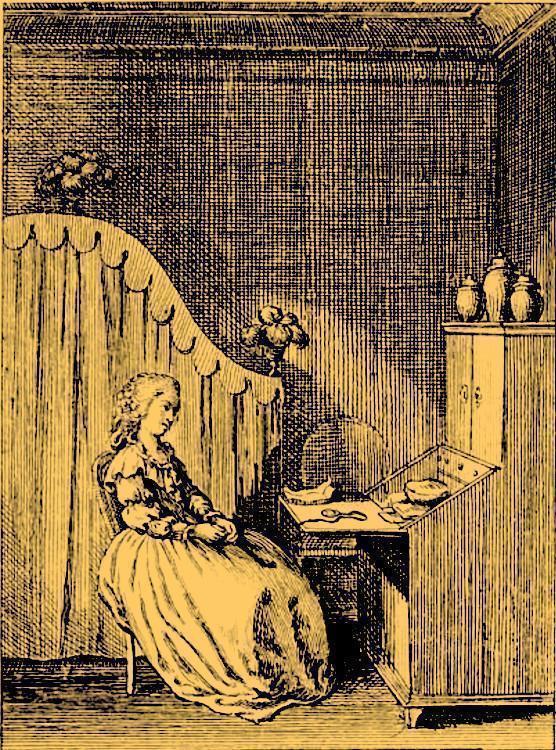
See the following engraving from 1786 of a young woman similarly disheartened by lost love (“Ah, how he would have loved me”; Daniel Nikolaus Chodowiecki, Wie er mich würde geliebt haben [1786]; Herzog Anton Ulrich-Museum; Museums./Signatur DChodowiecki AB 3.709):
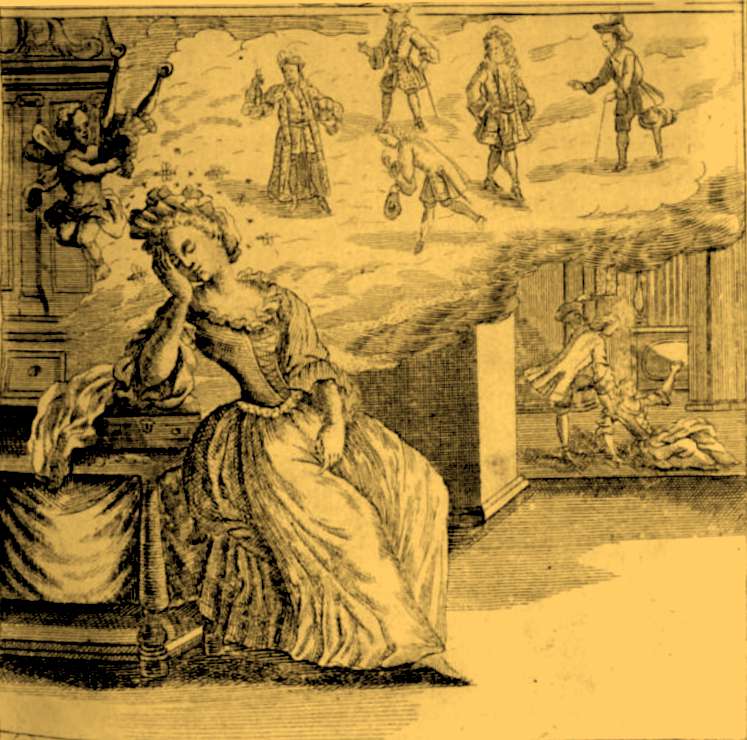
[3] Illustration: “Mannsichtiger Narr” (“Man crazy”), Albert Joseph Conlin, Der Christliche Welt-Weise Beweinent Die Thorheit Der neu-entdeckten Narrn-Welt, vol. 3 (1708), plate following p. 268:
[4] From Christoph August Tiedge, “Brief an M—, geschrieben im Frühling,” in Deutsches Museum (1783) 2 (July–December), 533–45, here 544:
Love is an early rose,
That blooms but in life's May,
A month that passes quickly,
As does the violet's day.
But its twin sister fair,
Friendship, does not so quickly fade,
Covering e'en the grave itself, good friend,
'Neath dense cypresses' glade. Back.
[5] Der Zauber des Orpheus für Freunde der Musik und Dichtkunst: Ein Almanach für 1798; Inhaltsverzeichnis deutscher Almanache, Theodor Springmann Stiftung:

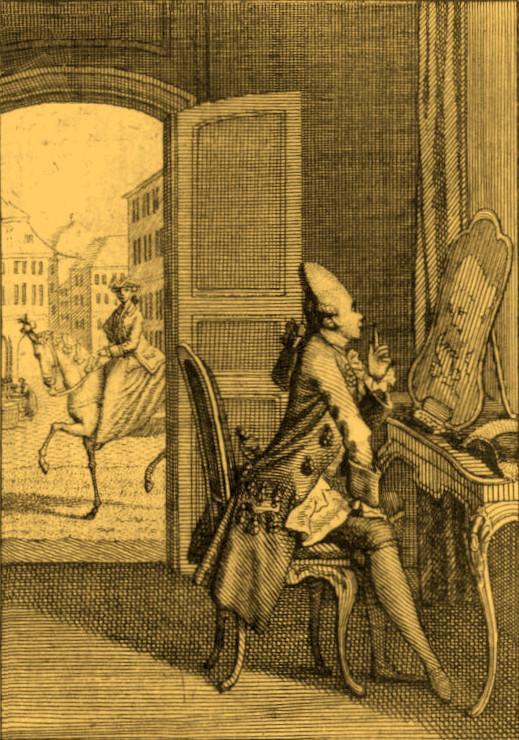
The dandy or fop as such was subject to satire even at the time. The illustration below, from 1772 (note the woman on horseback), is accompanied by the lines: “You loan us your dressing table, / We to you in return our hat and horse; / Thus does the male coquette remain / Worthy of the female dragoon” (Königl. Großbrit. und Churf. Braunschw. Lüneb. Genealogischer Calendar auf das 1772. Jahr; Inhaltsverzeichnis deutscher Almanache, Theodor Springmann Stiftung):
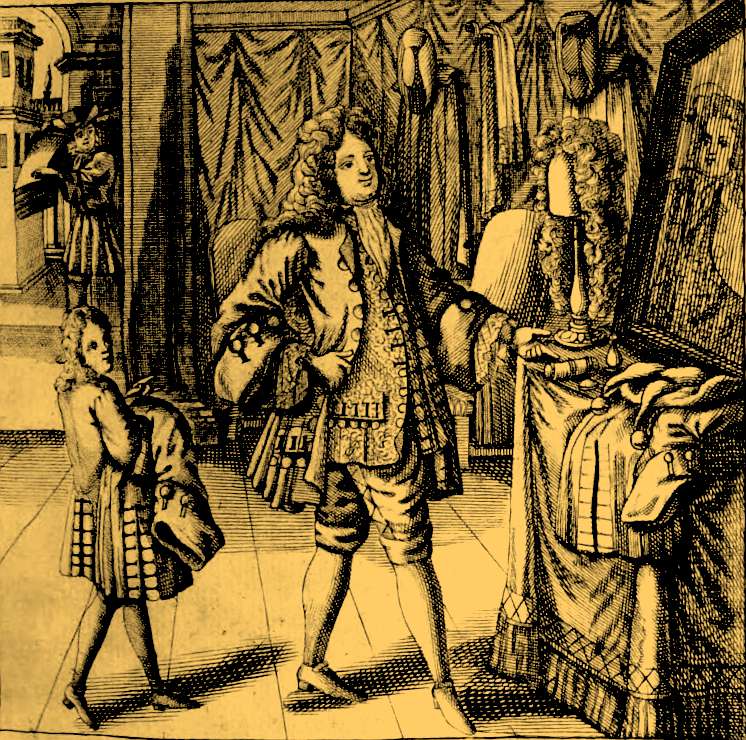
Second illustration: a “clothes fool” from a slightly earlier period (Albert Joseph Conlin, Der Christliche Welt-Weise Beweinent Die Thorheit Der neu-entdeckten Narrn-Welt, vol. 3 [1708], initial plate in volume):
Translation © 2011 Doug Stott