
258t. Dorothea Veit to Schleiermacher in Berlin: Jena, 17 March 1800 [*]
Jena, 17 March 1800
I have been wholly unable to concentrate or get any real work done for two weeks now; Caroline is seriously ill, with nervous fever, and this particular disruption certainly puts the crown on all the others. [1]
To entertain myself, I have been engaging in all sorts of rather innocuous tomfoolery, some of which I will relate to you here. It is not at all the stanzas alone that you will be receiving, they all grew and took root in Florentin. [2]
I now have the opportunity to become acquainted with the Brunonian method, and since I am unable to get any further revelation concerning it, I must make do with merely worshiping the miracles it performs. [3]
To wit, Hufeland initially treated Caroline with an anti-Brunonian method, but she got noticeably worse; Schelling, however, then badgered Hufeland to the point that he finally gave in and allowed her to be given volatile stimulants and continuous fortifiers such as quinine, Hungarian wine, nourishing creams, and strong bouillon, and behold, miracles are taking place before our very eyes. Moreover, she would already have recovered completely had not a wretched mustard plaster on her calf caused an inflammation that in its own turn caused her to take several steps retrograde.
I am writing all this to you because it interests me now, and because I am now quite interested in this system. . . .
Auguste sends her warm regards and has solemnly charged me with telling you that she would love you were you not blond; that, namely, is something she simply cannot stand, notwithstanding she herself is blondissime. . . .
Notes
[*] Sources: Briefe von Dorothea Schlegel an Friedrich Schleiermacher 45–47; KGA V/3 427–29; KFSA 25:75–77. Back.
[1] Johann Sigmund Stoy, Goldener Spiegel für Kinder. Mit Kupfern. Ein Lesebuch, bestehend in auserlesenen Erzählungen (Nürnberg 1791), 165:
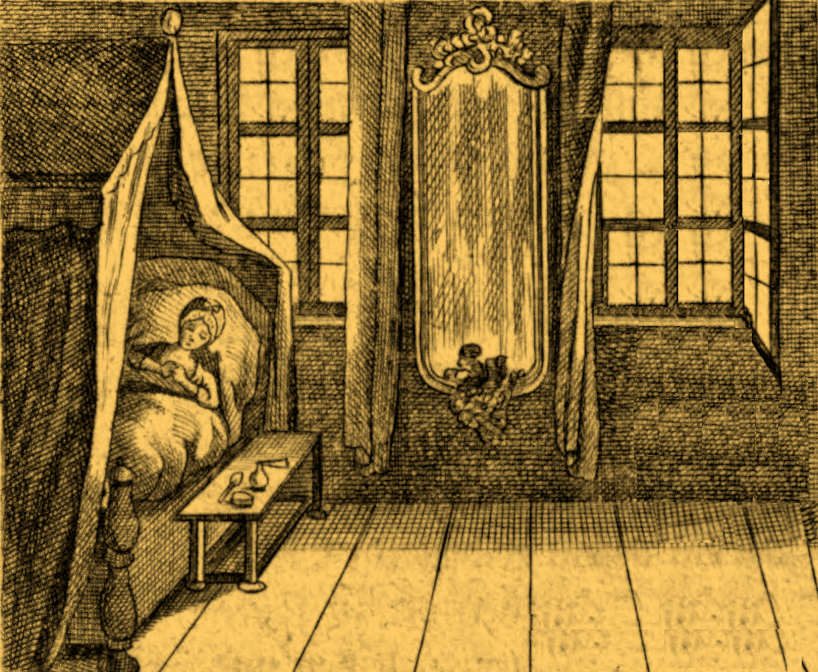
Concerning Caroline’s illness, see also Wilhelm Schlegel’s letter to Goethe on 8 March 1800 (letter 258p) and esp. the second paragraph (with notes and cross references to Auguste’s letters to Luise Wiedemann and Luise Gotter on 30 and 31 March 1800 [letters 258w, 259], in which she, too, discusses symptoms) of his letter to Johann Diederich Gries on 16 March 1800 (letter 258r). Her illness continues to be a topic of letters throughout March and most of April 1800. Back.
[2] Dorothea’s novel, Florentin. Ein Roman herausgegeben von Friedrich Schlegel, vol. 1 (Lübeck, Leipzig 1801). Back.
[3] The Brunonian method continues to be an issue over the next several years in this correspondence, not least with respect to Auguste’s death on 12 July 1800 in Bocklet and with respect to Schelling’s career and public quarrels, one of the latter of which insinuated that his meddling contributed to Auguste’s death.
Although this passage is the first in this correspondence attesting Schelling’s interest in the method, a year earlier, over the course of several sequential issues in February 1799, the Allgemeine Literatur-Zeitung had published an essentially negative collective review of several publications relating to the medical theories of John Brown.
In response, Schelling published an article on this review in a periodical resolutely inclined to propagate and defend the method, the Magazin zur Vervollkommnung der theoretischen und praktischen Heilkunde, ed. Andreas Röschlaub 2 (1799) no. 2, 255–61, pointing out that the reviewer misunderstood a fundamental point of the Brunonian theory (see supplementary appendix 258t.1).
Concerning the Brunonian method as such, see the editorial introduction to the 1795 edition of Brown’s own English translation of his original Latin work, The Elements of Medicine of John Brown, M.D., 2 vols., trans. from the Latin by the author, ed., rev., and corrected by Thomas Beddoes, 2 vol. (London 1795), “Of the Brunonian Doctine.” Back.
Translation © 2013 Doug Stott