
• 247a. Friedrich Schlegel to Auguste Böhmer in Dessau: Jena, 7 October 1799 [*]
[Jena, Monday, 7 October 1799]
Dearest Auguste,
Why are you so impatient, or rather: why are you writing that way, considering that things are doubtless going quite well for you and since everything is interesting for you and, I might add, also quite pleasant? [1] — Only do not stay away too much longer, regardless of what your mother might say.
Madam Veit has been here since yesterday and is doing quite well and is quite content, except that she is angry at your not being here.
Tell Mamsell Tischbein that Caroline still owes me a kiss; have her give it to you when you are ready to return here; also tell her that I dearly love Betty as well. [2]
Do not write your mother such witty letters, Auguste; [3] she is becoming increasingly funny herself, so funny, in fact, that it has almost become unbearable . . .
Your Friedrich
Notes
[*] Source: Schmidt (1913), 1:644 (letter 32); Waitz (1871), 1:374 (does not include the final paragraph); reprinted in KFSA 25:8. — Dating in Schmidt (1913) according to Friedrich’s remarks about Dorothea Veit’s arrival in Jena; she and her son Philipp Veit had journeyed from Berlin to Jena by way of Leipzig but did not travel through Dessau, where Auguste was staying (Post Karte Durch ganz Deutschland, ed. J. Walch [Augsburg 1795])
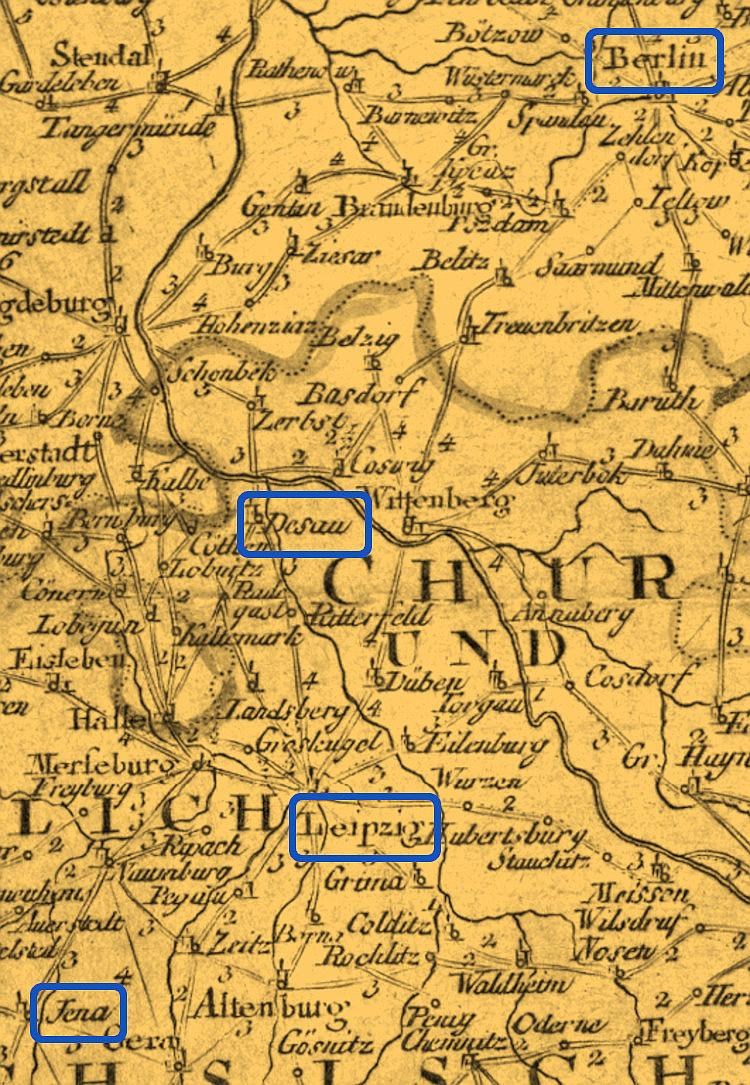
Concerning the textual history of Friedrich Schlegel’s letters to Auguste Böhmer, see supplementary appendix 181d.1. Back.
[1] Auguste was homesick in Dessau (map: Rudolf Koch and Fritz Kredel, Deutschland und angrenzende Gebiete [Leipzig 1937]; illustration: Dessau in an engraving by Matthäus Meria):


See the final paragraph in Caroline’s letter to Auguste on 6 October 1799 (letter 247). Back.
[2] Caroline Tischbein, who was fifteen years old when she met Friedrich that autumn in Jena, was not entirely comfortable with his attention; she writes in her memoirs that “Friedrich Schlegel did not otherwise particularly please me, nor did the attention he paid me make me any more favorably disposed toward him” (Göttinger Taschen Calender im Jahr 1784; Inhaltsverzeichnis deutscher Almanache, Theodor Springmann Stiftung):

[3] None of Auguste’s letters to Caroline seem to have survived. Back.
Translation © 2013 Doug Stott