
• 203d. Friedrich Schlegel to Auguste Böhmer in Dresden: Berlin, autumn 1798 [*]
[Berlin, autumn 1798]
|634| Why have you not written, you worldly child, you? [1] — Do you call that gratitude? — Is that why you were taught how to dance like a Cossack and read Greek? is that why Tischbein painted you with lowered eyes, [2] that you might not answer me, that you might behave so ill toward me? —
Although I am certainly depressed about Udli, [3] I am not as anxious about it as is Charlotte. I hope there is no cause for alarm this time.
Did your mother tell you that I intend to send you a sister? [4]
If Hardenberg is there, let me know whether there has been much symshouting. [5]
Stay well and take time to write me.
Friedrich Schl.
Notes
[*] Source: Schmidt (1913), 1:634 (letter no. 21); Waitz (1871), 1:367; reprinted in KFSA 24:172–73. — That Auguste is still in Dresden is suggested but not confirmed by the reference to Udli (Auguste Ernst) in Dresden. — Concerning the textual history of Friedrich Schlegel’s letters to Auguste Böhmer, see supplementary appendix 181d.1. Back.
[1] See Friedrich’s letter to Caroline on 20 October 1798 (letter 205): “You there are children of the world, Wilhelm, Henriette, also Auguste. We are clerics, Hardenberg, Dorothea, and I.”
The additional implication with Auguste, who was but 13 years old at the time, was that of a “frivolous young girl” concerned largely with “earthly” appearances and such (“Das leichtsinnige Mädchen,” Berlinischer Damen-Kalender auf das Gemein-Jahr 1809, Inhaltsverzeichnis deutscher Almanache, Theodor Springmann Stiftung):

[2] For the various renderings of Tischbein’s 1798 portrait of Auguste (and Caroline), the see the portraits gallery. Caroline later (to Julie Gotter on 18 March 1804 [letter 383]) was not entirely at ease with the “features Tischbein incorrectly added, as it were the downcast element of the spirit.” Back.
[3] The ill child was doing better by mid-October; see Caroline’s letter to Friedrich on 15 October 1798 (letter 204). Back.
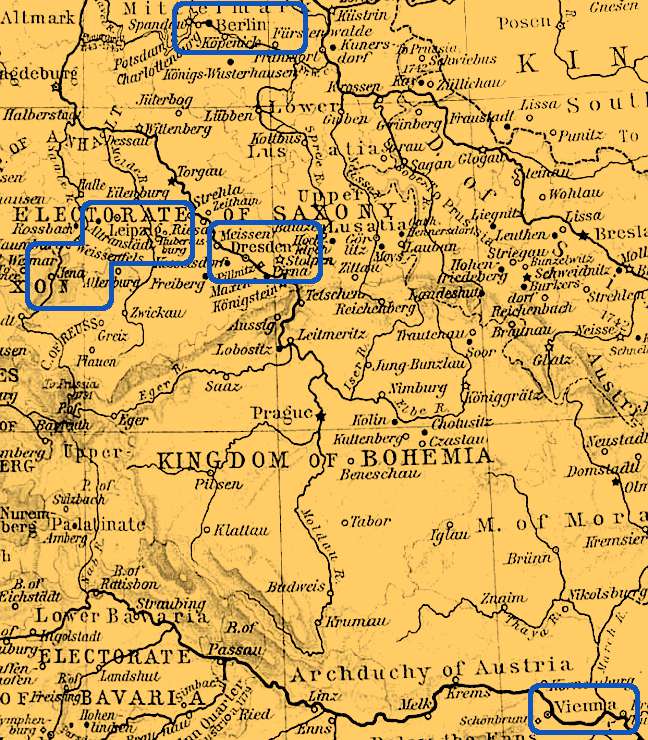
[4] Henriette Mendelssohn would be visiting the Schlegel family in Jena on her way to Vienna. References to her recur in several of the next letters (W. R. Shepherd, Historical Map of Central Europe about 1786 [1926]):
[5] A neologism with sym- (from Gk., “with, together”) similar to Friedrich’s others, such as “symphilosophy,” “symphysics,” etc., also “sym-idleness.” Back.
Translation © 2012 Doug Stott