
121c. Friedrich Schlegel to Wilhelm Schlegel in Amsterdam: Dresden, 3 April 1793 [*]
Dresden, 3 April 1793
. . . Jettchen writes to Charlotte, quite without suspecting anything, that people are saying [Caroline] B[öhmer] is Custine’s mistress. [1]
Notes
[*] Sources: Walzel, 83; KFSA 23:89. Back.
[1] Goettinger Taschen Calender Für das Jahr 1794:
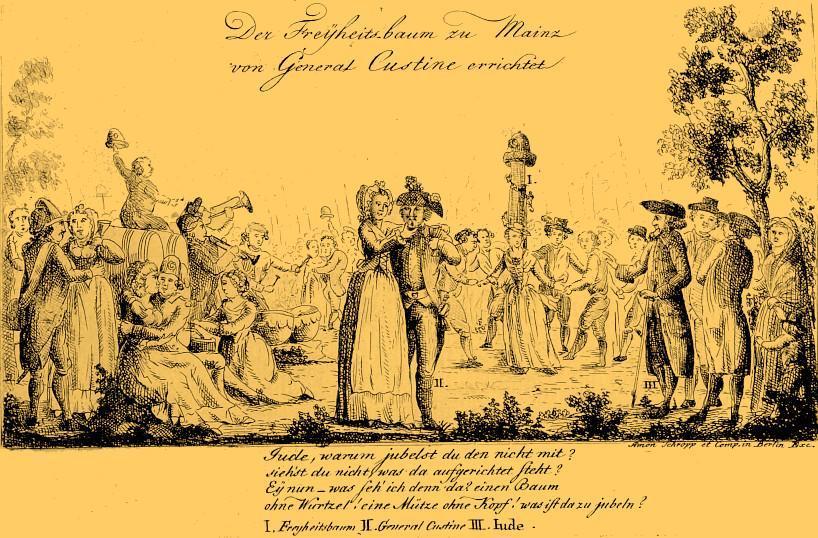
French general Adam Philippe de Custine was the commander in chief of the army of the Vosges that occupied Mainz. Custine’s questionable association with women in Mainz prompted several satirical illustrations, including the following, in which, on the arm of a less-than-demure woman, he wonders why a Jew is not excited about the erection of the Freedom Tree in Mainz, to which the Jew responds by referring to a “tree without roots, and a cap without a head” (Simon Schropp, Freiheitz-baum zu Mainz / von general Custine erritchtet [ca. 1792]; Musée Carnavalet, Histoire de Paris):
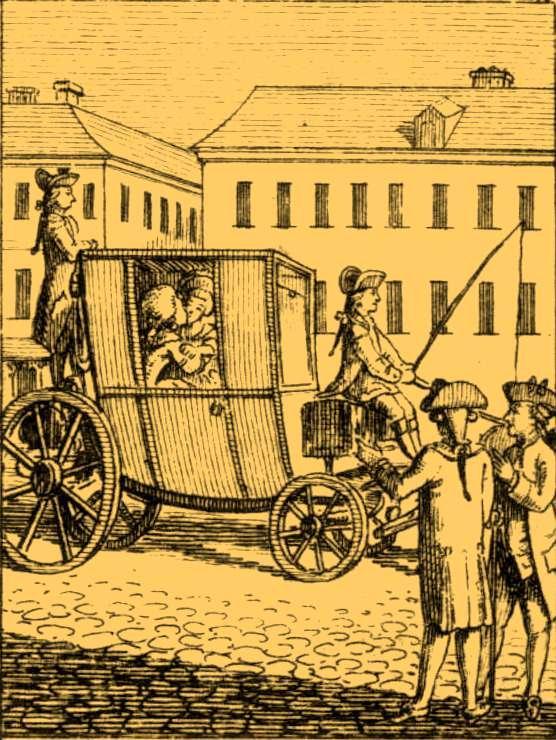
Concerning the alleged libertinism in Mainz during the French occupation, Caroline’s alleged intimate association with Custine, and esp. the ease with which egregious misinformation managed to shape — enduringly — her public image, see Carl Eduard Vehse, Geschichte der deutschen Höfe seit der Reformation, 48 vols. (Hamburg 1851–60), vol. 45, sec. 6, part 11: Die geistlichen Höfe, part 1 (1859), 241–45, who is citing (whence the quotation marks) and annotating Christian von Stramberg, Coblenz, die Stadt, Historisch und topographisch dargestellt, vol. 1 of sec. 2: Mittelrhein, of Denkwürdiger und nützlicher Rheinischer Antiquarius, welcher die wichtigsten und angenehmsten geographischen, historischen und politischen Merkwürdigkeiten des ganzen Rheinstroms von seinem Ausflusse in das Meer bis zu seinem Ursprung darstellt (Coblenz 1853[?]), 765–66 (illustration: Allmanach auf das Jahr nach der gnadenreichen Geburt Jesu Christi 1786 [Vienna]; Inhaltsverzeichnis deutscher Almanache, Theodor Springmann Stiftung):
“There was public licentiousness in the streets. No respectable woman dared show her face publicly. For a certain period of time, any and all marriages were allowed, including with married women. Custine himself allegedly had himself wed for two months to the wife of Doctor . . . , which act of marriage allegedly took place in the municipal offices. The entire marriage ceremony allegedly consisted in a public declaration and bestowal of the red [Jacobin] cap.
Custine allegedly had Madam . . . constantly driven around Mainz in the sumptuous state carriage of the prince elector accompanied by two Hajduks, while he himself made use of the prince elector’s beautiful suspended carriage.”*
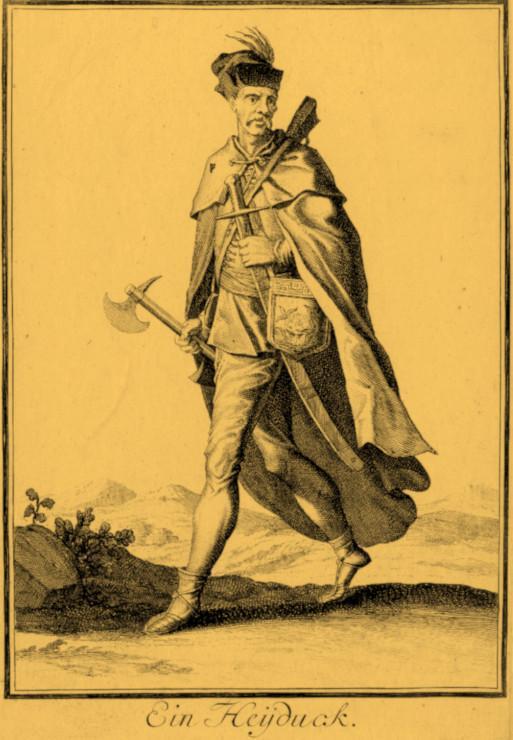
[Hajduks: at the time ennobled Hungarian warriors from an area in eastern Hungary who served during the struggle between the house of Hapsburg and Protestant insurgents in Hungary; illustration: Caspar Luyken, Ein Heÿduck (Nürnberg 1703) © British Museum 1871,1209.2717:]
*[Vehse’s footnote]: The lady in question here was the second most famous Göttingen woman during the revolutionary period after Madam Therese Forster-Huber, née Heyne, namely, the notorious Caroline Böhmer, later the wife of August Wilhelm von Schlegel and ultimately the wife of Schelling.
The daughter of the scholar of ancient Near Eastern studies Michaelis in Göttingen, she was an intelligent, fiery, physically well-endowed woman [Caroline was regularly described as petite or diminutive]. She was living in sin with Dr. Böhmer [i.e., Caroline’s brother-in-law], who had earlier been a Gymnasium professor in Worms, then a Mainz Clubbist and secretary, Custine’s so-called “civil adjutant.”
After Dr. Böhmer’s death [Böhmer died in 1839] she married August Wilhelm von Schlegel. She had a single daughter with Böhmer, Auguste, who died in 1800 at eighteen [Auguste was born in 1785, i.e., was fifteen when she died; her father, of course, was Franz Wilhelm Böhmer, with whom Caroline had three children] in Bocklet, the playground of the Würzburg canons.
Schelling, at the time a professor in Würzburg [Schelling did not become a professor in Würzburg until 1803], had ‘cured her to death’ using opium according to what at the time was the regnant Brunonian method of excitation [concerning Schelling’s treatment of Auguste, see, e.g., his letter to Wilhelm Schlegel on 3 September 1802 (letter 369d)].
A short while thereafter, the former Madam Böhmer, currently Madam von Schlegel [Wilhelm’s family patent of nobility was not renewed until 1813], divorced her second husband and married Schelling in her third marriage.
This philosopher was severely henpecked until her death; she was a genuine femme maîtresse [here: wife who is essentially a mistress]. Although the Rheinischer Antiquar claims to have uncovered excesses in the portrayal of morals and the time, morals during the period of the French Revolution were unusually lax in any case.
Concerning Caroline’s reputation otherwise during this period, see the supplementary appendix on the contemporary (1793) play The Mainz Clubbists in Königstein. Back.
Translation © 2011 Doug Stott