
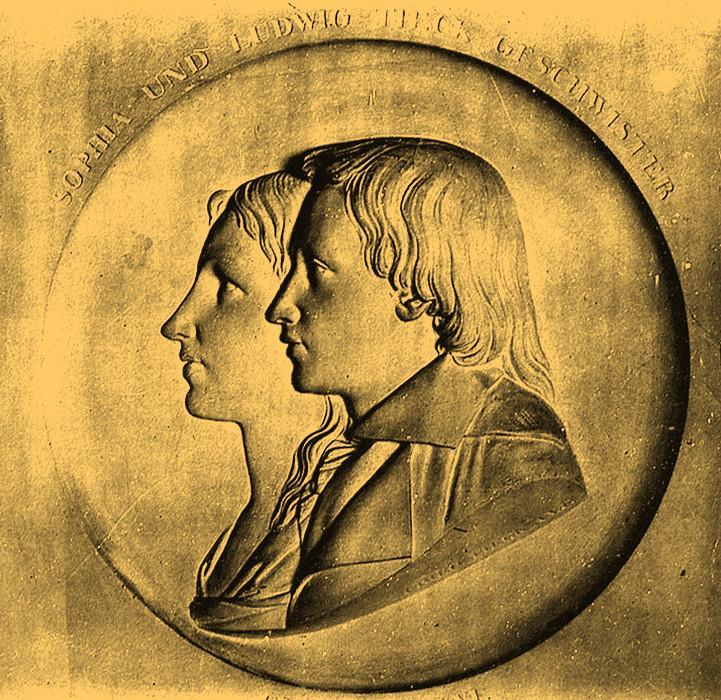
Sophie and Ludwig Tieck
Sophie and Ludwig Tieck in 1796. Sophie, unhappily married, contributed to the periodical Athenaeum and also had a serious affair with Wilhelm Schlegel in Berlin. Their extensive and revealing correspondence from 1801 is included in this present project. Sophie writes in August 1801, just after Wilhelm had returned to Jena for several months:
“I myself did not really believe how completely I belong to you; all my thoughts focus involuntarily on you, and I am being devoured by the ardent yearning to see you again; whenever someone opens the door, I am immediately convinced that it must be you who walks into the room — and I cannot conceal my pain when it does not happen.”
(Medal by Friedrich Tieck [1796], reproduced in Josef Nadler, Literaturgeschichte des deutschen Volkes, vol. 2 [Berlin 1938], illustration following p. 360).
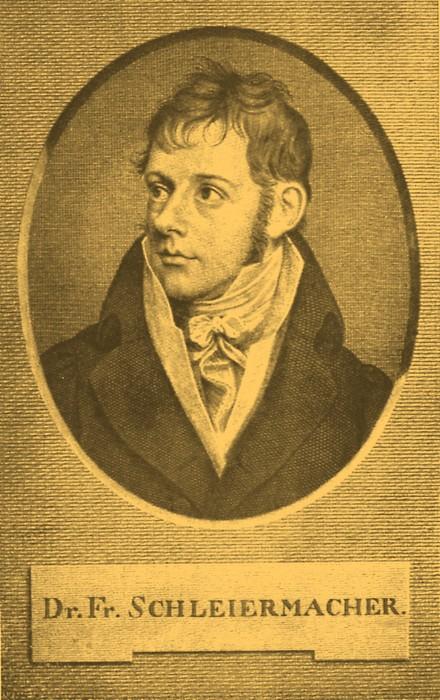
Friedrich Daniel Ernst Schleiermacher
Schleiermacher writes to his sister in late 1801 about Wilhelm Schlegel, not knowing about Wilhelm’s intense affair with Sophie Bernhardi:
“I do not know if I already wrote you about the awkward and regrettable relationship he now has with his wife, who is rewarding him for the great respect he has demonstrated toward her, and for his more than fatherly tenderness and love toward her daughter from her first marriage, with unfaithfulness that she is not even bothering to conceal or deny.”
(Engraving by Johann Heinrich Lips.)
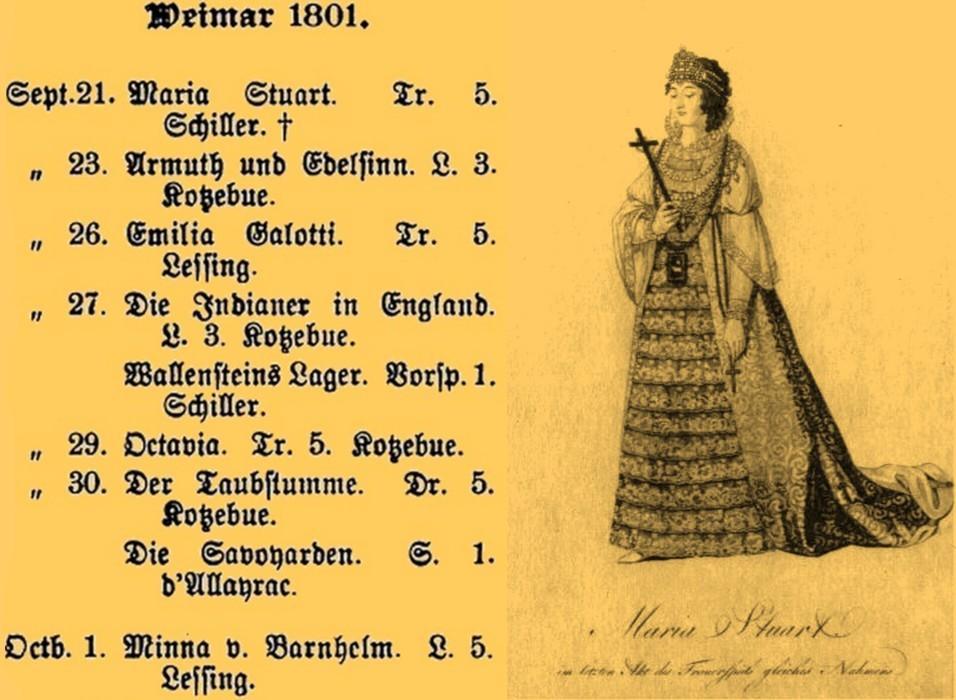
Friederike Unzelmann in Weimar 1801
Friederike Unzelmann: “Unzeline” or the “little fairy sprite” to Caroline. One of the most celebrated actresses of the time, and an intimate friend of Wilhelm Schlegel, perhaps a bit too intimate for Caroline, though Caroline never perceived Unzeline as a real threat as she did Minna van Nuys. During the autumn of 1801, while Wilhelm was in Jena briefly for the last time, Wilhelm and Caroline, accompanied by Schelling and others, traveled over to Weimar for Unzeline’s eight successive guest performances, seeing her perform, among other roles, in Schiller’s Maria Stuart on 21 September 1801. (She did not perform in Schiller’s Wallensteins Lager.)
(C. A. H. Burkhardt, Das Repertoire des Weimarischen Theaters unter Goethes Leitung. 1791–1817 [Hamburg, Leipzig 1891], 41; “Friederike Bethmann-Unzelmann als Maria Stuart als Gast in Weimar 1801,” p. 333 of an unidentified theater periodical.)
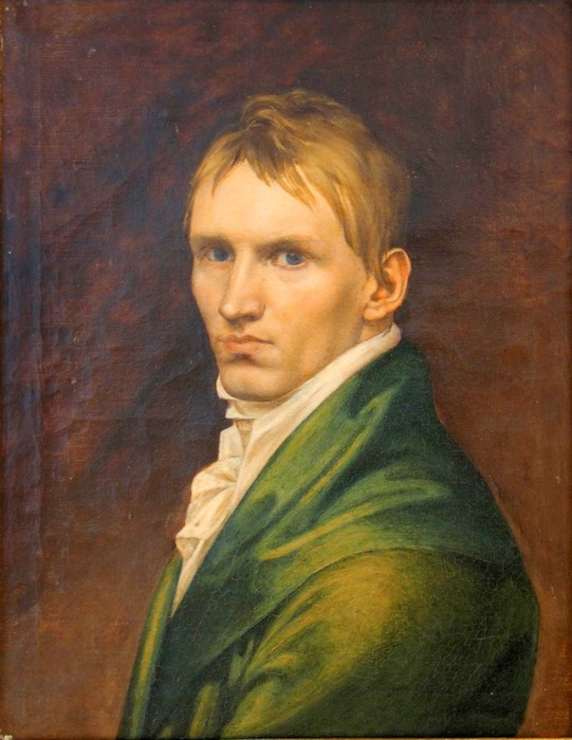
Friedrich Tieck
The brother of Ludwig and Sophie, a sculptor and artist, did a famous portrait of Schelling as well as drafts and sketches for Auguste’s monument and the bust of Auguste herself. Caroline met him in late 1801 in Jena after her return from Braunschweig:
“When he left us, he went on foot…walked up the military road, in his shabby coat…with a staff, and nothing in his pocket but a roll of paper hanging out quite long, and he quite thin, very thin, with his blond hair blowing about his face.” Tieck will visit Caroline and Schelling in Jena in September 1802.
(Self-portrait ca. 1805.)
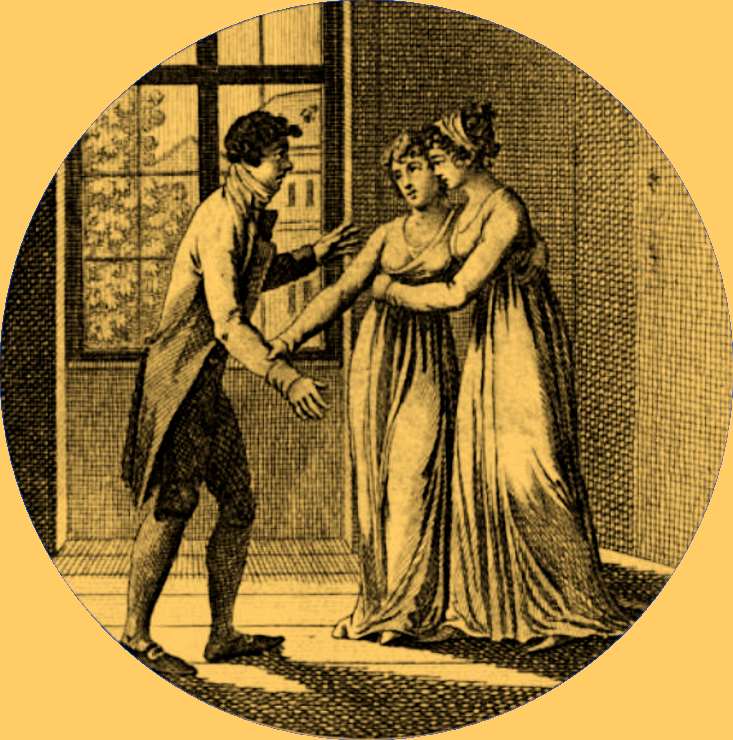
Julie Gotter, Caroline’s houseguest in Jena between June 1801 and March 1802, laments being teased about her alleged romantic interest in Friedrich Tieck, who was currently in Berlin but planning to return to Jena. She writes to her sister in October 1801:
Schelling is constantly plaguing me with “Tieck,” and Madam Wiedemann, as you can imagine, invariably concurs with him. Madam Schlegel merely smiles at it all, as do I myself. Although Schelling is telling me it is my own fault that a “gentle blush” comes over my face every time, I am undeterred. For the rest, it will nonetheless be irksome when he comes through here, and I will not be so inclined to speak with him.
(Title vignette to August Lafontaine, So gehet es in der Welt, vol. 1, Eduard u. Margarethe [Berlin 1804].)

Friedrich Tieck’s Costume Illustrations for Ion
Friedrich Tieck’s costume illustrations for Wilhelm Schlegel’s play Ion, which premiered in Weimar on 2 January 1802. Wilhelm’s indignant and piqued reaction to Caroline’s account precipitated a testy anonymous exchange in the Zeitung für die elegante Welt. From left to right: Pythia, Xuthus, Ion, Creusa, Phorbas.
(Goethe, “Weimarisches Hoftheater: . . . Colorirte Darstellungen der antiken Costumes im Ion, wie sie auf dem Hoftheater in Weimar erschienen,” Journal des Luxus und der Moden 14 [1802] [March], 136—48.)

Caroline Jagemann as Ion
The actress Caroline Jagemann as Ion in Wilhelm Schlegel’s play. Caroline writes of the 1802 premiere:
“There cannot possibly be a more splendid Ion…When the curtain rose and the radiant scenery came into view, with her greeting the morning as it bathed the peak of Mount Parnassus in red, it was as if a fresh breeze had come over us, and when after completing her ceremonious task she reached for her light weapons, her voice took on such a beautiful lilt, truly like that of a golden bow, that the entire audience seemed instantly captivated, and the initial words of Pythia were lost amid applause.”
(Portrait: in the role of Ion, 1803, by Jakob Wilhelm Christian Roux.)
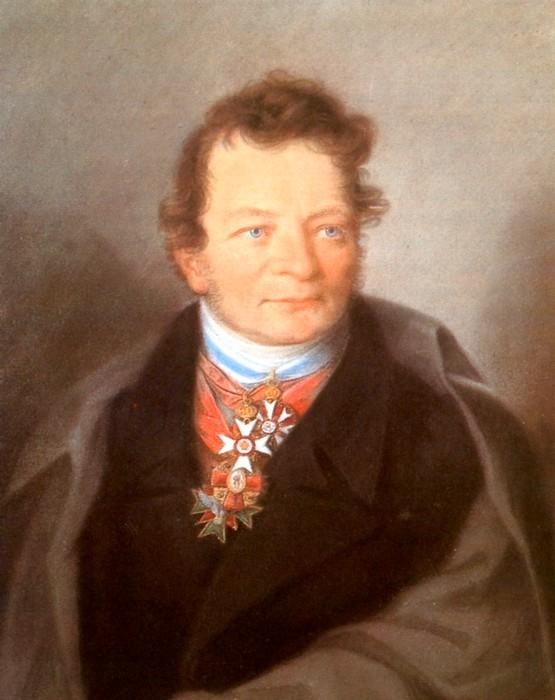
Anselm von Feuerbach
This young Jena law professor writes to his father in January 1802 about Wilhelm and Caroline:
“His domestic situation is peculiar and yet not peculiar, depending on how one understands the relationship. His wife, an extremely cultured and erudite lady, is living here; he himself is usually in Berlin, where he is currently giving lectures on aesthetics to handsome ladies and gentlemen. He occasionally pays a visit to his wife, though by “wife” nothing more is meant than a female person whose hand a cleric put into Schlegel’s own and who bears his name. As is universally known, Professor Schelling, the idealist, possesses and exercises the real marital rights.”
(Portrait by unknown artist.)
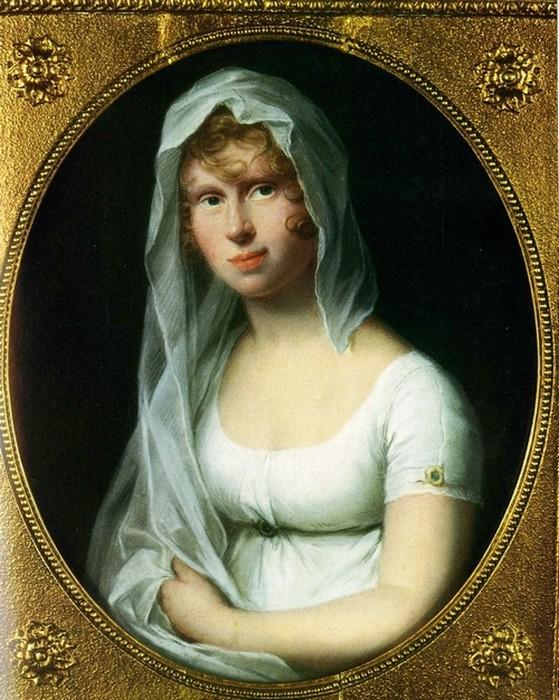
Charlotte VIeweg
The wife of Johann Friedrich Vieweg, publisher of the initial volumes of Athenaeum who had subsequently moved to Braunschweig. Caroline writes in January 1802 concerning her own anticipated trip to Berlin to visit Wilhelm Schlegel (during the visit, they decided to seek a divorce):
“Madam Vieweg recently expressed the following opinion. She interrogated Luise [Caroline’s sister in Braunschweig] about where I would be residing and where you were currently residing. Luise told her what she knew, namely, that the Grattenauers had offered a room etc. ‘Oh? Not together? The Berliners will certainly have a lot to say about that.'”
(Portrait: unknown artist, ca. 1800.)
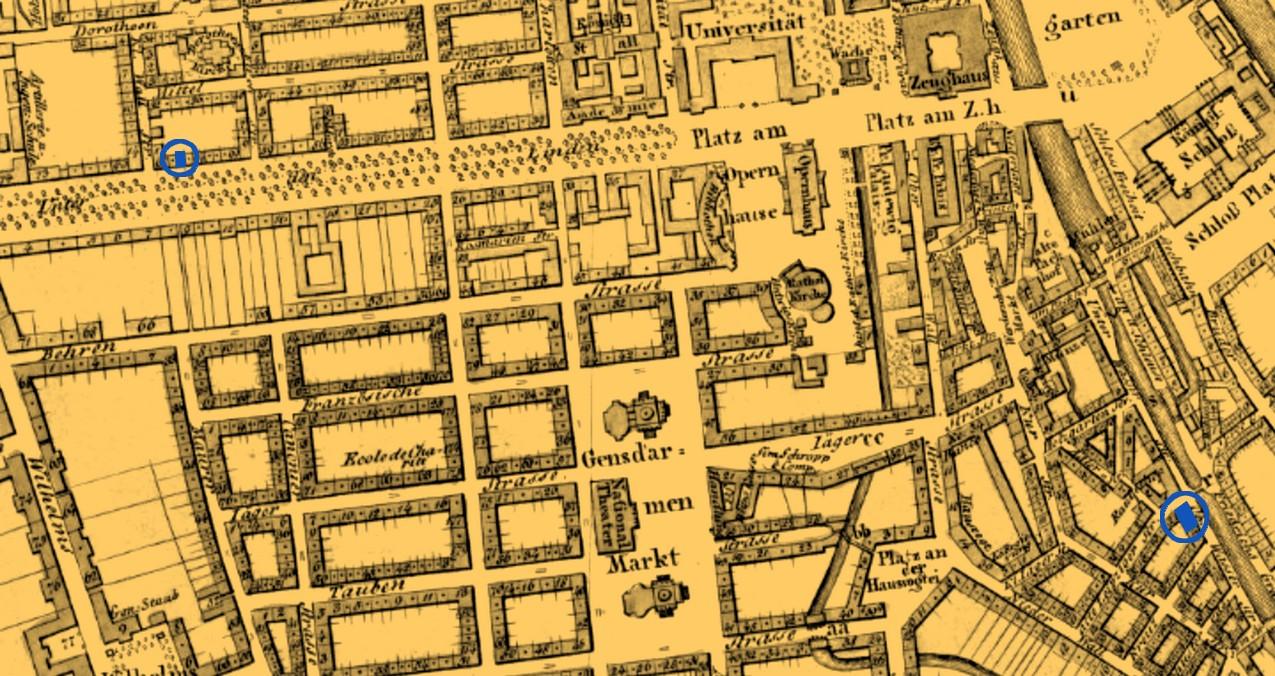
Berlin, Lindenstrasse 66
And indeed, during Caroline’s stay in Berlin between late March and mid-May 1802, she and her maidservant, Rose, lived at Lindenstrasse 66 (Unter den Linden, upper left) with Karl Friedrich Grattenauer (her traveling companion to Berlin) and his wife, Anna Philippine Elisabeth Grattenauer, whereas Wilhelm was living at Jungfernbrücke 10 with the Bernhardis (lower right), a rather peculiar arrangement that, of course, begged the question.
(D. G. Reymann, Neuester Grundriss von Berlin [1826].)
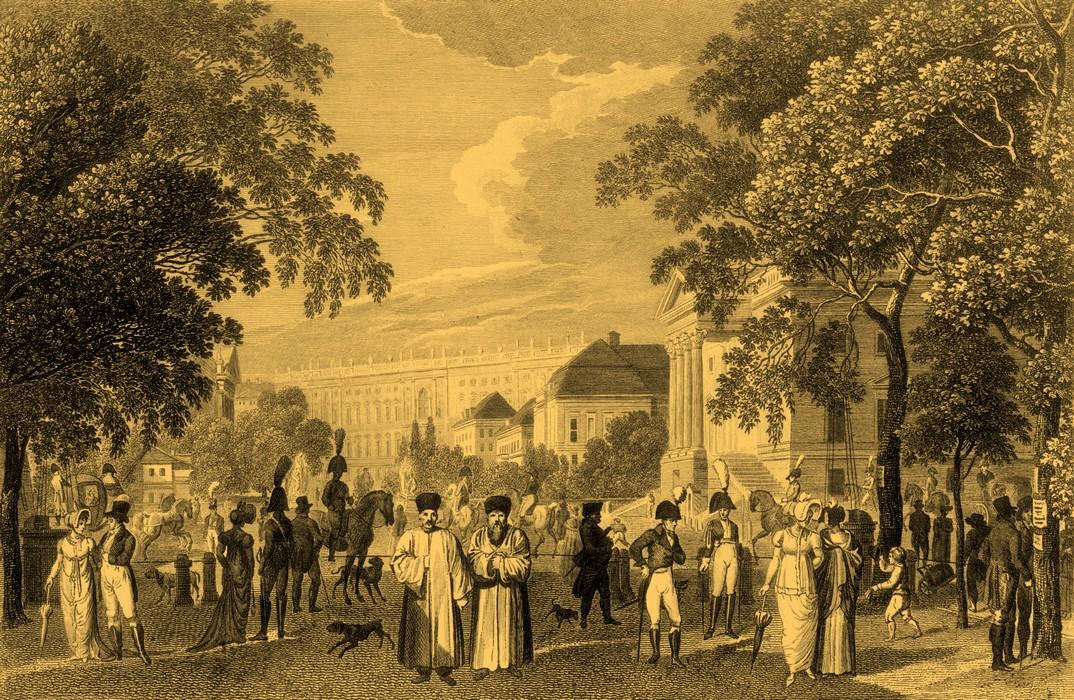
Unter Linden, ca. 1805
While visiting Wilhelm Schlegel in Berlin in the spring of 1802, Caroline resided along this street. An otherwise unclear incident occurred worsening their already strained relationship, and they decided to seek a divorce. Caroline writes to Julie Gotter in April 1802:
“The daring deed of my coming here has almost been too much for me, and I now so yearn for my quiet existence again…Let me confirm in a general way that I do indeed have many distractions here, as one puts it, but it is not really expedient now to go into detail. We have already had much fun; among other things, [Garlieb] Merkel sat next to me at a souper and flirted with me. Otherwise Berlin wholly displeases me.”
(Copper engraving by Günther after Catel, Vue de la place en face du Boulevard des Tilleuls à Berlin. Ansicht des Platzes am Eingang der Linden zu Berlin [ca. 1805].)

Asverus-Haus at Lutherplatz 3 in Jena
Caroline’s third and final residence in Jena. Caroline, Schelling, and her maidservant, Rose, arrived back in Jena from Berlin on the evening of 24 May 1802. Caroline immediately moved into a new apartment, the building at the right on this teacup illustration, next to the inn Zum Schwarzen Bär, also known as the “Asverus house” after the previous lessee, Ludwig Christoph Asverus. She remained in this apartment till her departure in June 1803 She writes to Wilhelm Schlegel during the lease negotiations:
“It is an extremely amiable place, the view from the upstairs rooms, especially out the back, is as pleasant as might be imaginable, taking in the entire valley from Kunitz all the way to Dornburg. . . In any event, I will take it for only a year.”
(Photo: Städtische Museen Jena, Stadtmuseum.)
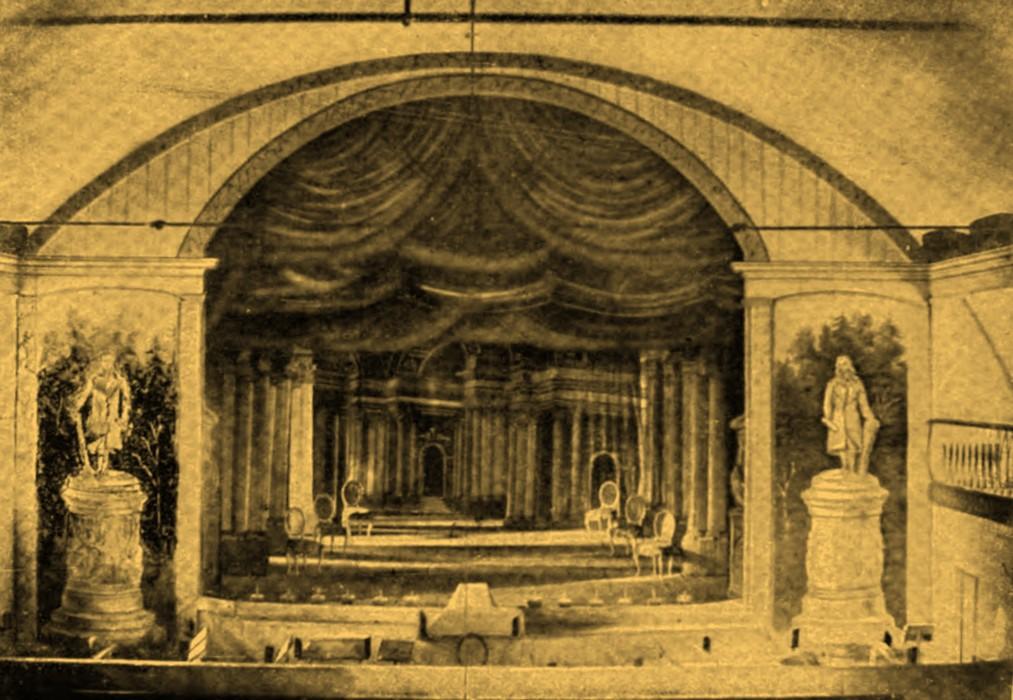
Stage in the Lauchstädt Theater
During the summer of 1802, Caroline and Schelling (essentially openly as a couple) attended performances at the newly renovated theater in Lauchstädt, one of which was Friedrich Schlegel’s controversial Alarcos. Josef Körner describes one of the performances:
“Although the piece was never reprised in Weimar, it was performed in guest performances in Lauchstädt. There, too, as Goethe’s wife recounts, an anti-Schlegelian group inspired by August von Kotzebue tried to disrupt the performance; but the Jena students in attendance, who were in the majority, shouted them down, thereby assisting the piece to a triumphant performance…In the autumn of that year, a decree from the duke himself [Karl August] seems to have banned both Alarcos and Wilhelm Schlegel’s Ion from the Weimar stage forever.”
(This and the following images from Goethe und sein Kreis, ed. Franz Neubert, 2nd ed. [Leipzig 1919], 135–36.)
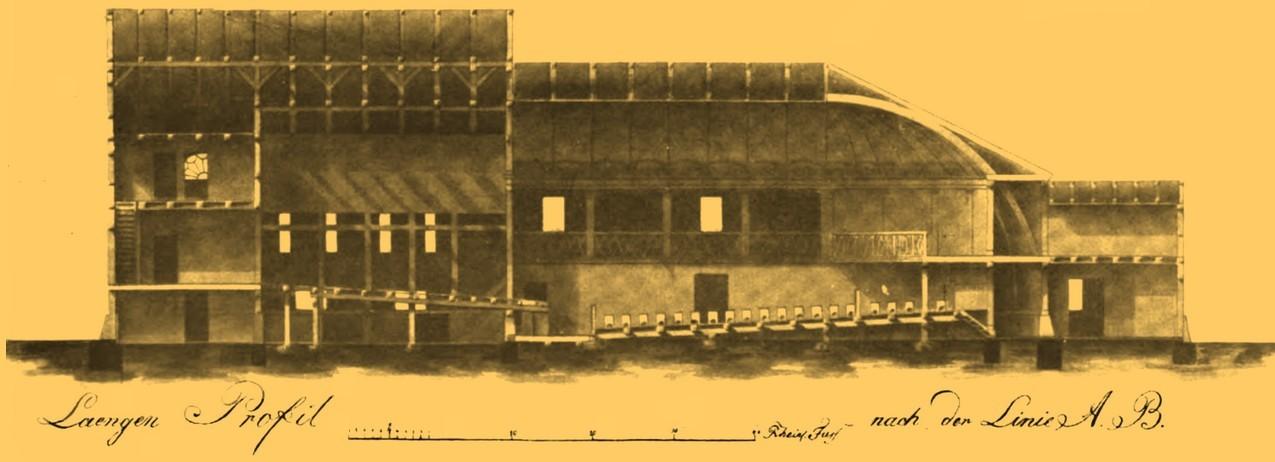
Interior of the Lauchstädt Theater
The actor Eduard Genast describes the interior of the renovated theater in Lauchstädt in the summer of 1802:
“The entire audience hall consisted actually of only a single room divided into three sections. The first, constituting the larger half and bordering the orchestra, was called the parquet, the second the parterre, and the third the last place. A semicircular balcony elevated above this latter space could seat approximately sixty persons.”
(This quote and the following from Eduard Genast, Aus dem Tagebuch eines alten Schauspielers, 3 vols, 2nd ed. [Leipzig 1862–65], 1:128–30.)
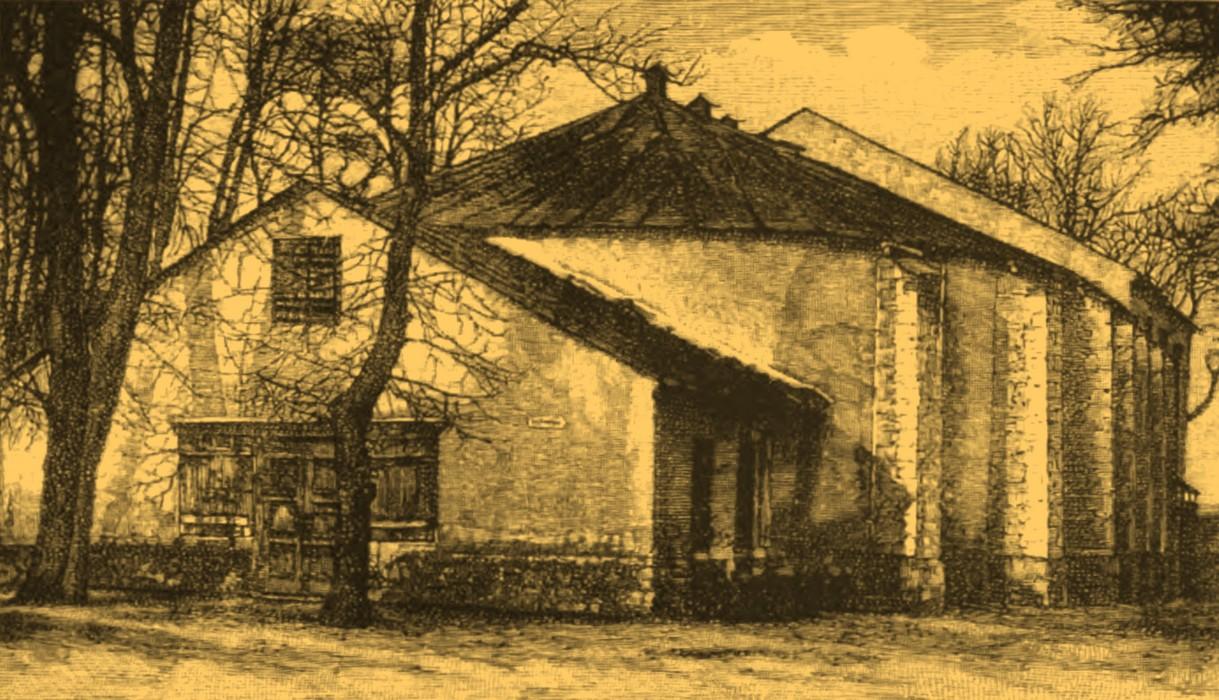
Exterior of the Lauchstädt Theater
Eduard Genast describes the reopening in the summer of 1802, when Caroline and Schelling attended several performances in the renovated theater (the buttresses were added ca. 1830):
“Unfortunately, the building could not hold the large number of spectators, and the external doors had to be opened, so powerful was the crush of the crowd. Although the poor people who managed to get a place there could admittedly not see a thing, they could, however, hear everything, since the walls of the theater were so thin that one could hear every word spoken on stage, and even those outside could understand what was being said. Lest anyone inappropriate join those outside, twenty Saxon dragoons from nearby Schaafstedt were summoned by the authorities to surround the theater with drawn swords.”
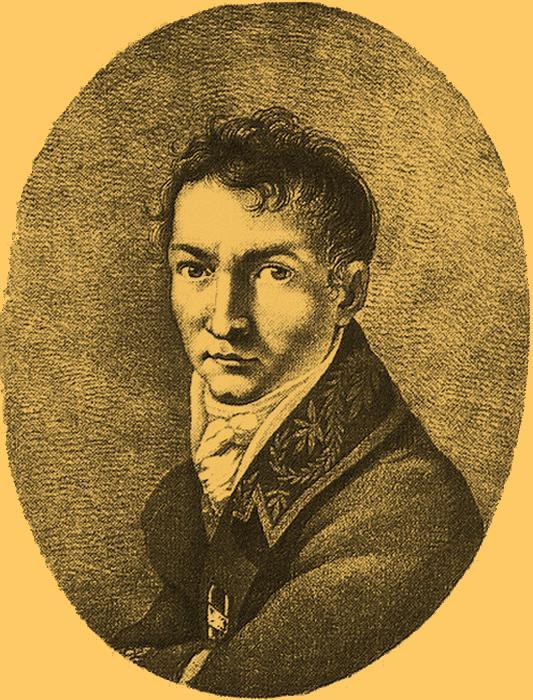
Andreas Röschlaub
A Bamberg physician and resolute advocate of the Brunonian (Brownian) method of healing, he translated many of John Brown’s medical works into German. Röschlaub played a significant role in Caroline’s time in Bamberg, in the circumstances surrounding Auguste’s, death, and eventually especially in the ensuing controversy and oppressive scandal, the beginnings of which began even as Caroline was in Braunschweig and which continued with increasingly unpleasant consequences, especially for Schelling, over the next two years or so.
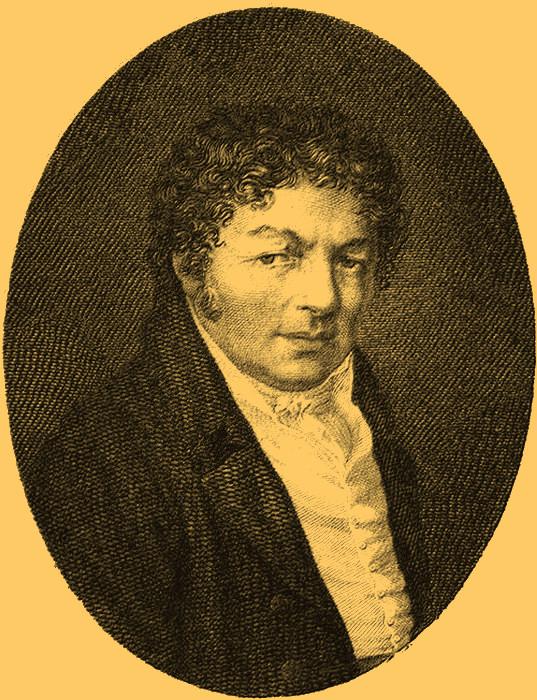
Adalbert Friedrich Marcus
Bamberg physician, also a follower of John Brown’s theories of healing, close acquaintance of Caroline and Schelling, provided a supporting affidavit in 1802 together with Andreas Röschlaug in the fatiguing scandal involving Auguste’s death. His intimacy with Karoline Paulus, however, prompted duplicitous behavior toward Caroline in Bamberg during the summer of 1801.
(Portrait: frontispiece to Dr. Speyer and Dr. Marc [Marcus’ nephews], Doktor A. F. Marcus nach seinem Leben und Wirken [Bamberg 1817].)
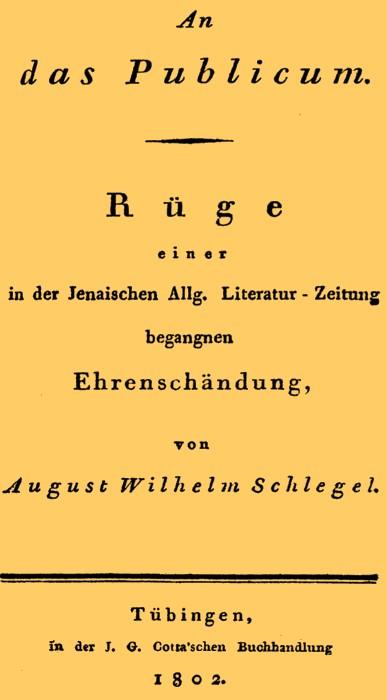
Wilhelm Schlegel’s “To the Public”
One of Wilhelm’s finer moments. On 13 October 1802, Wilhelm Schlegel’s defense of Schelling was distributed in Jena, To the Public: Rebuke of a Defamation of Honor Perpetrated in the Allgemeine Literatur-Zeitung. In it, Wilhelm courageously takes issue with the Allgemeine Literatur-Zeitung for reviewing Franz Berg’s anonymous Encomium for the Most Recent Philosophy, in which Berg sarcastically ridicules Schelling’s philosophy, which seemed to be proceeding “not merely with the goal of healing, but rather of driving out death itself once and for all,” and concluding:
“Except may heaven forbid that he suffer the misfortune of killing in reality those whom he heals in ideality, a misfortune that befell Schelling, the One and Only, in Boklet in Franconia in the case of M. B.* [Mademoiselle (Auguste) Böhmer], as malicious people maintain.”
Wilhelm’s brochure includes affidavits in Schelling’s defense by the physicians Andreas Röschlaub and Adalbert Friedrich Marcus.