
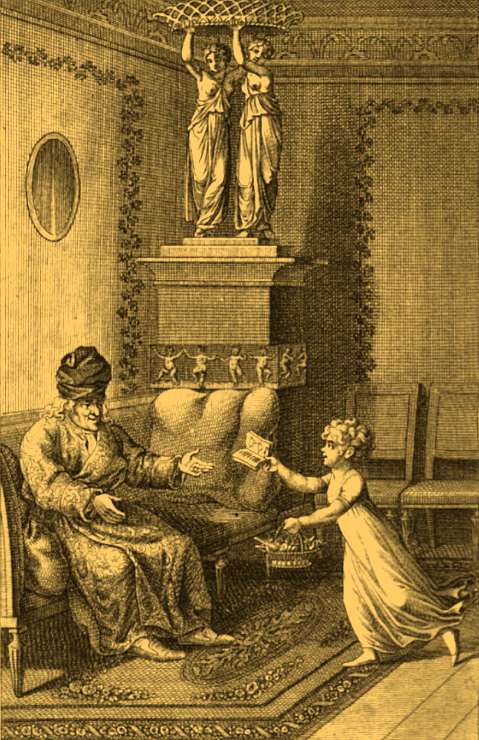
After losing her husband, Caroline, Auguste, and Röschen lived with Caroline’s mother and sisters in Göttingen. For her father’s birthday, Caroline had her children present to their grandfather a poem by Wilhelm Schlegel — the first mention of Wilhelm in Caroline’s extant letters.
“I am enclosing a poem for you that my children presented to their grandfather on his birthday with the head of Asclepius that I myself embroidered and beneath which the inscription stood that one finds beneath the poem itself. Both by Schlegel.”
(Johann Ludwig Ewald and Wilhelm Jury, Der gute Jüngling, gute Gatte und Vater, oder Mittel, um es zu werden: ein Gegenstück zu der Kunst ein gutes Mädchen zu werden, vol. 2 [Frankfurt 1804], following p. 430.)

Marburg, 1902
Marburg in Hessia, where Caroline lived with her brother Fritz from the summer of 1789 to February of 1792. Her youngest daughter, Therese, died here in December 1789, an event Caroline movingly recounts in her letters. Caroline in 1789:
“Marburg has little — but it suffers neither from stultifying uniformity nor from the conceit of an imperial city. The people here are not as cultivated and are more talkative, but they are also more tolerant. I am very well liked here because my heart casts a cloak over the merits of my mind such that the expressions of both are then credited to me as something of merit.”
(Anonymous 1902 illustration.)

Marburg, Reitgasse 14, ca. 1875
Reitgasse 14 in Marburg ca. 1875 (house on left; demolished in 1965), where Caroline, Auguste, and Röschen resided with her half-brother, Fritz. Caroline writes about her room:
“In it are my own and my children’s beds and a night table, and all the silhouettes—surrounded by the shadow of my loved one[s] — the silhouette of my father with the wreathe of wilted flowers hangs over my sofa, and Lotte at Werther’s grave.”
(Photo: Friedrich Küch and Bernhard Niemeyer, Die Bau- und Kunstdenkmäler im Regierungsbezirk Kassel, VIII Kreis Marburg-Stadt, Tafel 60, 2; Historische Bilddokumente, Landesgeschichtliches Informationssystem Hessen [LAGIS].)

Caroline’s youngest daughter, Röschen, died in December 1789; Caroline describes Auguste’s reaction to her sister’s death:
“Finally I told her that Röschen would no longer be able to play with her.
And then it broke forth — she screamed in an almost repulsively violent tone of voice: ‘You are not to say that to me, Mother!’ as if she had been trying to conceal it from herself until then.”
(Frontispiece to Stéphanie Félicité de Genlis, Adelheid und Theodor oder Briefe über die Erziehung, vol. 1 [Gera 1783].)

Marburg, ca. 1842
Marburg, ca. 1842, showing — to the right — the Lahn River and valley Caroline could see from her room. She writes in December 1789, during the final days of Röschen’s illness:
“I, too, am not yet feeling well, and since you have been gone there have been very few days when I have even been able to go outside—which is why I have also essentially forgotten about the entire world, excepting my room and my valley, through which the river runs and a couple of ravens take friendly flight.”
(Painting by Georg Michael Mades, 1842.)
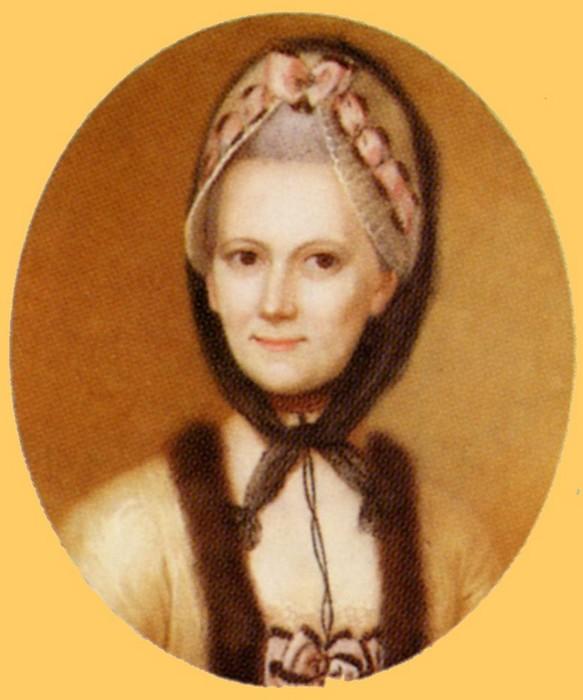
Sophie von La Roche
Sophie von La Roche: Caroline socialized with this famous authoress in Marburg, albeit not without some unkind criticism of her novels:
“I promised to embroider her a cap if…she would send me the Mannheimer Briefe, which are allegedly the best thing she has written…She agreed on the condition that I give her my opinion of Miss Lony — fortunately I had not read it yet, for surely I can come up with something that is true, something I can praise, which will doubtless, however, still not interest me.”
(Portrait: unknown artist.)
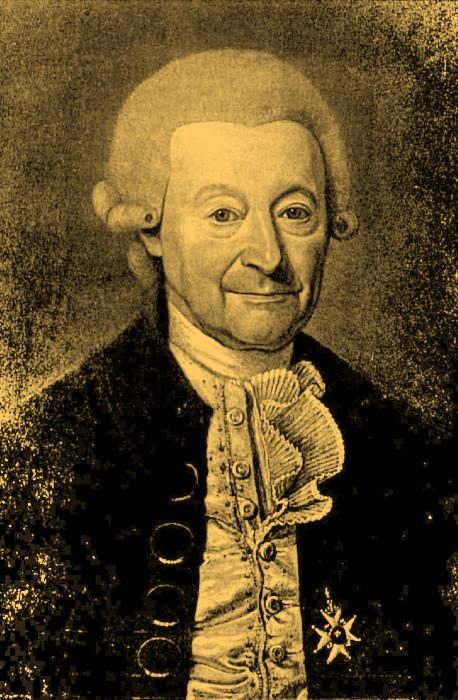
Johann David Michaelis, 1790
J.J. D. Michaelis, 1790, Caroline’s father, who died on 22 August 1791 but whose later years were embittered. Caroline writes in late 1790:
“Our father is not very happy even as it is—he is so irritable, and his old age is becoming such a burden to him that the mere thought of contributing to the trouble he is already experiencing would terrify me. Consider for a moment this man who has so utterly outlived himself, and precisely where he might yet find a measure of enjoyment, namely, in his children, what do they give him instead?”
(Portrait: by Carl Arnold Friedrich Lafontaine; Voit Collection, SUB Göttingen.)
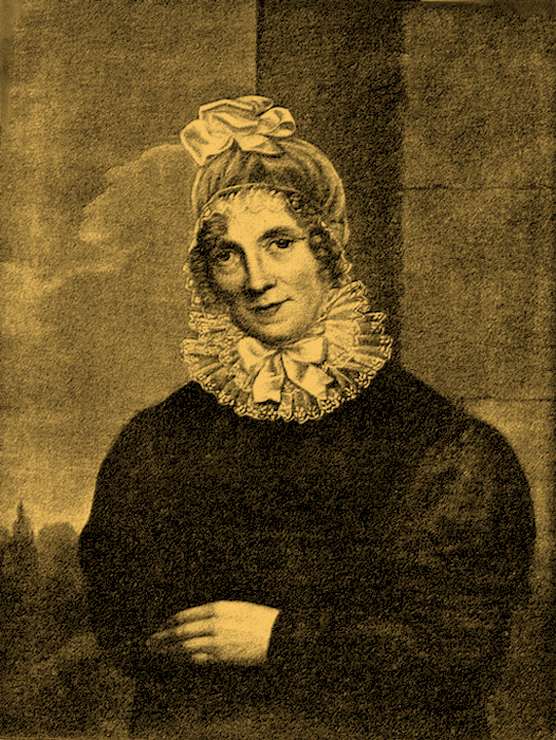
Luise Gotter, née Stieler
One of Caroline’s childhood friends and her most loyal lifelong correspondent. She writes to Schelling after Caroline’s death in 1809:
“I count my friendship with her, a friendship that began in my early youth, among the most fortunate occurrences of my life. Every hour spent with her was pure gain for both heart and mind.”
(Portrait by Louise Seidler; from Carolinens Leben in ihren Briefen, ed. Ricarda Huch [Leipzig 1914], facing p. 8.)

Friedrich Wilhelm Gotter
This writer, an acquaintance of Goethe from their days in Wetzlar, later married one of Caroline’s lifelong friends and most consistent correspondents, Luise Stieler. In the autumn of 1791, Caroline and her younger sister Luise traveled to Gotha to visit the Gotters. While there, Caroline was wooed by a certain distinguished clergyman for whom the Gotters functioned as mediators.
(Portrait: Gustav Könnecke, Bilderatlas zur Geschichte der deutschen Nationallitteratur, 2nd ed. [Marburg 1895], 320.)
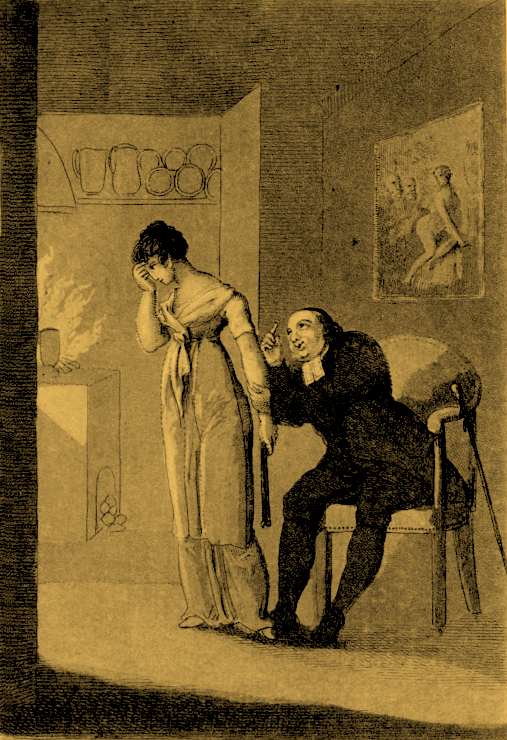
Caroline’s good friend Friedrich Wilhelm Gotter did indeed try in October 1791 to persuade her to accept the marriage proposal of the clergyman Josias Friedrich Löffler even though the latter enlisted Gotter himself to make the offer as middleman.
Both Löffler and, of course, Gotter were doubtless apprehensive that if the clergyman himself were to approach Caroline with such an offer, the resulting scene might well resemble this illustration (see below concerning Caroline’s answer):
(Neoterpe: Auf das Jahr 1810; Inhaltsverzeichnis deutscher Almanache, Theodor Springmann Stiftung.)
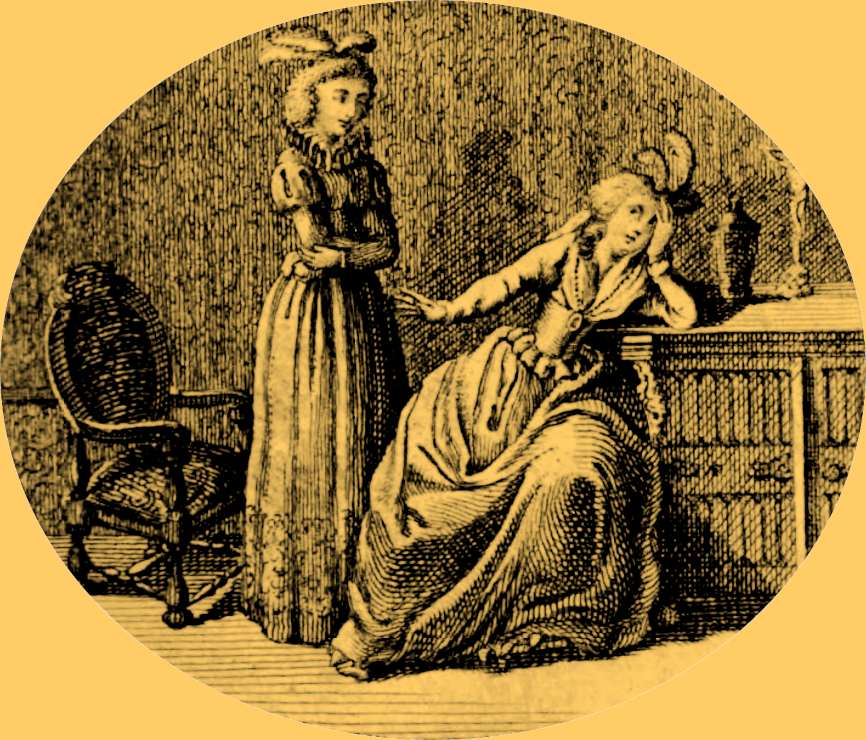
Caroline declines the offer of Josias Friedrich Christian Loeffler’s hand
“My dear Louise — your simple, straightforward wisdom already anticipated it — nor does the tone of your last missive contain any more element of tense anticipation — hence you will not really be taken aback if I confess to you that I cannot.”
See next illustration.
(Title vignette to J. F. E. Albrecht, Die Familie Eboli: Dramatisch bearbeitet vom Verfasser der Lauretta Pisana, vol. 3 [Dresden, Leipzig 1792]).
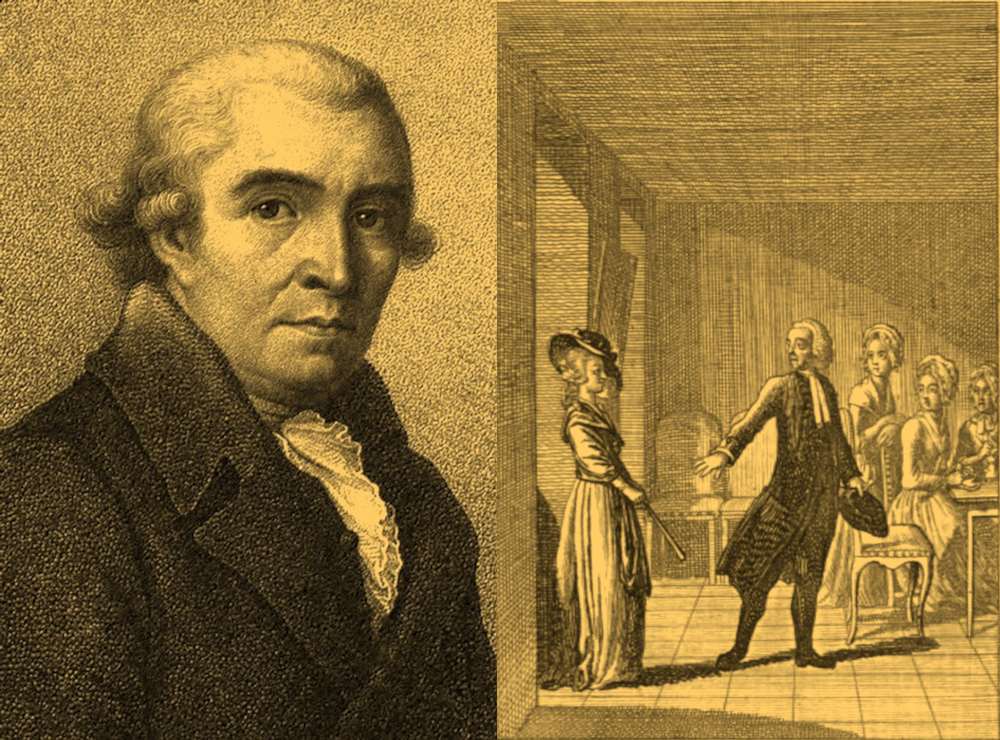
Josias Friedrich Christian Löffler
The Gotha clergyman who tried to entice the widowed Caroline back into marriage. Had she accepted his offer, her life would have been far different. In many ways, he was to Caroline what Mr. Collins was to Elizabeth Bennet. Caroline writes:
“I admittedly could have made myself quite useful to the state by keeping a proper household for him and by raising another half dozen children just like my own, one and only, dear little girl — but all that will happen just as well without me.”
Luise Gotter writes to Caroline: “The day before yesterday, he appeared thus [without a peruke] at our tea gathering. Everyone was paying him compliments on that account, and Wilhelmine and I whispered to each other what a terrible pity it was that Caroline was not there!”
([1] frontispiece to Josias Friedrich Löffler, Kleine Schriften von Josuas Friedrich Christian Löffler nach seinem Tode gesammelt, vol. 3 [Weimar 1818]; [2] Genealogischer Kalender auf das Jahr 1788; Inhaltsverzeichnis deutscher Almanache, Theodor Springmann Stiftung.)
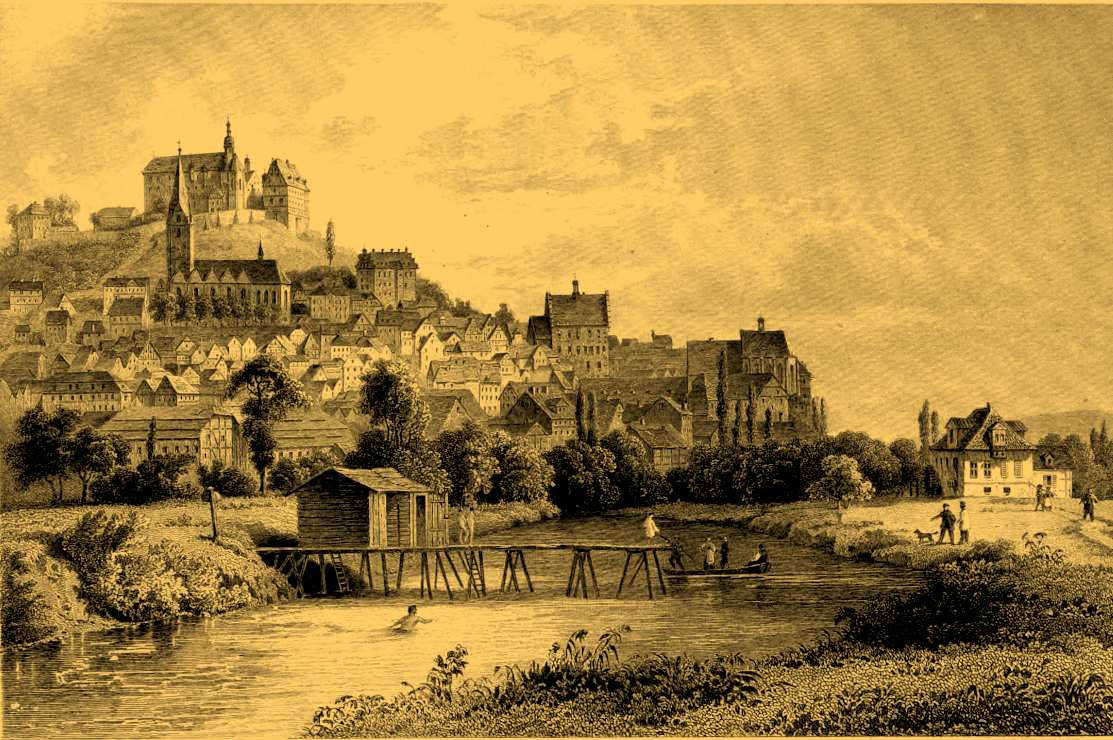
Marburg
Marburg, castle and upper town viewed from the Lahn River.
(Aloys Henninger, Marburg und seine Umgebungen [Marburg 1856], following p. 10.)
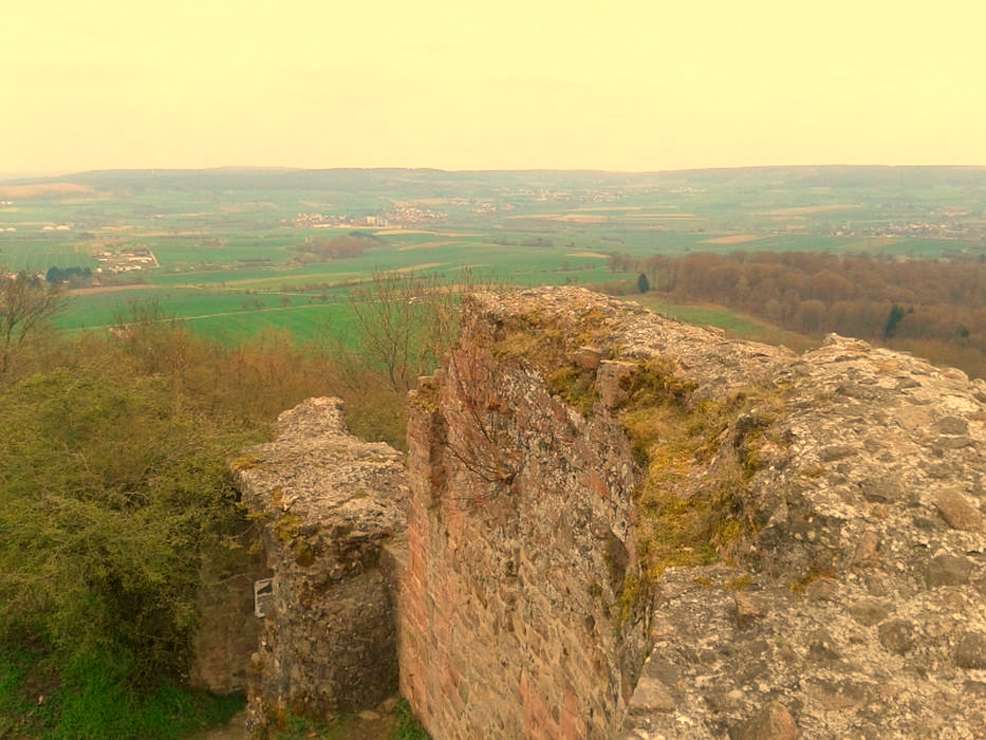
Frauenberg Castle ruins outside Marburg
Caroline enjoyed a picnic here in August 1790, writing to Lotte Michaelis:
“On Sunday we enjoyed a delightful company, almost 100 people, though by a long shot not all our better society. The setting was heavenly, out in the open countryside with tall oaks towering over us at the foot of the Frauenberg castle and with a view so heavenly it simply defies description.”
(Photo: Martin Reulecke.)
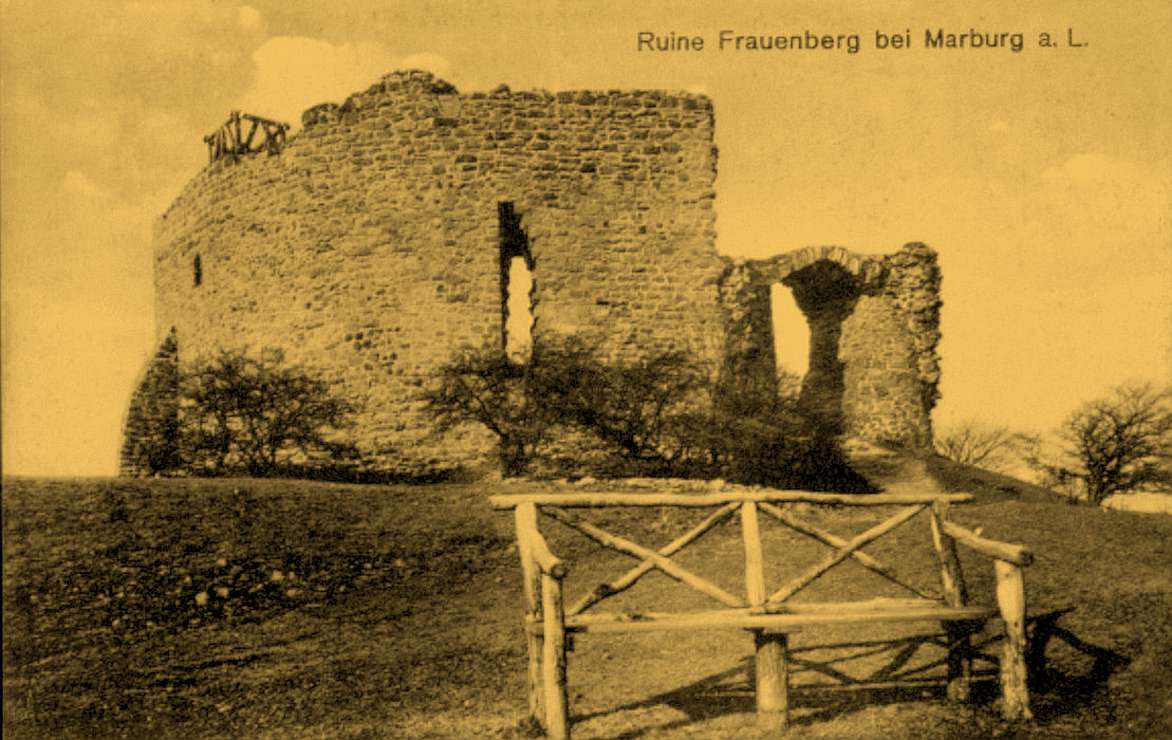
Frauenberg Castle ruins outside Marburg
(Photo: undated postcard.)
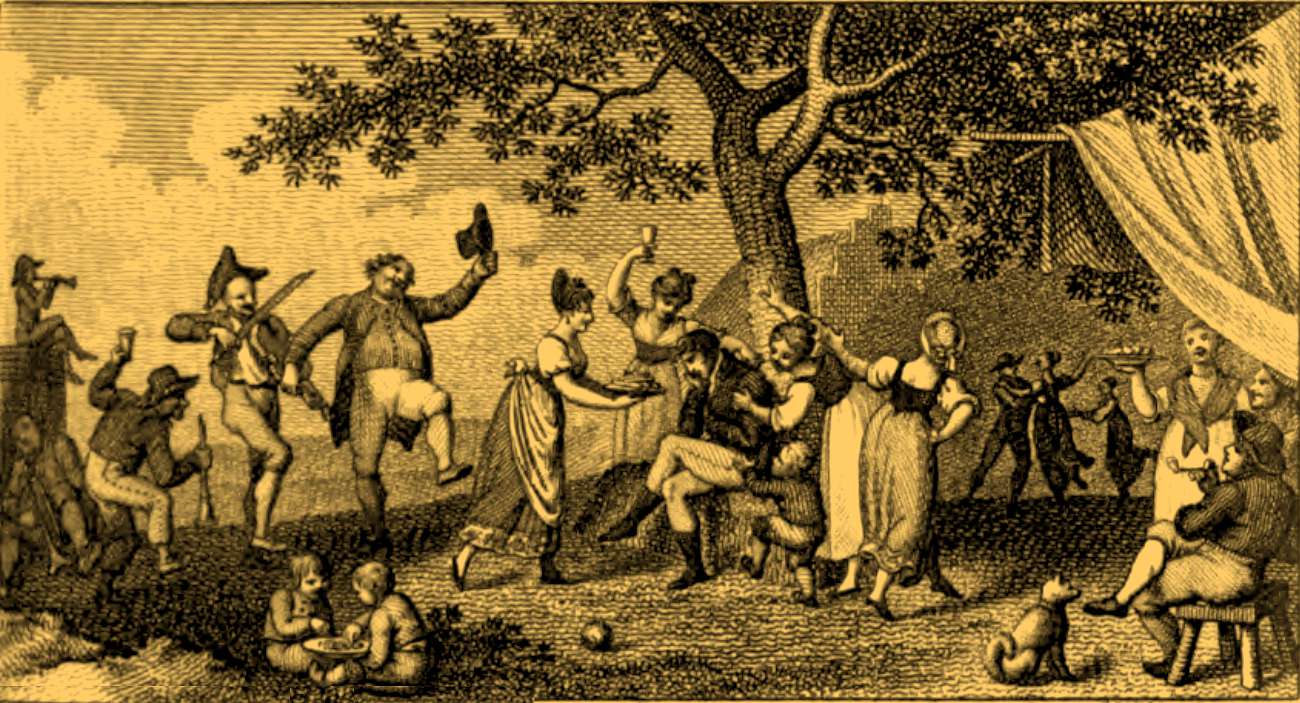
Caroline describes her outing:
“We ate under tents, everything free and easy and sumptuous. During the afternoon, when the farmers assembled, the girls were drawn into the dancing…Saturnalias were celebrated that came close to being Bacchanalias, though they stopped just in time.”
(Taschenbuch für das Jahr 1822: Der Liebe und Freundschaft gewidmet; Inhaltsverzeichnis deutscher Almanache, Theodor Springmann Stiftung.)

Church of St. Elisabeth
The Church of St. Elisabeth, whose construction was begun in 1235 over the tomb of Elizabeth of Thuringia (in background: what Caroline refers to as her “enchanted castle”). Caroline writes on a Sunday morning in 1789:
“Yesterday evening the Schulers and Hansteins had tea with us, and we made arrangements for several outings, one to the Church of St. Elisabeth and St. Elisabeth’s washing fountain, and to the Frauenberg.” (Concerning “St. Elisabeth’s washing fountain,” see the next gallery images.)
(Ansicht der Stadt Marburg mit der Elisabethkirche von Nordosten, Hessen, 1826–50; Foto Marburg, 1.451.039; Bilddatei fm1451039 Microfiche-Scan mi12586b11;; Aufn.-Datum: um 1960/1970.)
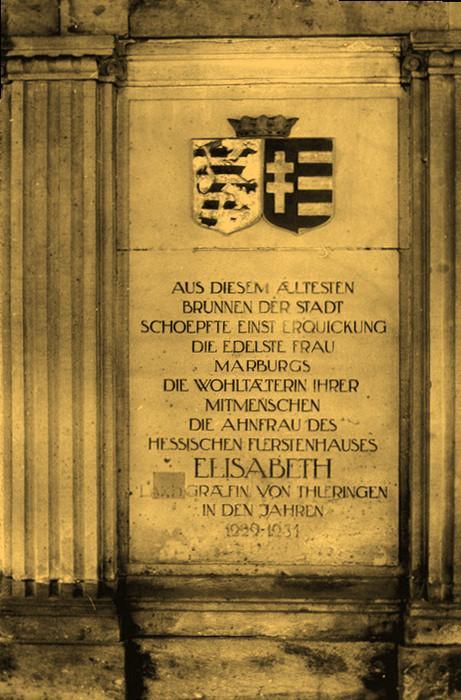
St. Elisabeth’s Fountain in Marburg
Marburg, St. Elisabeth’s Fountain at the corner of Bahnhofsstrasse, Elisabethstrasse, and Wehrdaer Weg. According to a late 18th-century text, St. Elisabeth used its waters for washing. Although Caroline may have been referring to this fountain in town, her more likely excursion goal was the second fountain associated with St. Elisabeth, outside town (see next illustration).
(Photo Stadtarchiv Marburg.)
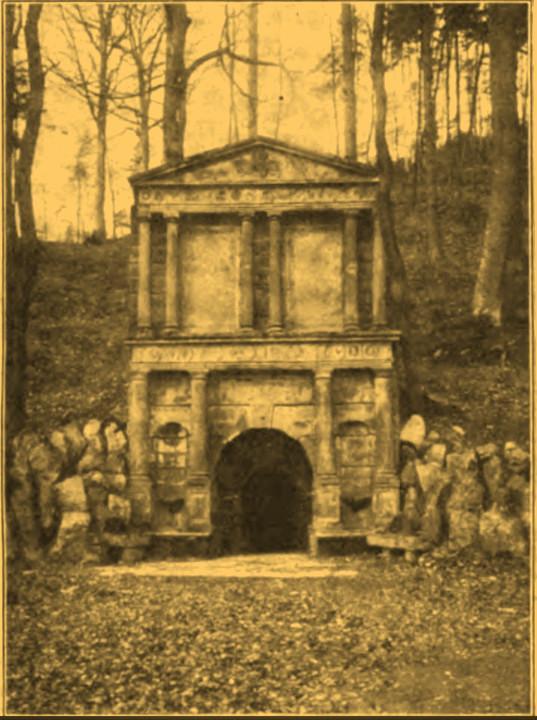
St. Elisabeth’s Fountain outside Marburg
This fountain, located in the formerly primarily wooded area just outside the center of town on the Lahnberg, seems the most likely location of Caroline’s anticipated excursion from town in 1789.
(Photo: Hessische Landes- und Volkskunde: Das ehemalige Kurhessen und das Hinterland am Ausgange des 19. Jahrhunderts, Carl Kessler, vol. 1: Hessische Landeskunde: Zweite Hälfte [Marburg 1907], 265.)
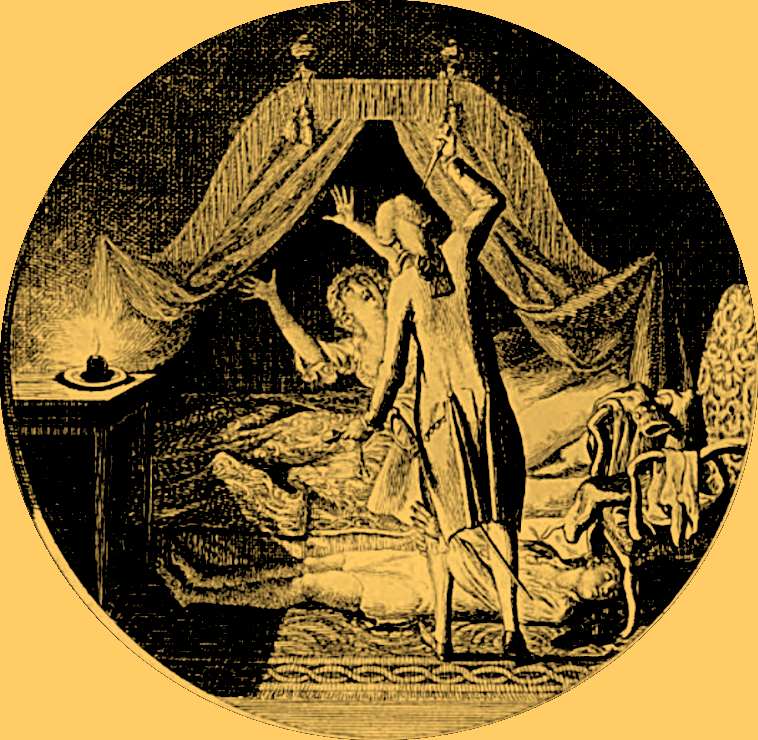
Caroline writes to her brother Philipp from Marburg:
“Mlle. Wiederhold experienced firsthand a tragic catastrophe. Her fiancé, a certain Herr Schulz from Bovenden, was just coming from her parents to get her assent. Another suitor became infuriated on learning of it and stabbed her that night between 2 and 3 o’clock with a bread knife — but then was so distraught that he also stabbed himself three times, missing his heart by scarcely an inch.”
(Frontispiece to Edouard Romeo Graf de Vargas, Novellen, vol. 2 [Berlin 1792].)
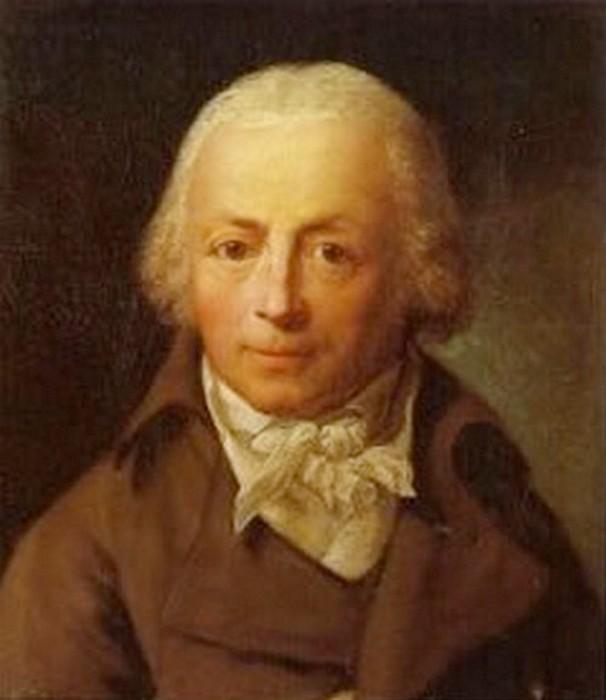
Gottfried August Bürger
The Göttingen poet for whom Caroline maintained an affectionate understanding. Caroline in 1791:
“If I had space, I would write you about literary things — about Schiller, who stripped Bürger of all human dignity in a review, and about Bürger, who knows how to defend himself only with irony — a weapon that generally misfires in the hands of most writers, since most writers are men — and also about Bürger the husband, the shadows of whose blessed deceased wives are now taking revenge in his present, living one.”
(Portrait: 1792 by Anton Graff.)
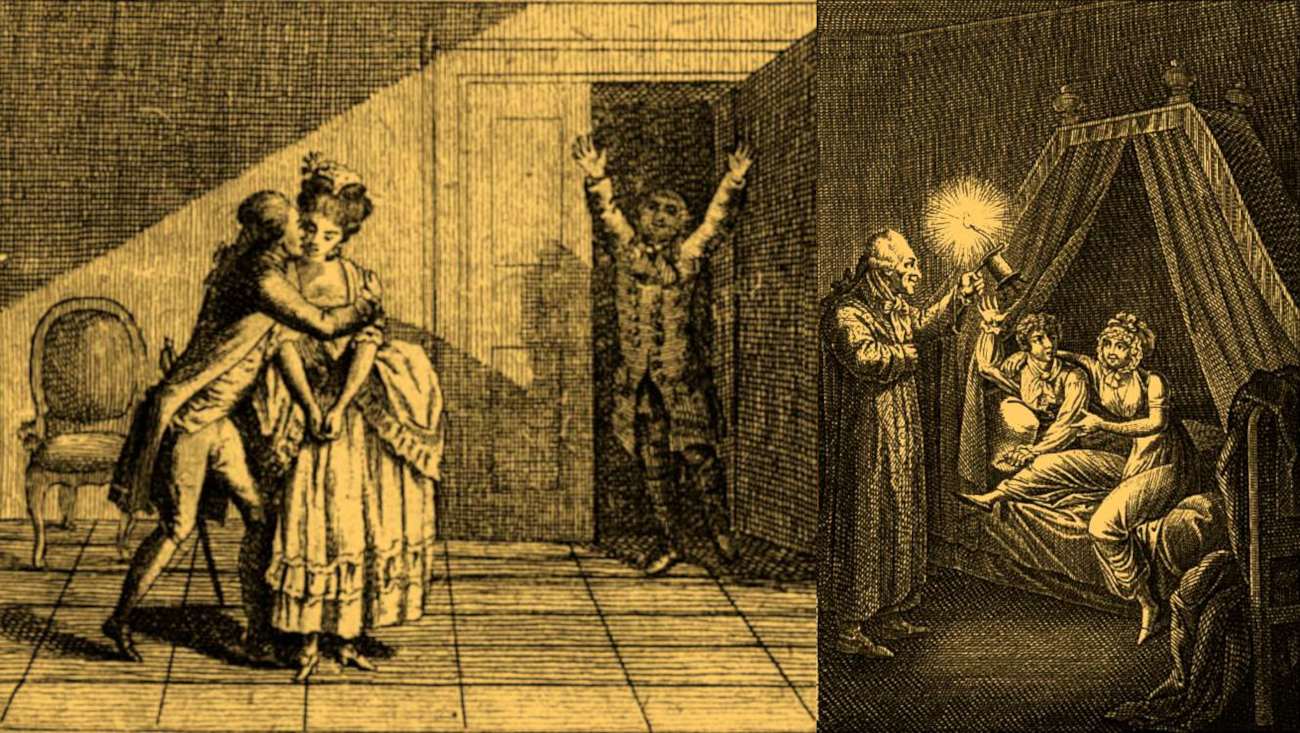
Romantic Trysts with Paramour
To wit, after marrying Gottfried August Bürger and moving to Göttingen, Elise Bürger — Bürger’s “present, living” wife — quickly began a series of trysts with young men, one of whom was Philipp Michaelis. Bürger himself even surprised them on one occasion.
(Illustrations: [1] title vignette to Henry Fielding, Geschichte des Thomas Jones, eines Findelkindes, vol. 6 [Vienna 1788; [2] frontispiece to Christian Althing (Christian August Fischer), Erotische Schriften, vol. 3, 2nd ed. [Leipzig 1807].)

Elise Bürger, née Hahn
Elise Bürger, as Cleopatra in August von Kotzebue’s play Oktavia. Gottfried August Bürger’s third wife, notorious in Göttingen for her randy behavior with students, including Caroline’s brother Philipp. Bürger writes to Wilhelm Schlegel in 1792:
“This past winter I had to secure a legal divorce from the most wasteful, extravagant, hypocritical, wanton, and adulterous of all women under God’s sun…A museum piece of marital vice equal to this woman will probably never again exist in nature.”
(Illustration: from Gotthelf Wilhelm Rupert Becker, Einige Charaktere aus den Darstellungen der churfürstlichen sächsischen Hofschauspielergesellschaft [Leipzig 1804].)