

George Washington
Caroline’s half-brother, Fritz, was a staff medical officer with Hessian troops in America during the Revolutionary War. Caroline writes in February 1780:
“The most recent newspapers reported that Washington was dead, and I was all ready to celebrate his death when, unfortunately, I learned I would be rejoicing in vain, since he was still in the best of health. Perhaps he has no more desire to die than I. I do not believe, however, that the war can last much longer, though the death of Washington, who must be an excellent general, would have put an end to everything, and I would have seen the best of brothers once again.”
(Granger Collection, New York.)
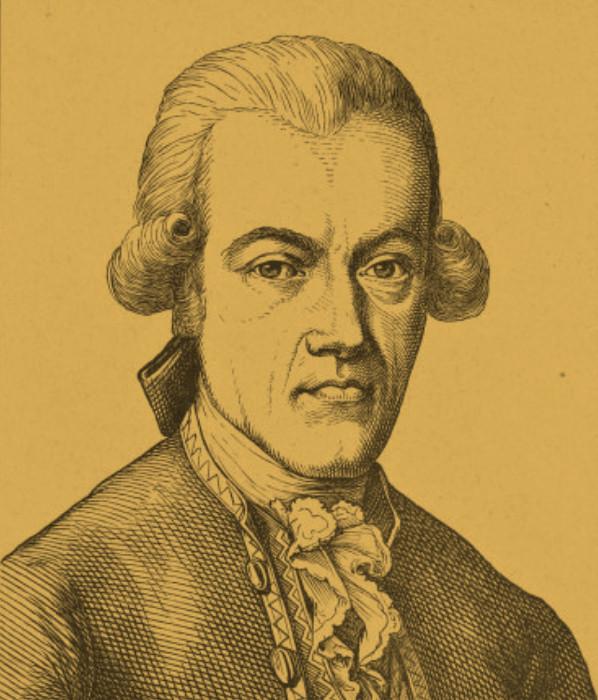
August Ludwig von Schlözer
August Ludwig von Schlözer: Professor in Göttingen, good friend of Caroline’s father, and someone with rather radical notions about the education of women.
(Portrait: drawing after an oil portrait ca. 1779; New York Public Library, Miriam and Ira D. Wallach Division of Art, Prints and Photographs: Print Collection.)
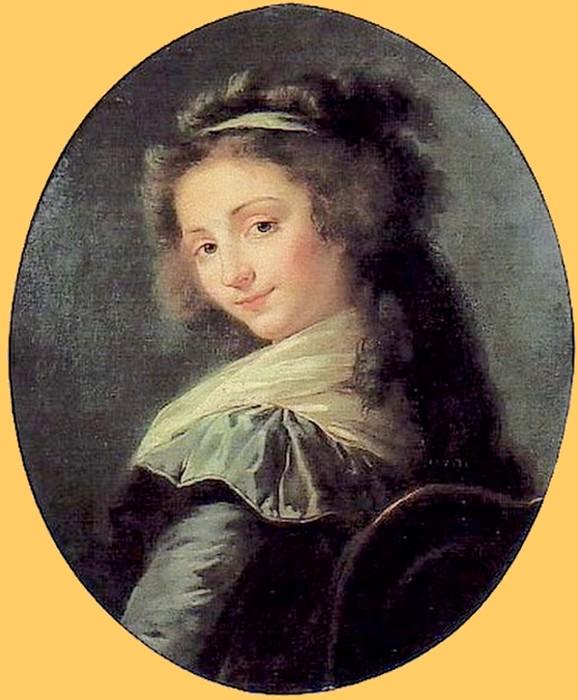
Elisabeth Mara
Elisabeth Mara: Operatic singer with essentially a three-octave range, for a time recognized as the greatest singer Germany had produced. Caroline in 1778:
“She gave two concerts here, singing divinely at the first. Someone [Lichtenberg] who had heard the famous Gabrieli told me that Madame Mara sang better. But at the second concert she did not do so well because her husband made her utterly lose her composure with his constant rudeness. Hence he now possesses my complete hatred.”
(Portrait by Élisabeth Vigée-Lebrun.)
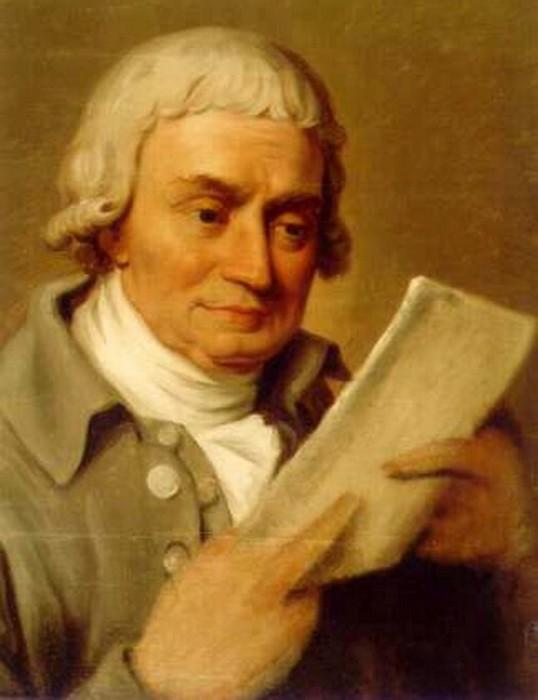
Christian Gottlob Heyne
Christian Gottlob Heyne: Renowned Göttingen professor, classical scholar, archaeologist, neighbor of the Michaelis family, and unrelenting critic of the Michaelis children, especially the daughters. Refers to Caroline in November 1793 as “that depraved creature…such an utterly wretched female, unworthy of any and all respect”.
(Portrait by Johann Heinrich Wilhelm Tischbein, ca. 1800.)
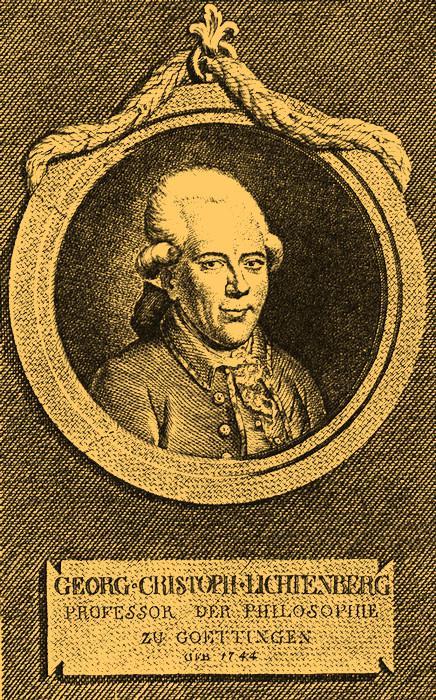
Georg Christoph Lichtenberg
Georg Christoph Lichtenberg: An extremely popular lecturer in Göttingen in experimental physics whose letters provide revealing commentary on events there, including some of the same events Caroline mentions.
(Portrait: presumably by Johann Conrad Krüger after Johann Ludwig Strecker.)
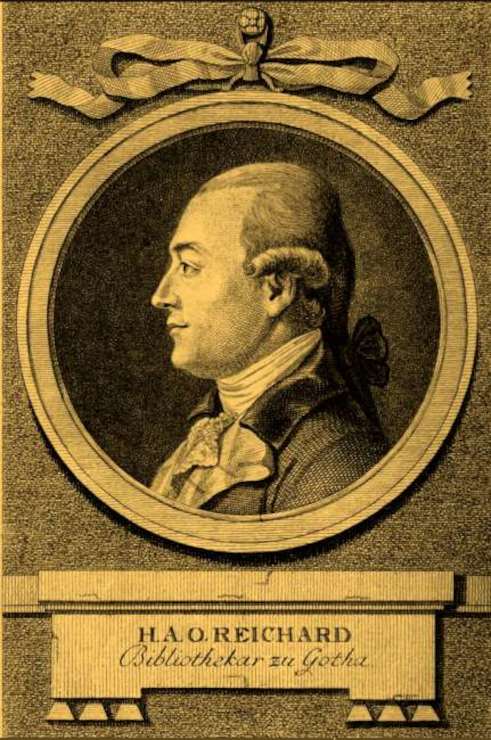
H.A.O. Reichard
H.A.O. Reichard, Gotha librarian with whom Caroline was never quite on good terms. His wife, Amalie, would later be one of her severest detractors in Gotha. Caroline writes as early as 1778:
“Reichard’s verses enjoy sufficient approbation from me and would perhaps enjoy even more were it not for this terrible prejudice I already harbor against that odious man. I almost believe our hatred is reciprocal; at the very least, we certainly had a falling out during my last visit in Gotha. And yet there was a time when we got along quite well.”
(Portrait: by Daniel Berger, engraver, ca. 1780; frontispiece to Litteratur- und Theater-Zeitung 3 [1780] no. 2.)
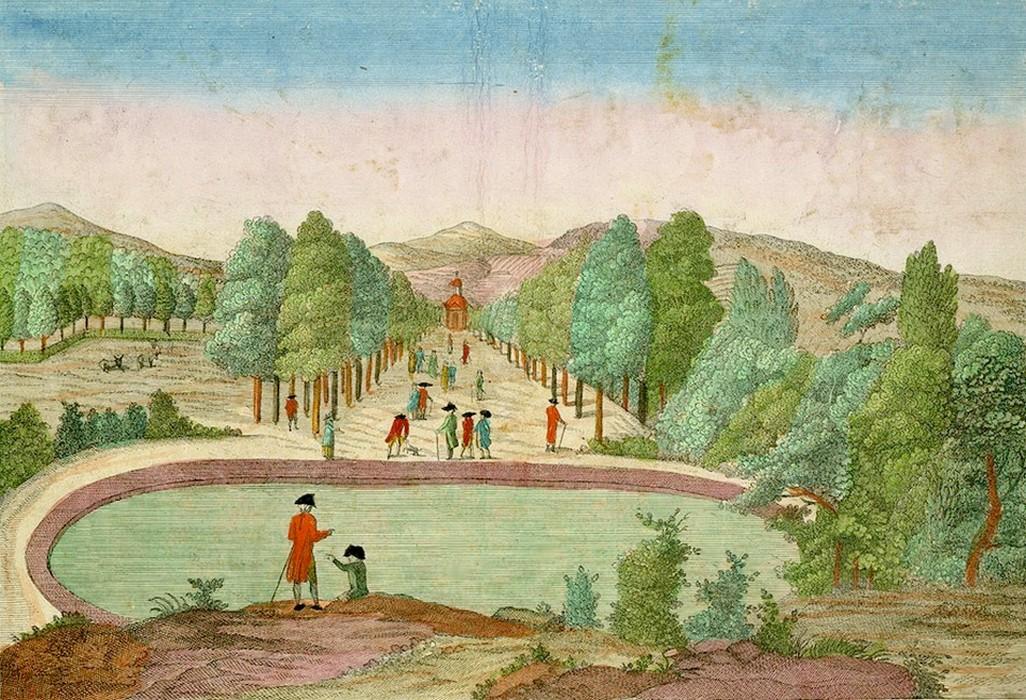
Pyrmont, ca. 1780
Pyrmont in the 18th Century: promenade in 1780. Caroline enjoyed a heady visit with her father during his stay at this trendy resort spa in the summer of 1780:
“I was impressed more than I can tell you by the beauty of the place and by the multitude of foreigners. It is impossible for me to describe it for you. The road was illuminated that same evening, there was a ball, and we saw Pyrmont in all its brilliance. The next day we were introduced and received with the greatest politeness and graciousness, and I made the most agreeable acquaintances there.”
(Zweyte Ansicht der Promenade vom Baad zu Pyrmont, ca. 1780, unknown artist.)
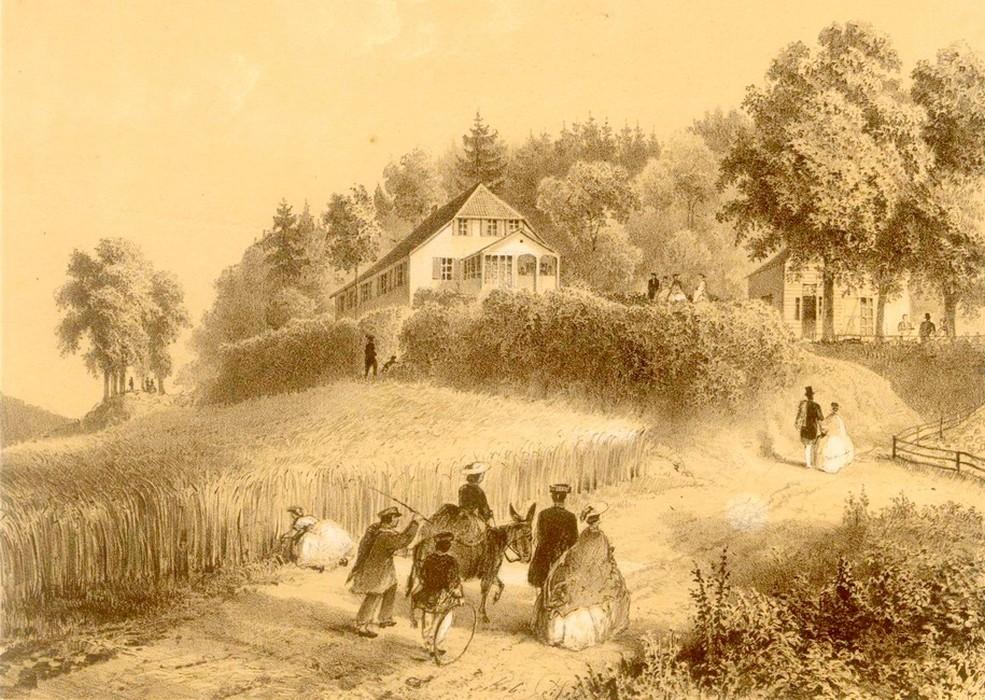
Königsberg, Pyrmont
View from the Königsberg near Pyrmont. Note the promontory at left. Caroline continues her travelogue:
“We took a carriage tour to Königsberg, which owes this name to the king of Prussia, whose favorite promenade it was during his own stay at Pyrmont; they have also marked the place where he was accustomed to sit. How could I describe for you the charming and varied environs that presented themselves to my gaze there”.
(R. Geissler, Der Königsberg bei Pyrmont, lithograph [Göttingen, ca. 1850].)
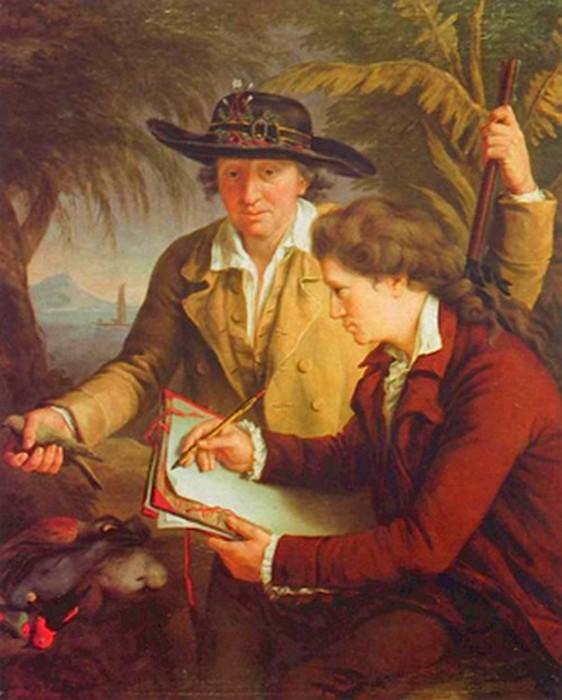
Johann and Georg Forster
World travelers Johann and Georg Forster: In 1779, Caroline mentions the elder Forster’s financial problems in England:
“Monsieur Forster is here to distract himself a bit, since he is quite melancholy, and I do believe he has reason to be. His fate is not among the most agreeable. His father causes him considerable anxiety; they were not fair to him in London, he has not been compensated for his voyage, and Lord Sendwich despicably surrendered him over to the king.”
(Portrait: John Francis Rigaud, ca. 1780.)
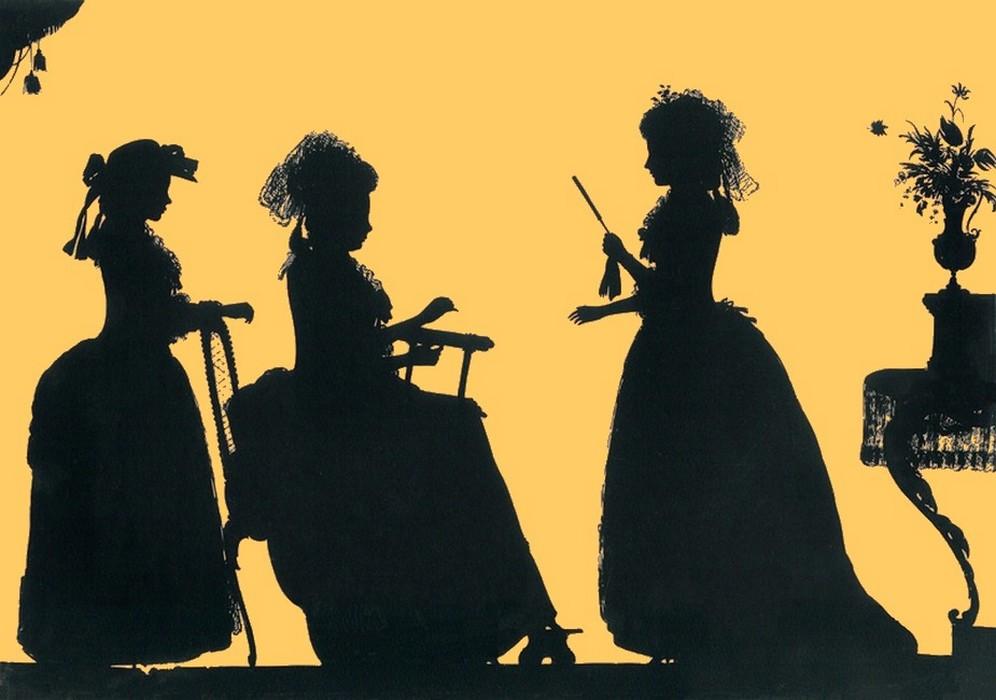
The Michaelis Ladies
Undated silhouette of Luise, Madam, and Caroline Michaelis.
(Otto Cramer Family Archives, courtesy of Martin Reulecke.)
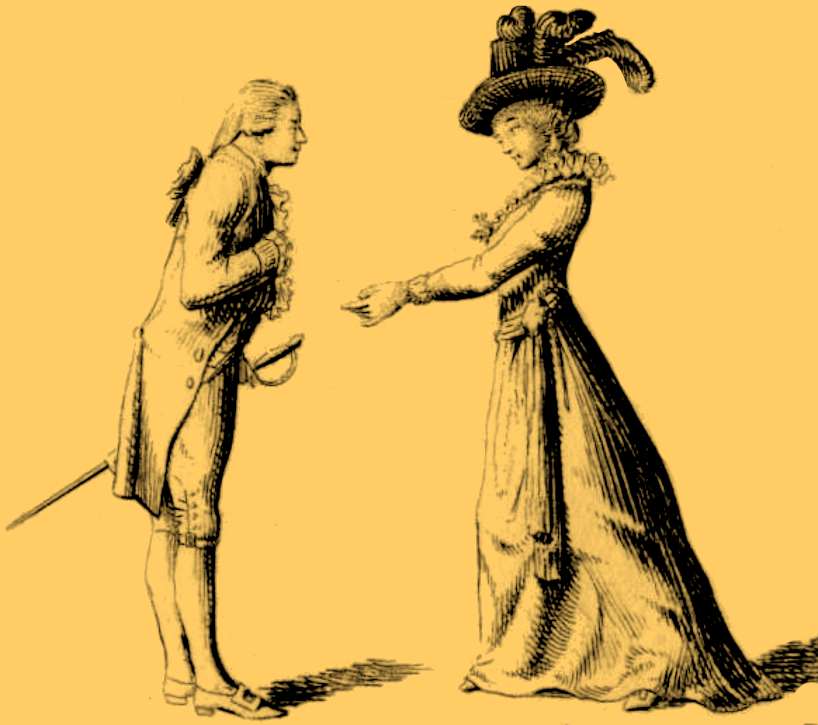
In May 1779, Heinrich Christian Boie meets Caroline — still three months shy of her sixteenth birthday — at a social event for the first time after an absence of five years, then immediately writes to Luise Mejer that
Mamsell Michaelis is — a bit wild. She came right up to me without me even recognizing her, an experience I had with others as well: young girls had turned into young women.
(Goettinger Taschen Calender vom Jahr 1783; Inhaltsverzeichnis deutscher Almanache, Theodor Springmann Stiftung.)
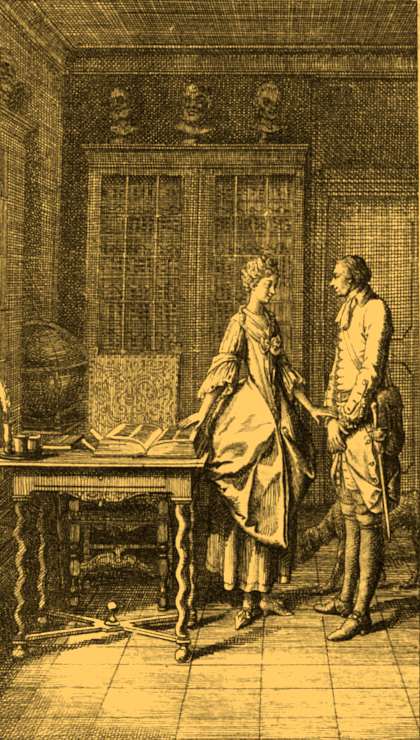
A young Caroline writes to Luise Gotter in June 1780 concerning the student Wilhelm Link, her early flame:
“Far be any romantic notions from me! I do feel I could come to prefer Link to all others, I know he deserves the preference I accord him, and I hope that because my inclinations toward him are based on the characteristics of his soul and on his excellent manner of thinking, they are innocent and cannot be displeasing to our kindly father in heaven.”
(Representative illustration from Thomas Amory, Leben, Bemerkungen und Meinungen Johann Bunkels, nebst den Leben verschiedener merkwürdiger Frauenzimmer, trans. Reimarus von Spieren, vol. 1 [Berlin 1778], illustration following p. 44.)
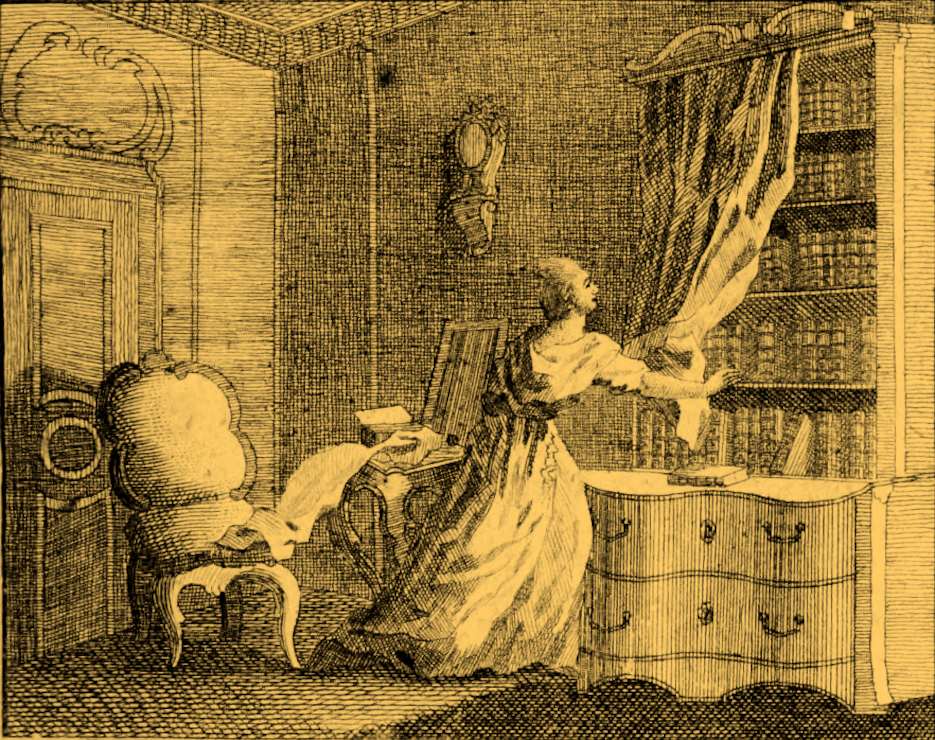
Access to the Family Library.
As a young woman, Caroline was indeed fortunate insofar as she had access to her father’s scholarly library.
(Frontispiece to Christian Gottlieb Steinberg, Lehrbuch für Frauenzimmer [Breslau Leipzig 1772].)