
Production Notes to the Music from Nina, or The Love Distracted Maid:
Personal, Musical, and Technical
Dave Moyer [*]
“I couldn’t believe that Dalayrac
was suddenly being so fiendish
to his poor second violinists.”
— Dave Moyer
1. Personal Background, Connection with the Caroline Project; — 1.1. Personal Background; — 1.2. Connection with the Caroline Project; — 2. Musical Issues; — 2.1. Original Orchestration; — 2.2. The Score; — 2.2.1. Rehearsal Figures and Bar Numbering; — 2.2.2. Errors; — 2.2.3. Spacing and Readability; — 2.2.4. Inconsistent Phrasing and Articulations; — 2.2.5. Dynamics; — 2.3. Tempos; — 2.4. Vocal Parts; — 3. Technical Issues; — 3.1. Instruments And Voicing; — 3.2. Panning; — 3.3. Effects; — 3.4. Sequencing; — 3.5. Recording, Mixing, and Mastering; — 4. Conclusion. —
Preface
Back in April of 2025, Doug Stott introduced me to his website devoted to Caroline Schelling. He explained her association with the Singspiel Nina; or, The Love Distracted Maid, with music by Nicolas Dalayrac (1786), and the sad fact that it had never been recorded apart from a single aria. When he wondered if I might be interested in sequencing that aria and the overture, I jumped at the opportunity — little realizing that, before the year was over, the entire Singspiel would be complete and available for the world to enjoy.
Here are my notes on how my personal connection with the project came about and on some of the more interesting and quirky musical and technical issues I encountered in this eighteenth-century score.
1. Personal Background, Connection with the Caroline Project
1.1. Personal Background
(illus.2)
I’ve been playing the piano since early childhood and developed an interest in electronic keyboards as far back as high school; eventually I bought an electronic piano and two sound expansion modules as well as an early model software sequencer. I very quickly discovered how much I loved creating my own interpretations of classical music, although my instruments were somewhat limited in range, capacity, and tonalities.
Just a few years later I bought my first proper synthesizer, a Korg M1, and joined a rock group. My classical dabblings went by the wayside for a few years until I bought a Roland JV-1080 synthesizer module. The main reason for that purchase was to increase the range of sounds I had available for my band work, but I soon discovered that its orchestral instrument patches made me interested in doing classical material again. I started with smaller pieces before eventually graduating to material such as Vivaldi’s Four Seasons, Handel’s Water Music, Rossini’s William Tell Overture, and a portion of Dukas’ Sorcerer’s Apprentice, as well as fragments of J.S. Bach’s Orchestral Suites and Brandenburg Concertos.
1.2. Connection with the Caroline Project

(illus.2a)
At some point I joined an online discussion group devoted to the Roland JV/XP line of synthesizers, and that’s where I met Doug. We quickly bonded over a shared sense of humour and similar musical interests. For a long time the friendship was solely long distance, carried out via E-mail — but when my wife, Hai Toh Lim, and I started to winter in Florida, we found that our route southward from our home in Ottawa, Canada, led right through Atlanta. This led to (almost) annual visits with Doug and his wife, Barbara Wojhoski, on either the southbound or, more frequently, northbound leg of our journey, and the four of us soon forged a deeper relationship.
I developed a habit of sharing music with Doug and Barb, usually annually at Christmas. In 2020, I shared the largest project I’d undertaken to date — the complete Brandenburg Concertos, arranged and recorded over the previous few years. Digging deeply into these masterpieces had taught me invaluable lessons about orchestration, arrangement, and digital recording techniques, all of which I continued to apply to subsequent annual projects. But meanwhile, Doug was apparently already starting to think about Nina.
(illus.3)
On that warm April afternoon in 2025, when Doug first started telling me about Caroline Schelling and his astonishingly comprehensive website, I honestly wondered where he was heading with it. But as soon as he mentioned the previously unrecorded Singspiel, my interest was piqued. When he allowed that he’d even managed to obtain the complete score to said Singspiel, I was hooked — the opportunity to realize and record a significant piece of music, unheard by anyone currently alive, is vanishingly rare, and not one I would have missed for any reason.
By the time we were back home in Ottawa, Doug had sent me pdfs of the score, and I got down to work. The overture was complete in a few months — and after I finished the aria we discussed adding the lover’s duet featuring the two lead voices, Nina and Germeuil. I agreed, and started on that piece as well. Of course, that led to a fourth piece, and by the time that one was complete, I knew I wouldn’t be satisfied until I’d finished the entire opus. By December 2025, I reached that goal — and I’m very pleased with the results. I hope subsequent listeners are, too.
(illus.4)
2. Musical Issues
The score was remarkably complete and in surprisingly good condition considering how old it was when finally scanned and digitized (the work was written in 1786 but fell into obscurity sometime in the early 19th century).
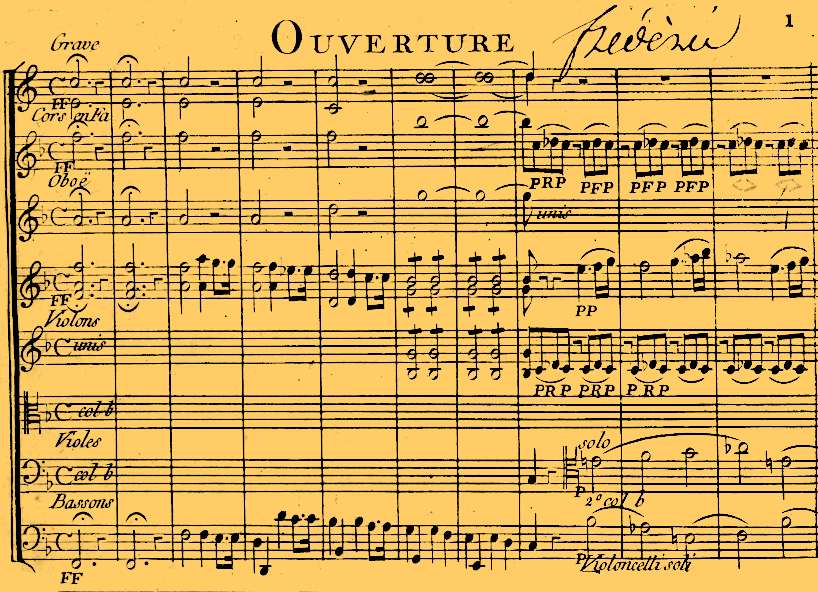
(illus.5)
To my great delight, it included both the full score (accessible under “Music” in the header menu) and the individual partitions for all the instruments, and all were fully intact. This meant not only that I’d have a choice as to which specific score to use as a source, but also that, in the case of anything questionable or possibly unclear, I’d have a second source to refer to. In fact, this became a lifesaver on more than one occasion.
2.1. Original Orchestration
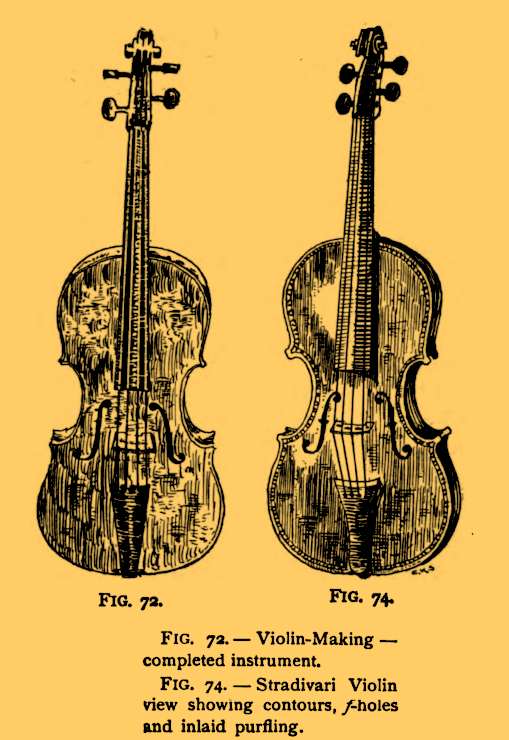
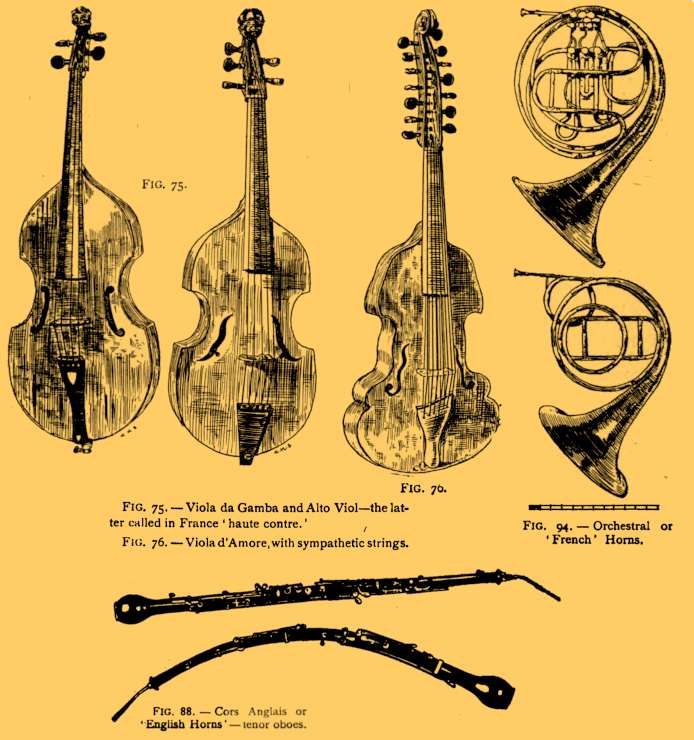
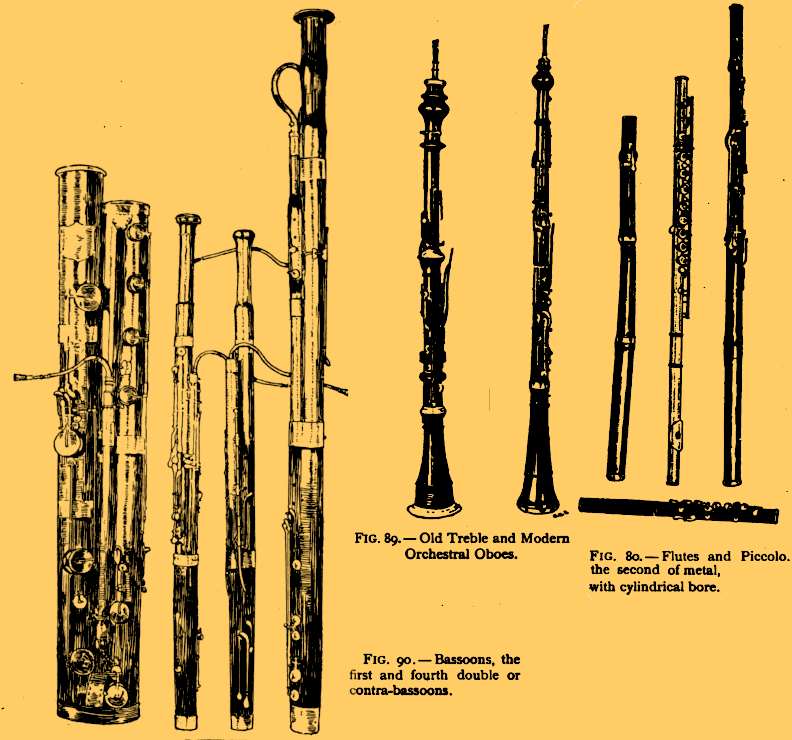
(illus.6)
The first step was to establish the orchestration. Nina is written for a moderately large orchestra — the standard complement of strings (first violin, second violin, viola, cello, bass), two bassoons, two horns, and two oboes that occasionally double on flute. The cello partitions are, without exception, identical to the bass other than being pitched an octave higher — this resulted in a minor but nonetheless welcome reduction in workload. The violin parts are often divisi, increasing the density of the sonic field. In any event, this orchestration was well within the capabilities of the instruments that I’d be using.
2.2 The Score
My initial thinking was to use the full score as a reference for the recording, as that was what I was used to with my previous work on the Brandenburgs and other orchestral pieces. After only a couple of hours of perusal, however, I realized that the full score wasn’t actually quite as “full” as I’d thought — it turned out to be a sort of cross between a full score and a conductor’s score, leaving out many sections that were either somewhat unison with other parts or perhaps repetitive, and it soon became obvious that I’d have to work with the partitions instead. This, as it turned out, led to a new and unexpected series of difficulties.
2.2.1 Rehearsal Figures and Bar Numbering
It didn’t take long to realize that, unlike any score I’d worked with previously, Nina was utterly bereft of not only rehearsal figures, but also bar numbers. I’ve since learned that these only became common in the Romantic Era, but one of the advantages of working with music by composers as well known as Bach and Vivaldi is that their scores have had modern editing techniques applied to them over the years — and, as a result, modern conventions such as these are generally to be found in most editions. Here, working with a score untouched since the late 1700s, I wasn’t quite so lucky — every partition had to be carefully reviewed and tracked, with bar numbers added diligently by hand. Not only did this addition greatly ease the recording process, it also was instrumental in identifying more than one egregious error, which will be explained in the next paragraph.
2.2.2 Errors
When working with modern editions of well-known music, I’ve frequently seen notes regarding the correction of “errors” found in autograph scores or earlier edits. I was somewhat puzzled when I first saw this — what, I pondered, constituted an “error”? How could the editor know for certain what the composer’s intention was? I was soon to learn not only that actual score errors do indeed exist, but also that many of them are remarkably easy to spot — and sometimes remarkably eyebrow-raising.
The first and perhaps most startling error showed up in the overture itself, in the middle 6/8 portion (later appearing in the Singspiel as “Shepherd’s Air”), at bar 39 and, later, bars 55 and 71 of the 1st oboe part. Not to put too fine a point on it, there are simply too many notes in these three bars — they add up to seven eighth-note beats, not six. This was such a surprise to me that I actually asked two other experienced musician friends to review it, just to ensure that I wasn’t missing something obvious.
(mss. 39, 71):
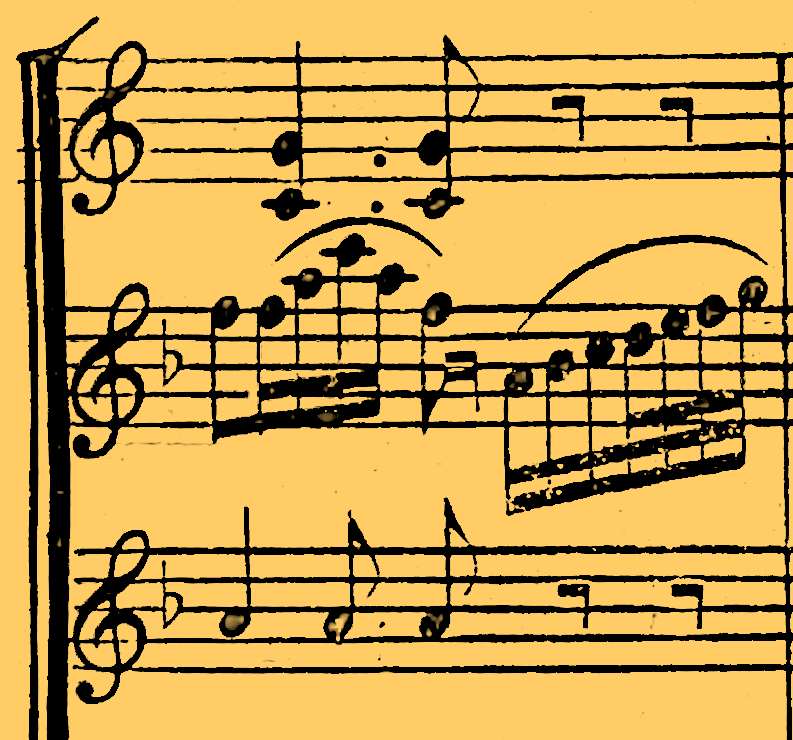
(ms. 55)
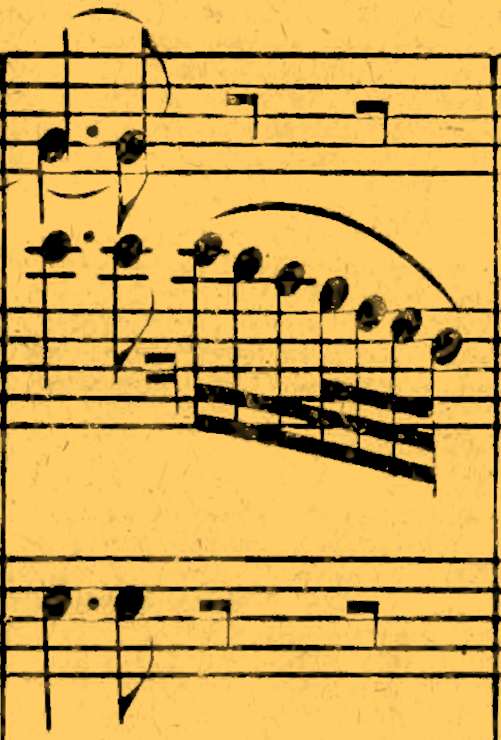
(illus.7)
They confirmed that I was, indeed, reading it correctly and that somehow the composer had written something that was quite impossible — and repeated it 16 and 32 bars later. I dealt with this by changing three sixteenth-notes and a sixteenth-note rest in each of the three offending bars to thirty-second-note duration. While this may not be precisely what Dalayrac had intended, it’s nevertheless musically appealing, and retains the full melodic content of the bar.
In addition, on more than one occurrence I realized that a partition was missing a bar. Here’s where the bar numbering became invaluable, as it made it much faster to determine where precisely the missing bar was located. On one occasion, this was due to inaccurate note durations in a part — on another, it seemed to be a note that was forgotten altogether. In any event, these were easy to correct based on musical context from the other parts.
And finally, there was one incident where an unmistakably “wrong” note was very clearly designated in a part — and another equally wrong note was found in the same location in an adjacent part. A close look revealed that those two notes had been mistakenly swapped from their respective parts — moving them back to where they belonged resolved the situation.
A distantly related error is that the score progresses from scene vii to scene ix without an intervening indicator for scene viii.
2.2.3 Spacing and Readability
In one of our discussions regarding the original score, Doug made the point that under certain circumstances people of that time often operated (or were forced to operate) on the principal that “paper is expensive” — in other words, a tendency might develop to cram as much music (and text) as possible into as little space as practicable. It was apparent that Dalyrac and/or his copyist were following this same practice, resulting in extraordinarily crowded staves in many of the partitions.
While most modern music, or modern editions of older music, tends to have between four and eight bars per staff, sometimes going as high as thirteen or fourteen bars per staff if the music is less complex, the Nina parts frequently feature as many as twenty-five bars per staff. Rather than being a somewhat consistent physical size, bars are written to be only as wide as they minimally need to be in order to contain the notes within them.
While not at all “wrong,” this nonetheless results in a score that’s much more difficult to read than it might otherwise be, even in the mostly ideal circumstances under which I was working — that is to say, with plenty of time and plenty of good lighting. I pity the players who had to read this in an orchestra pit with only a candle to provide illumination!
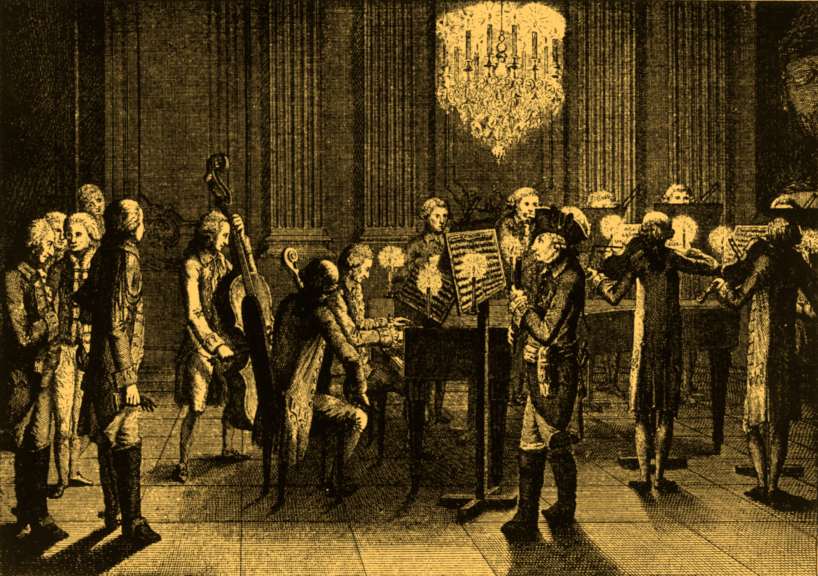
(illus.8)
As if this wasn’t enough, the printed score frequently uses a convention I have never seen or heard of before, one that would likely horrify almost anyone today with experience in reading music: In the case of a particularly busy or lengthier bar at the end of a staff, the copyist simply broke the measure between staves, – with the first half of the bar at the end of one staff, the second half at the beginning of the next. The only indication was an unusual, mordent-like symbol inserted at the break (here an example with the initial five instruments of a staff):
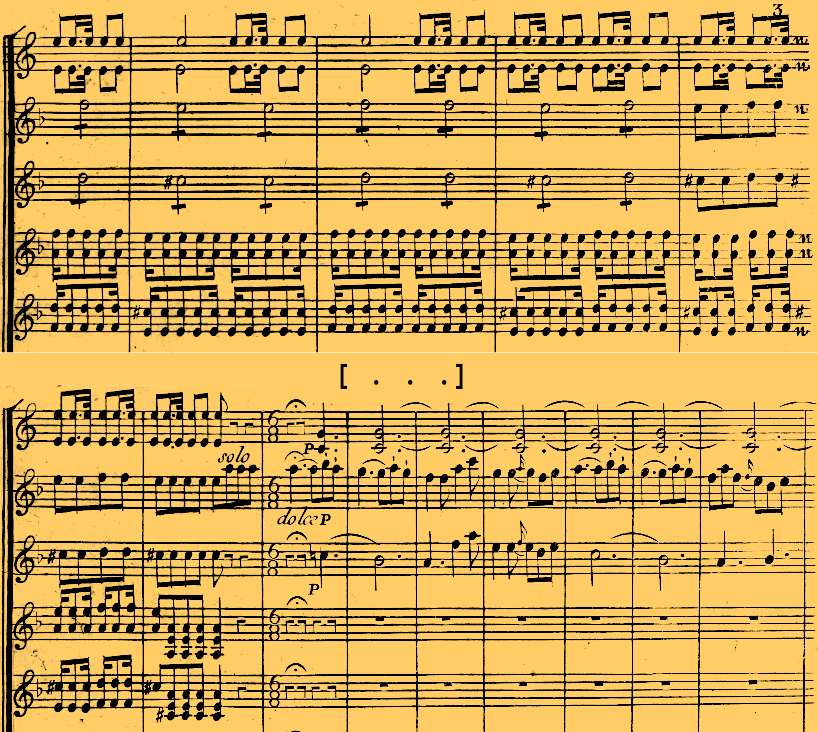
(illus.9)
This phenomenon showed up most frequently in the full score, but occasionally also in individual partitions, and its occurrence never failed to throw me for a loop. It is gratifying that modern notation practice has rejected this idea.
2.2.4 Inconsistent Phrasing and Articulations
These issues ended up being, collectively, perhaps the most time-consuming element of the recording process — or at least one of the more frustrating elements. On too many occasions, the phrasing and articulation marks were infuriatingly inconsistent — the initial statement of a musical figure would include clear staccato markings, for instance, as would the second and perhaps third statement of that figure, but on subsequent statements the staccato markings would be absent. Or they’d be absent entirely in an adjacent part, for example the second oboe as opposed to the first oboe. The only way to resolve this was through experimentation — more often than not, I decided that the copyist had simply forgotten to include them, and that the work was improved when it was more consistent.
A similar, albeit slightly different, problem occurred frequently with phrasing — here the inconsistency was often between parts. For example, the first violin would feature a perfectly logical and musically pleasing phrasing pattern, and the second violin would have an equally logical but quite different phrasing pattern — and the two patterns put together resulted in an unpleasantly muddy morass. Here it was useful to refer to the conductor’s score — and while it sometimes would help to clarify such a difference, on other occasions it only served to muddy the waters further. In these cases, I had to rely on my own judgment.

(illus.10)
2.2.5 Dynamics
While inconsistency wasn’t as big a problem with the dynamic markings, it wasn’t a total non-issue. Generally the correct dynamics were easy to determine through context, so this wasn’t as much of an issue as it was with phrasing and articulation. I did notice, however, that an occasional solo (usually oboe, flute, horn, or violin) wouldn’t be marked as such on the individual part, whereas it was clearly indicated on the conductor’s score — a situation that may, in performance, have resulted in a soloist having to endure a rather baleful glare from the conductor.

(illus.11)
Also, the Overture featured a handful of dynamic markings which were unfamiliar to me, and I suspect may actually be misprints. In several bars, in several of the parts, the notes are given the dynamic markings of “p r p” (see illus.5) — and while “r” might in this case mean rinforzando, I’ve only seen that abbreviated to either “rf”, or “rfz”, or “rinf”. In any event, the musical context really wouldn’t be calling for rinforzando in these bars — my suspicion is that “r” in each of these cases should probably have been “f”, which would have made more musical sense.
2.3 Tempos
As with so much music of this period, no tempo markings are given in the score. In the past, I’ve never really found this to be a problem, as it was always possible to hear a wide variety of recordings of different interpretations of the work illustrating different choices and interpretations. In this situation, I was in virgin territory for the most part. Fortunately, most of the pieces seem to beg for a fairly specific tempo, although I did end up revisiting a couple of them after I thought I was done — and to be honest, I may do so again in future.
2.4 Vocal Parts
I hadn’t initially planned to record any of the vocal parts of the individual songs. Given that I’d started with the overture, which was entirely instrumental, I hadn’t even really thought about it — and when Doug and I eventually did discuss it, we thought at first that it would make the most sense to have the parts recorded live at a later date by vocalists should the opportunity ever present itself. Given that this would involve quite a number of people and a much more complex recording process, however, I eventually decided to record the vocal parts as instrumental parts as well — it also, quite frankly, was much more satisfying than leaving the project less than complete.
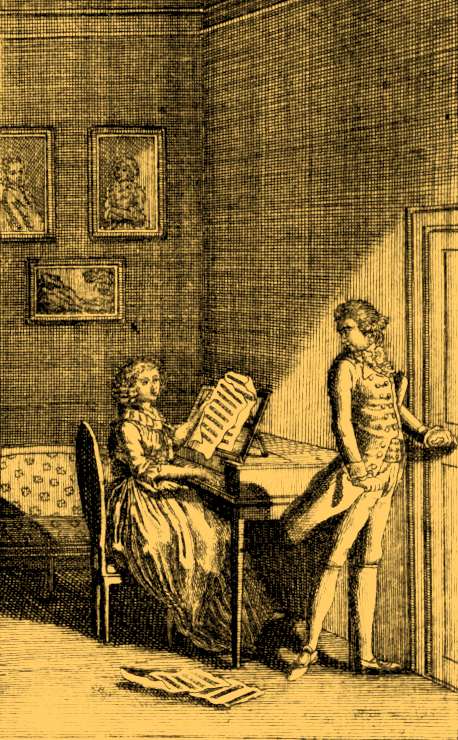
(illus.12)
After further discussion with Doug, I decided to use double-reed voices for all the vocal parts. This decision was based on a number of factors, of which the most prominent was the simple practical fact that double-reeds have a clear and distinctive character that makes them stand out quite noticeably over an orchestra. Also, the instruments that I was using have a good number of excellent double-reed sounds, both solo and ensemble, allowing for a nice mix of complementary tone colours in the vocal parts.
The first step was to assign appropriate instruments to the vocal parts. Nina has six named solo vocal roles, as well as a three-part chorus, so nine distinct voices were necessary. The roles and the instrument assigned to each one are as follows:
Elise (soprano): oboe
George (bass-baritone): bassoon
Le Comte (baritenor):  bassoon
Nina (soprano):  oboe
Germeuil (baritenor):  English horn
Mathurine (soprano):  oboe
Chorus — Dessus (soprano):  oboe ensemble
Chorus — Tailles (baritenor):  oboe/clarinet ensemble
Chorus — Basses-Tailles (bass-baritone):  low double-reed/horn ensemble
Mathurine is a somewhat curious presence — she only has a solo part in one song, “Chantons Nina,” and as she’s a soprano like Elise, her role very likely could have been subsumed into Elise’s. For that reason, and for the fact that her only solo is in a song that doesn’t feature Elise, I chose to assign her the same oboe voice as I did to the latter.
3. Technical Issues
3.1 Instruments And Voicing
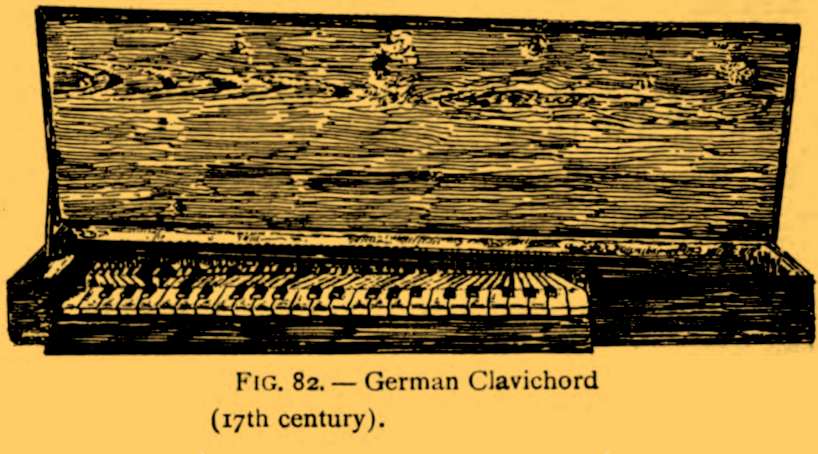
(illus.13)
All the music was created on a Yamaha Motif-6 Music Production Synthesizer and a fully expanded Roland JV-1080 64-Voice Synthesizer Module. The JV-1080 was outfitted with the “Keyboards Of The 60s & 70s,” “World,” “Orchestral,” and “Orchestral II” 8Mbyte expansion boards, although only the latter two were used for the recording.
It should be noted that, well into the recording process, Doug made a gift of the “Orchestral II” expansion board to me after I’d made a rather wistful comment to him regarding finding enough appropriate voices that sounded significantly different from each other. Although I only ended up using it for two of the vocal parts, it was much appreciated, and those two voices do indeed sound markedly different from the others
The voice assignments were as follows, and, unless otherwise noted, are from the JV-1080. “XP-C” indicates the “Orchestral” expansion board, and “XP-D” indicates the “Orchestral II” board.
Flute I & II:  Sweet Flute (Motif)
Oboe I:  XP-C:091 Oboe 1
Oboe II:  XP-C:092 Oboe 2
French horn I & II:  F.Horn Ens (Motif)
Bassoon I:  XP-C:100 Bassoon 1
Bassoon II:  XP-C:101 Bassoon 2
Violin I & II:  XP-C:053 Stereo Vln
Viola:  XP-C:017 Va Small Sec
Cello:  XP-C:021 Vcs Legato 1
Bass:  XP-C:027 Cb Sect ff
Elise: XP-C:095 Oboe 4
George: XP-C:101 Bassoon 2
Le Comte:  XP-D 136 Bassoon 3
Nina:  XP-C: 094 Oboe 3
Germeuil:  XP-D: 134 English Horn 4
Mathurine:  XP-C:095 Oboe 4
Chorus — Dessus:  XP-C:142 Wood Sect 3
Chorus — Tailles:  XP-C:145 Oboe + Cla
Chorus — Basses-Tailles:  XP-C:139 Horn+Wood 3
3.2 Panning
Stereo panning was kept quite simple due to the nature of the work. All pans were static, although dynamic (i.e. automated) panning was technically possible.
Rather than use the relative pan positions of a traditional orchestra, I used a panning technique that I’d used previously and found satisfying. Specifically, I tried to keep bass instruments relatively close to the centre of the stereo field, with the deepest instruments being the closest. Higher pitched instruments that were complementary to each other (e.g. the two flutes, the two oboes, the two French horns) were panned more widely, and on opposite sides to each other. To my mind, this gives a more interesting listening experience, particularly with headphones.
Flute 1:  15 left
Flute 2:  15 right
Oboe 1:  15 left
Oboe 2:  15 right
French horn 1:  25 left
French horn 2:  25 right
Bassoon 1:  7 left
Bassoon 2:  7 right
Violin 1:  12 left
Violin 2:  12 right
Viola:  8 left
Cello:  8 right
Bass:  3 left
A similar strategy was used for panning the vocal parts.
Elise:  30 left
George:  3 right
Le Comte:  15 left
Nina:  7 left
Germeuil:  30 right
Mathurine:  30 left
Chorus — Dessus:  10 left
Chorus — Tailles:  10 right
Chorus — Basses-Tailles:  3 left
3.3 Effects
Given the high quality of the native effects in both the Motif and the JV-1080, there was no need for an outboard effects processor. Effects were limited to hall reverberation and an occasional use of a small amount of chorus. Nothing more was required to produce a realistic orchestra simulation.
3.4 Sequencing
This project was produced using the Motif on-board sequencer. Although dedicated software sequencers are far more flexible and powerful, I’ve been using the Motif sequencer for so long that it’s now second nature to me — I use it for all my band work, which I’m still quite involved with. It has the added advantage of not requiring the presence of a computer to do the job. Whatever limitations it imposed on me were, I felt, quite worth it.
For all but three songs — the “Overture,” “Quand le bien-aimé reviendra,” and the “Shepherd’s Air” — I created two separate stand-alone sequences, one for the orchestra and one for the vocal parts. The “Overture” and the “Shepherd’s Air” have no vocals, of course, and “Quand le bien-aimé reviendra” has only Nina’s voice — this made it simple to integrate that single additional voice part into the orchestral sequence.
Of course, “O Ma Nina,” “Ah, Pour Ses Jours,” and “C’est Donc Ici” also feature but a single voice — why did I separate these three into two separate sequences? Although I no longer recall exactly, the decision likely derived from the environment or exigencies of the recording session at the time.
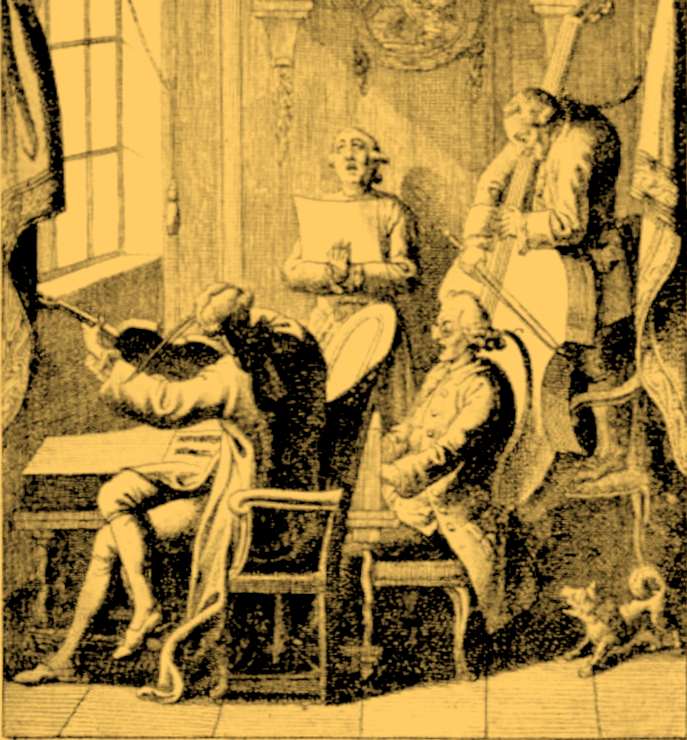
(illus.14)
I am, however, glad that it ended up that way — and if I were to change anything, it would be to put Nina’s voice in “Quand le bien-aimé reviendra” into a separate sequence, not only for consistency but also for ease of future editing, on the hopefully slim chance that any is required.
Having two separate sequences for each song necessitated careful tempo matching. Luckily, this wasn’t a particularly onerous task — tempo changes are very easy to track and edit in the Motif sequencer, so the job was accomplished with a minimum of time and effort.
3.5 Recording, Mixing, and Mastering
Recordings were done using one instrument at a time, putting the stereo signal from each instrument through a Focusrite Scarlet 4|4 A/D interface to a laptop computer. I used NCH Software’s Mixpad for the actual recording — this is an inexpensive and yet quite capable package that I’ve been using for a few years and strongly recommend.
One stereo track was recorded for the Motif, and one for the JV-1080; those two tracks were then manually synchronized. I added a short series of clicks to the beginning of each track sequence to make this process easier — in fact, it made it remarkably simple, possibly simpler than any other synchronization technique.
Once the stereo tracks for the instruments were synchronized, I recorded the vocal sequence into a third stereo track, using the same synching technique. At this point it was necessary to mix the three tracks to ensure the proper relative balance, and again, this was usually quite straightforward — the Motif and JV tracks generally sounded best when they were at or near the same level, which isn’t surprising given the way they were produced. As the vocal tracks were produced in isolation from the orchestral tracks, they generally needed a bit more adjustment up or down, with isolated spots requiring attention as needed. Overall, mixing wasn’t a very challenging or time consuming job — quite a relief, compared to a project involving multiple non-electronic instruments and multiple human voices.
Once the tracks were mixed, I exported them as a single Mixpad WAV file to NCH Software’s Wavepad for normalization and mastering. Wavepad, like Mixpad, is inexpensive, very capable, and easy to use, and again, I can’t recommend it highly enough. The finished files were saved in both WAV and MP3 format for use in different applications.
Each song with vocals was saved in three formats — (1) orchestra parts alone, (2) vocal parts alone, and (3) combined orchestra and instrumentally supplied vocals (namely, the versions one currently hears on the website). If vocal parts are eventually rerecorded with human voices and mixed with the existing orchestra tracks, the isolated recordings of the vocal parts will then be useful to the vocalists learning the parts.
4. Conclusion
This was a notably challenging project, to put it mildly, but it was also an immensely enjoyable and deeply rewarding one. In addition, it was more than a little humbling — it’s difficult to describe the sense of responsibility that comes with the realization that one is the first person in almost two hundred years to hear a uniquely beautiful piece of music, and that there isn’t another person currently alive who as yet shares that experience with you.
That responsibility grows even greater when you realize just how many performance choices are now solely up to you — the pressure to do it well, and to do right by M. Dalayrac, is considerable. I can only trust that he would approve.
I hope that you’ve enjoyed this little tour of the process, and even more I hope that you enjoy the music — if you do, please share it with others. It deserves to be much more widely known. And once again, I want to give huge thanks to Doug Stott for giving me the opportunity to tackle this and leave my mark on it — I hope I’ve done him proud, too.
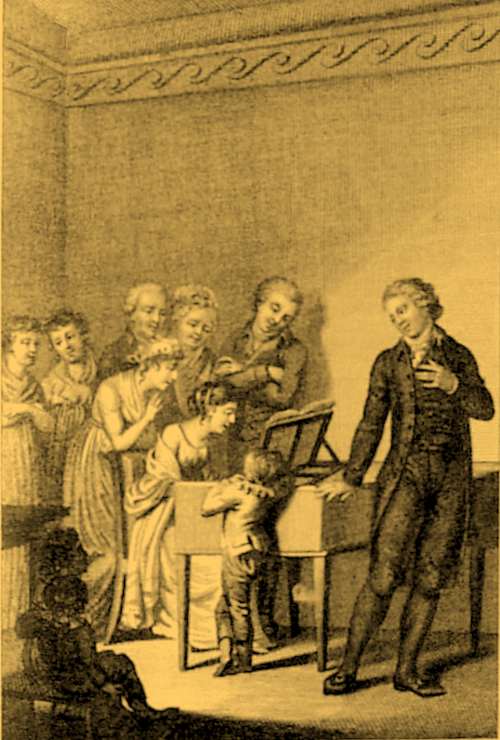
(illus.15)
Notes
[*] Editor’s note: In connection with his arranging, sequencing, and recording of the music of this Singspiel — the lighter form of German opera in the late 18th century characterized by spoken rather than recitative or sung-through dialogue between songs and by lighter themes — Dave Moyer here also provides, as a pedagogical enhancement to the Caroline project for interested students, faculty, musicians, and other readers, some notes on his experiences in dealing with an eighteenth-century score that in its published form, apart from having never been recorded, is not always entirely consistent or predictable.
Here he invites readers into the concrete world of eighteenth-century musical performance from the perspective of present-day publishing practices and digital music production, into the challenges and excitement of dealing with a piece of music that despite its immense contemporaneous popularity has not been heard for two centuries, and of course into the exhilaration of hearing this music for the first time.
Illustrations, selected by the editor:
(1 top) Daniel Nikolaus Chodowiecki, Der Gesang (1780), Herzog August Bibliothek; Museums./Signatur Uh 4° 47 (157);
(2) frontispiece to Elementarbuch der Tonkunst zum Unterricht beim Klavier für Lehrende und Lernende mit praktischen Beispielen: Eine musikalische Monatsschrift, vol. 1, ed. H. P. Bossler (Speyer 1782);
(2a) Taschenbuch auf das Jahr 1803 für edle Weiber und Mädchen; Inhaltsverzeichnis deutscher Almanache, Theodor Springmann Stiftung;
(3) Toilettenkalender für Frauenzimmer (Vienna 1801); Inhaltsverzeichnis deutscher Almanache, Theodor Springmann Stiftung;
(4) Chodowiecki, Kupfersammlung zu J[ohann] B[ernhard] Basedows Elementarwerke für die Jugend und ihre Freunde: Erste Lieferung in 53 Tafeln. Zweyte Lieferung in 47 Tafeln von L bis XCVI (Leipzig, Dessau, Berlin 1774), plate 18;
(5) original score of Nina;
(6) from Waldo Selden Pratt, History of Music: A Handbook and Guide For Students, 4th ed. (New York 1911);
(7) original score of Nina;
(8) Johann Peter Haas, “Flötenkonzert Friedrichs des Großen” (1786);
(9) original score of Nina;
(10) Chodowiecki; uncertain source, possibly a different edition of the Elementarbuch cited above;
(11) Goettinger Taschen Calender für das Jahr 1794; Inhaltsverzeichnis deutscher Almanache, Theodor Springmann Stiftung;
(12) Christian Felix Weisse, Briefwechsel der Familie des Kinderfreundes, vol. 11 (Reutlingen 1792), following p. 192;
(13) from Waldo Selden Pratt, History of Music: A Handbook and Guide For Students, 4th ed. (New York 1911);
(14) Musicalischer Almanach auf das Jahr 1782; Inhaltsverzeichnis deutscher Almanache, Theodor Springmann Stiftung;
(15) “Fühlst Du vieleicht [sic], was dem Entfernten fehle,” Almanach der Musen und Grazien, ed. F. W. A. Schmidt (1802), Inhaltsverzeichnis deutscher Almanache, Theodor Springmann Stiftung. Back.
© 2025 Doug Stott