
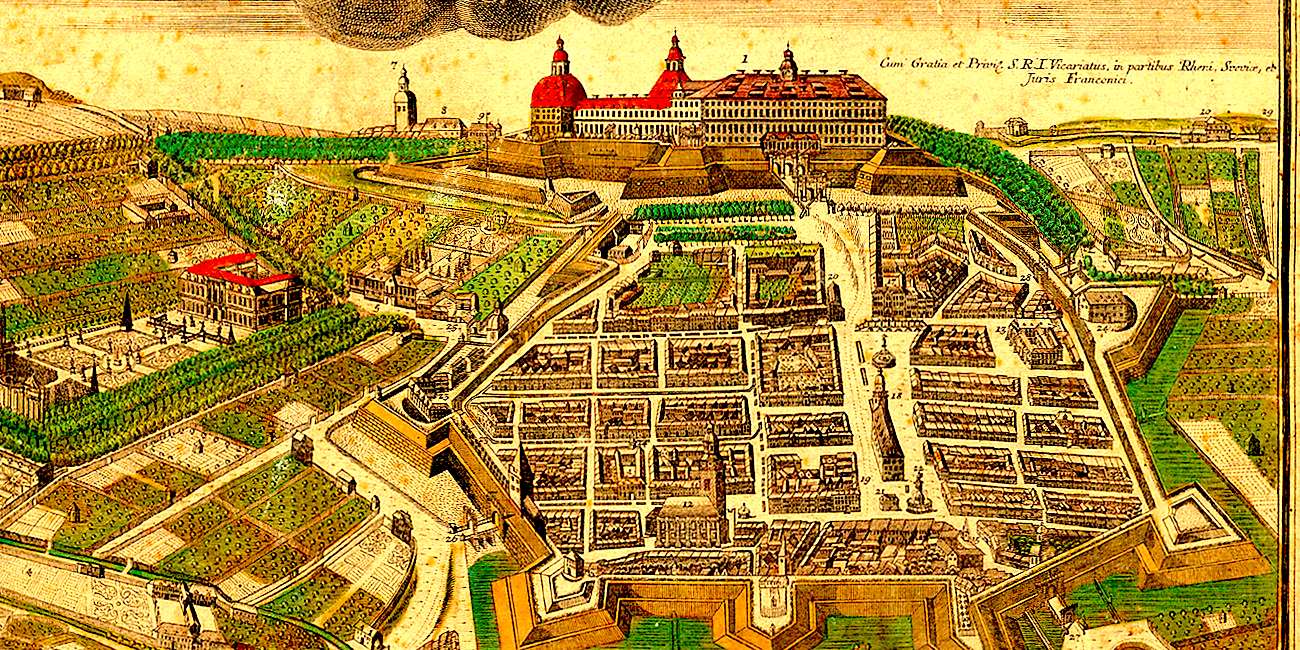
Gotha ca. 1740–60
Gotha essentially as Caroline experienced it.
From Lucka Caroline moved to Gotha, where she lived from February 1794 till March 1795 with her friends Luise and Friedrich Wilhelm Gotter, albeit not without social discrimination because of Mainz and her incarceration. Caroline to one of her detractors. She writes:
“If you feel constrained to demonstrate disapproval toward me for your own sake, even that consideration is superfluous if the public is not in a position to become acquainted with your disposition. But if it is supposed to constitute punishment intended for me — let me assure you that no one reproaches himself more harshly than do I myself where I consider myself worthy of such—but also that the opinion of no other persons, nor any behavior of another person toward me, can shake the convictions shaping my own, steady opinion concerning the past.”
(Excerpt from H. A. Koenig, Die hochfürstliche Residentz Friedenstein und Hauptstadt Gotha [Augsburg, ca. 1740–60].)

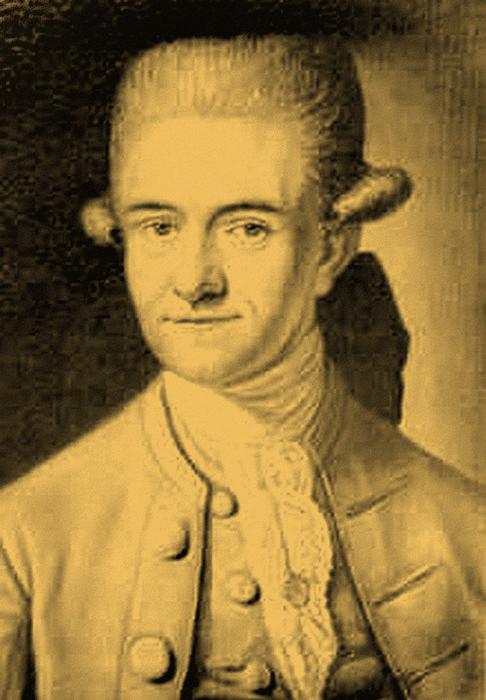
Friedrich Ludwig Wilhelm Meyer
Friedrich Ludwig Wilhelm Meyer: An acquaintance from Göttingen days and the recipient of some of Caroline’s most intense letters, but also a not entirely straightforward or loyal friend, not least because of his complex relationship with Therese Forster. Caroline writes in 1794 about his attitude toward her damaged reputation:
“I might fear that the plethora of accusations might finally fatigue your good opinion…If your good opinion departs, then so will our friendship — you must judge me the same way I do, or I can no longer desire either your sympathetic interest or your advice.”
(Portrait of Meyer as a student: Silhouetten-Sammlung Schubert, Handschriften Abteilung der SUB Göttingen.)
Christoph Meiners
Göttingen professor from whom Caroline hoped to receive advice concerning where to settle after her experiences in Gotha, where her earlier imprisonment and connection with the Mainz Republic rendered her a persona non grata. She writes in March 1794:
“There is one thing I have done to help me narrow down my choices — I wrote to Meiners and his wife — they are familiar with Germany and with German-speaking Switzerland — they will survey my situation and, I hope, be willing to advise me.”
(Portrait: engraving by unknown artist; Universitätsbibliothek Heidelberg, Inventar-Nr. Graph. Slg. P_1067.)
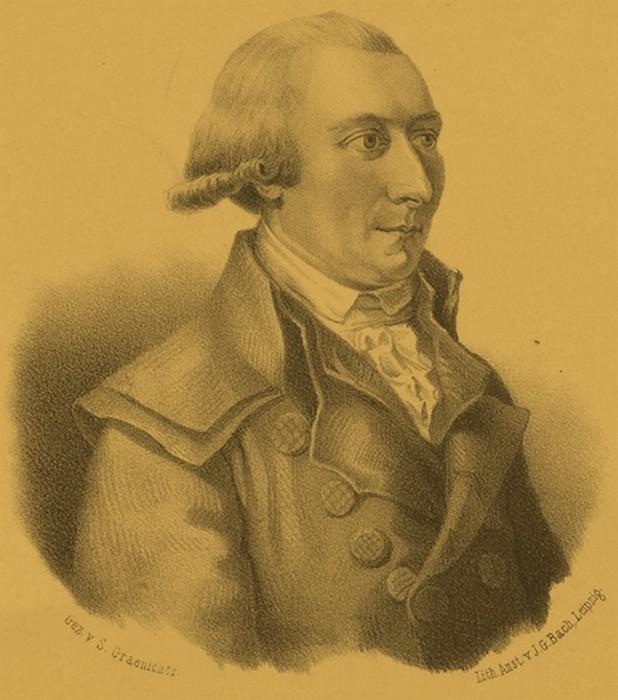
Georg Joachim Göschen
Georg Joachim Göschen, Leipzig publisher who generously (and not without risk to himself) arranged Caroline’s stay in Lucka and for the foster care for her son, Wilhelm Julius Krantz, after her departure. Caroline writes him in August 1795 after the boy’s death on 20 April 1795:
“I have not yet acknowledged the receipt of the sad little packet which you sent me, nor thanked you for your sympathy. Time will not heal the sense that through this death I have lost the possibility of my happiness, even of my inner peace; and if what I thus feel in me is at all less acute, it is only because it has been blunted by my becoming used to sorrow and loss.”
(Portrait: Samuel Gränicher [Leipzig ca. 1830].)
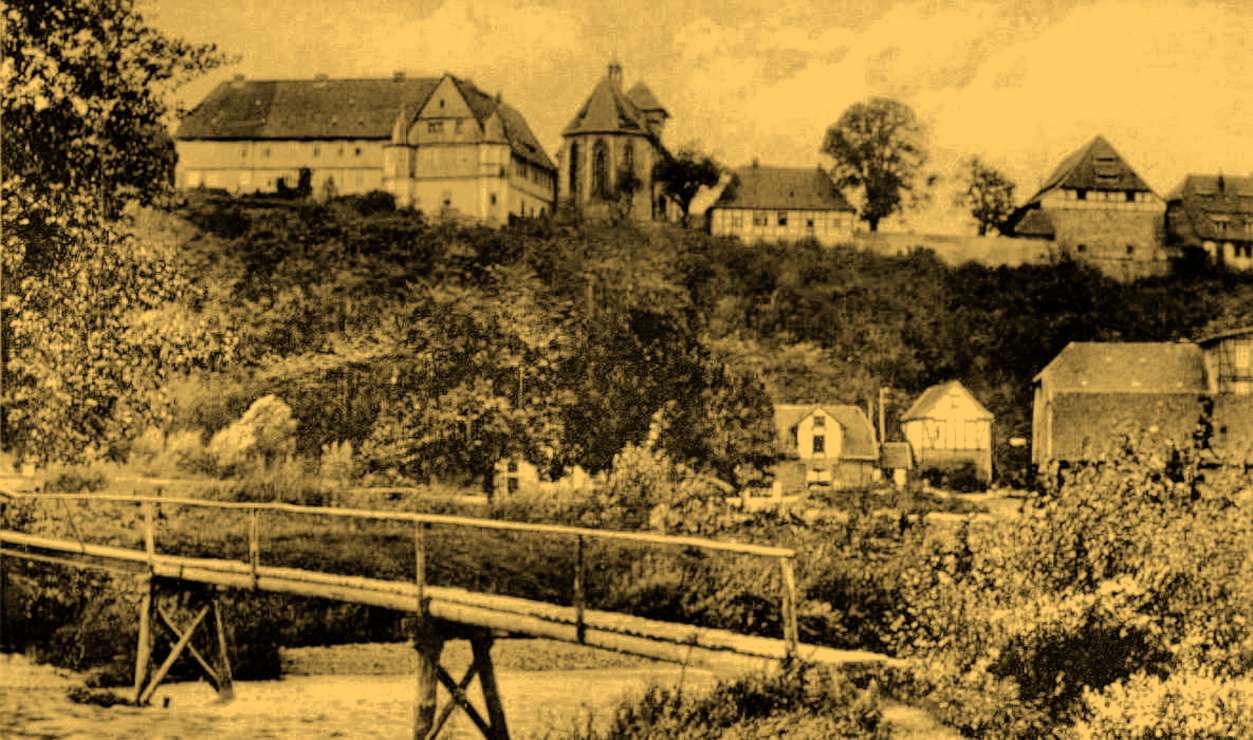
Katlenburg
Katlenburg Estate, which Caroline and Auguste passed on their journey from Gotha to Braunschweig during the spring of 1795; Caroline writes:
“Catlenburg — thus the name of the fairy-tale castle of Bailiff Reinbold.”
(Early postcard.)
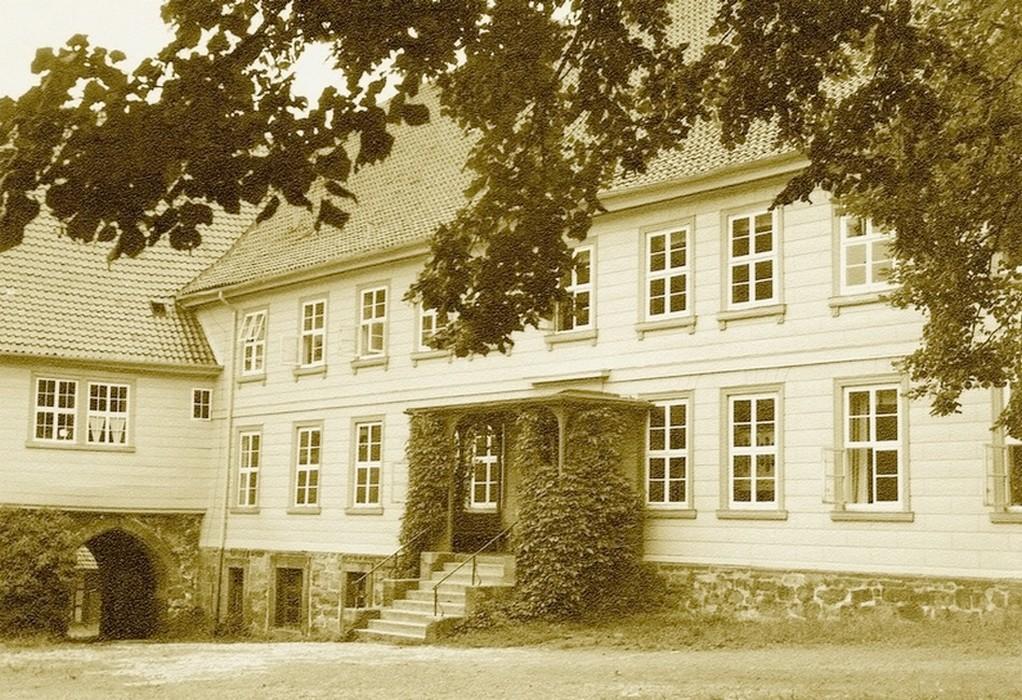
Katlenburg, Magistrate’s Residence
Magistrate’s house in Katlenburg ca. 1960. Caroline recounts to Luise Gotter her and Auguste’s journey from Gotha to Braunschweig in April 1795, mentioning a house in Katlenburg they had visited earlier — at one time apparently often — doubtless the house of former magistrate Johann Arnold Reinbold (Caroline’s mother’s uncle, who had died in 1793), whom she mentions in 1785 and the windows of whose house and estate — the “Katlenburg” — do indeed face the the road toward the south. Caroline writes:
“We stayed overnight in Giebelhausen [Gieboldehausen], where I made Gustel [Auguste] some chocoladesuppe so she would have the courage to spend the night in our horrible room with its filthy floor and nothing but a bed of straw and a wooden stool. On the morning of the third day, we came in sight of the Harz Mountains and traveled on toward the Catelnburg [Catlenburg] and past the windows of a very familiar house.”
(Photo courtesy Kristian and Birgit Schlegel, Katlenburg.)
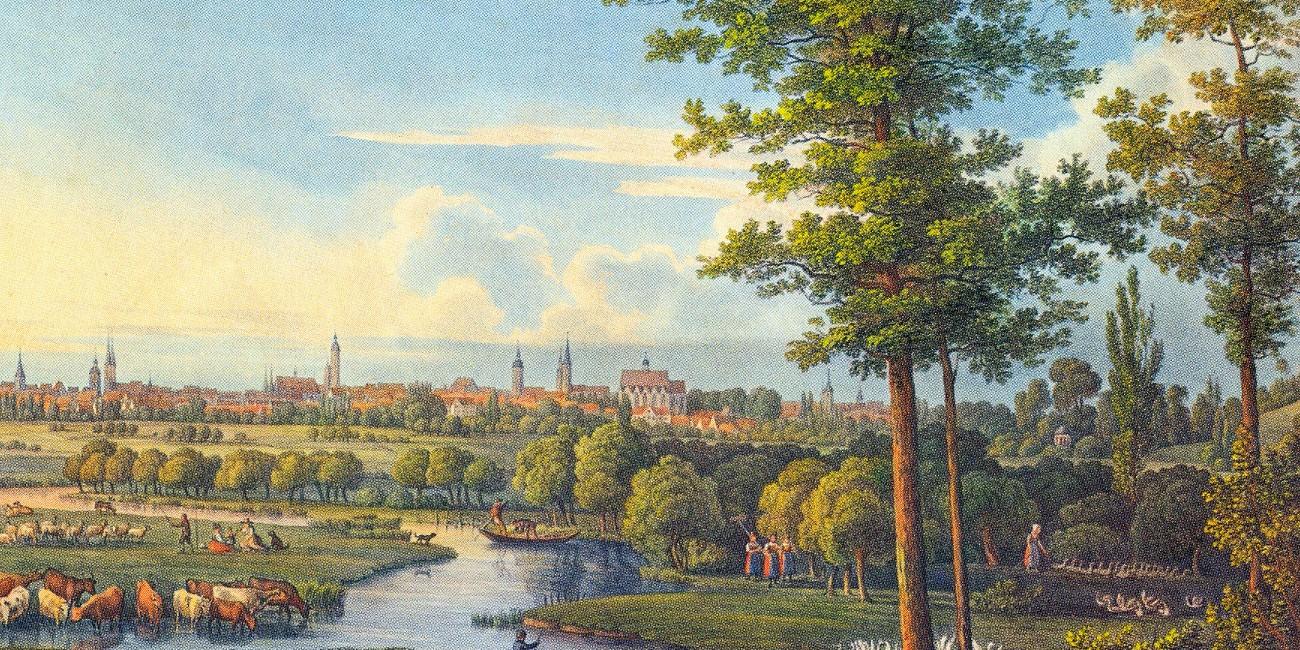
Braunschweig
Braunschweig, where Caroline lived from April 1795 till July 1796. Caroline writes just after arriving:
“We found the roads quite pleasant until just before Braunschweig itself — here the landscape becomes a bit too flat, though the city itself is anything but gloomy. I can see that Gustel has already made a bit of a mess of the apartment, but the painters and wallpaper hangers are already at work making things as bright on the inside as it is outside.”
(Illustration ca. 1825 by Wilhelm Pätz.)

Johann Joachim Eschenburg
Johann Joachim Eschenbrug: Shakespeare translator and head of the other “literary” family with whom Caroline socialized in Braunschweig. Caroline remarks:
“Madam Eschenburg, who was quite cordial, has a little girl Auguste’s age, who was, however, not at home when we recently visited them, and she assured me that her own little one was so incurably imbecilic that she would rather not put her up next to Gustel.”
(Portrait ca. 1793 by Friedrich Georg Weitsch, whose wife allegedly [so Dorothea Veit] greatly resembled Caroline. Gleimhaus Halberstadt.)
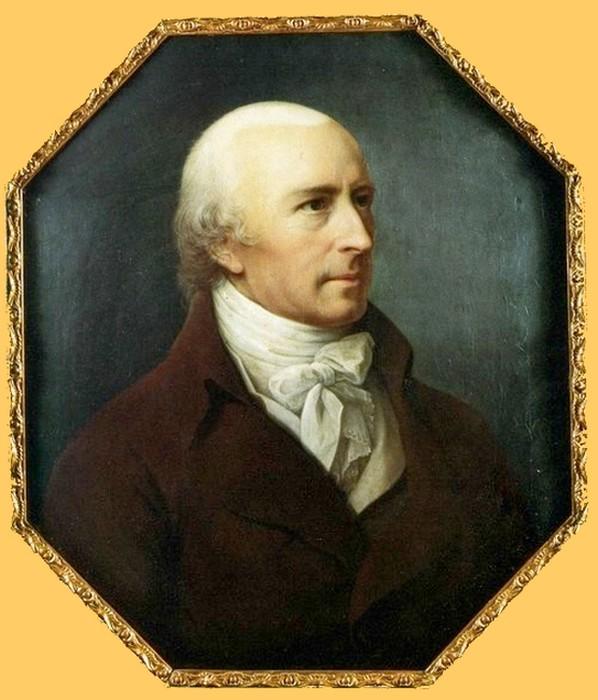
Joachim Heinrich Campe
Head of one of the two “literary” families with whom Caroline socialized during her stay in Braunschweig in 1795–96. Campe published books on the education of youth as well as an immensely popular free adaptation of Defoe’s Robinson Crusoe. Caroline remarks:
“Gustel is getting all her reading material from Campe; you cannot imagine how delighted she was to be invited along to go over there, where we then had a quite charming souper. We often take walks over to the Campes’ garden.”
(Portrait by unknown artist.)
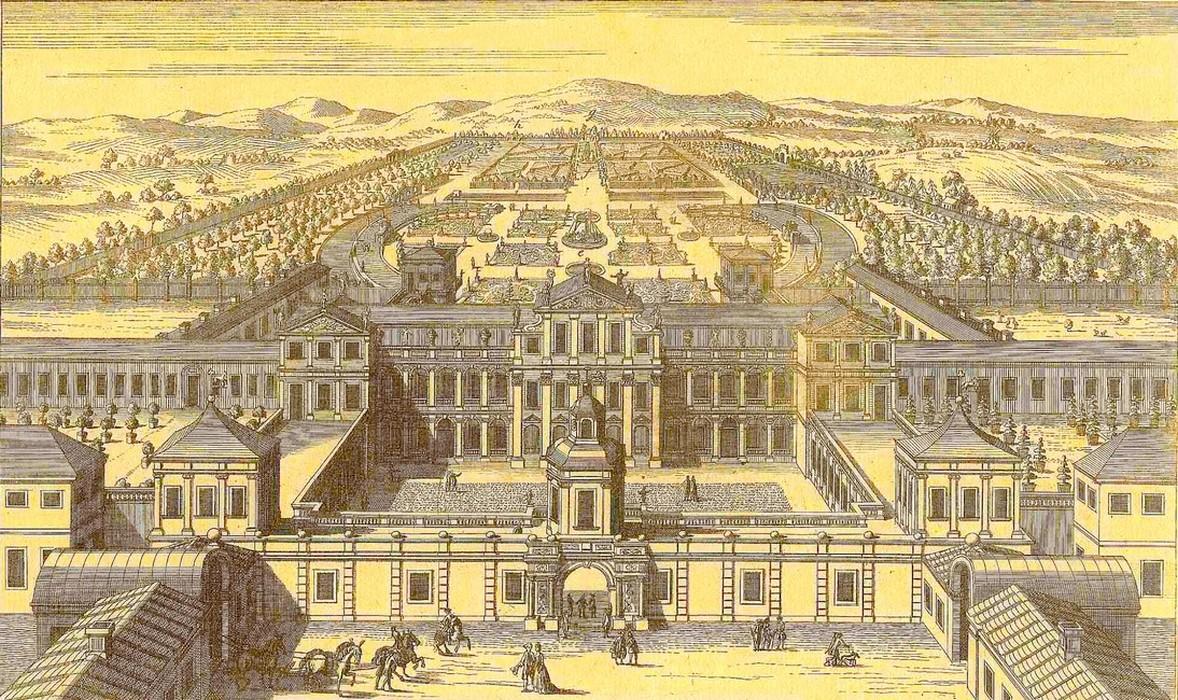
Salzdahlum Castle
Salzdahlum Castle between Braunschweig and Wolfenbüttel, summer residence of Duke Karl Wilhelm Ferdinand von Braunschweig-Wolfenbüttel; the ducal art collections were also housed here. Caroline and Auguste visited the gallery in June 1795 with Caroline’s brother Philipp Michaelis, then again in the autumn of that year with Wilhelm Schlegel. Caroline writes about the latter visit:
“We recently arranged a very nice day indeed for ourselves. On one gentle autumn morning, we drove over to Salzdal once again accompanied by Schlegel — lingering in the gallery till midday, where the inspector told us a great deal about [Friedrich Wilhelm Basilius von] Ramdohr. Afterward we went to Wolfenbüttel to the Trapps [Ernst Christian Trapp, who also had a house in Salzdahlum], where we ate and then returned here [Braunschweig] toward evening to dine with the Campes [Joachim Heinrich Campe].”
(Engraving by Schleuen, ca. 1780, view of the front toward the gardens in the back.)
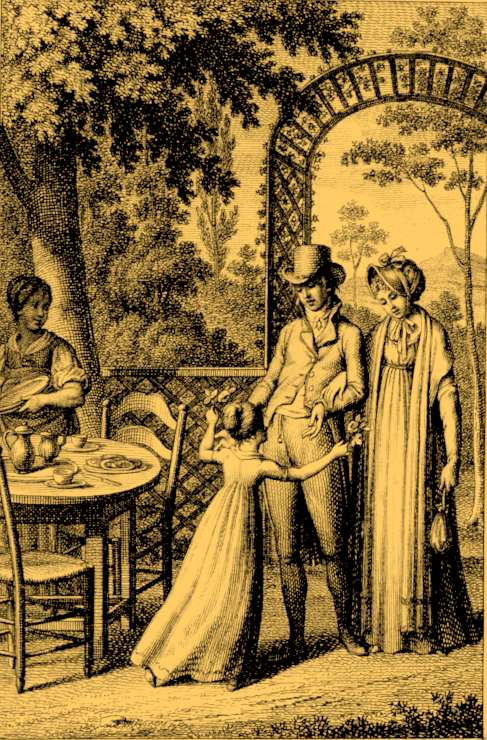
Wilhelm Schlegel arrived in Braunschweig in late June or early July 1795, after which ten-year-old Auguste once again had a father figure in her life. He writes to her:
“The two of you, you and your mother, will have to decide together sometime whether you are willing to trust me. Surely you will not be against me, my dear Gustel!”
(Frontispiece to Jakob Glatz, Sittenlehre für jüngere Mädchen in Beyspielen und Erzählungen, vol. 1 [Frankfurt 1807].)

Minna Körner
Minna Körner, wife of C.G. Körner and sister of Dora Stock. Friedrich Schlegel writes to Wilhelm from Dresden in February 1794, after Caroline has already moved to Gotha:
“The Körners have proven to be nosy in an extremely immodest fashion (it goes without saying that this does not include him), and that I responded quite unaffectedly, telling them that, as rumor had it, she [Caroline] had journeyed to Russia. From what they said I concluded that at least here no one knows anything about Cranz [the father of Caroline’s child] and that there seems to be no doubt concerning [her allegedly intimate relationship with Georg] Forster.”
(Portrait by Anton Graff.)
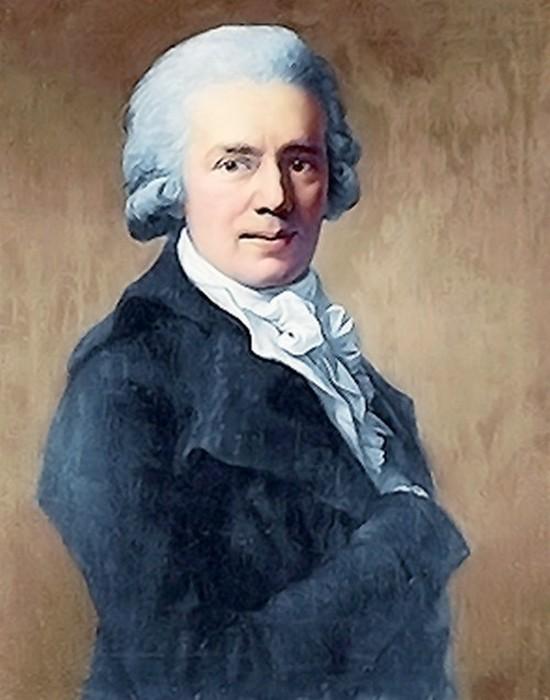
Christian Gottfried Körner
Christian Gottfried Körner of Dresden, brother-in-law to Dora Stock, whom L.F. Huber had left for Therese Forster. Caroline had doubts about moving to Dresden from Lucka because of his family:
“I fear only that I may be too well known there, and I fear especially one house in particular — that of Körner. . . . They judge and hate me just as they do Therese, and from their acquaintances in Leipzig they know more for certain than is good, since once I am there, the ladies will perhaps turn it into a meritorious undertaking to tell everyone about that particular element they do know for certain [namely, Caroline’s pregnancy in Lucka].”
(Portrait by Anton Graff.)

Altar in the Church of St. Catherine, Braunschweig
Caroline and Wilhelm Schlegel were married at this altar on 1 July 1796; by 8 July they had moved from Braunschweig to Jena.
(Oskar Doering, Braunschweig, Berühmte Kunststätten 31 [Leipzig 1905], 87)
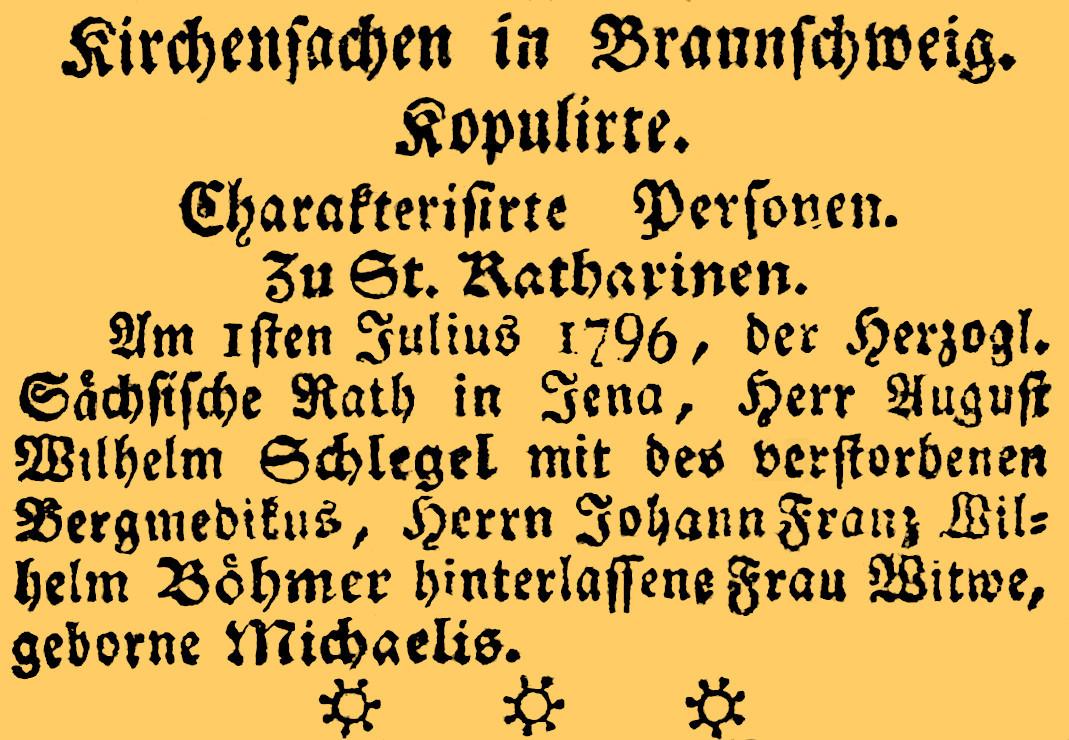
Caroline and Wilhelm’s Wedding Announcement
“On 1 July 1796, the ducal Saxon Rath in Jena, Herr August Wilhelm Schlegel [was married to] the surviving widow of the deceased mining physician Herr Johann Franz Wilhelm Böhmer, née Michaelis.
(Braunschweigische Anzeigen [1796], no. 54 [Wednesday, 13 July 1796], 1139.)